Load Capacity for I-Beams: A Practical Engineering Guide
A practical, data-driven guide to understanding the load capacity of I-beams, including calculation methods, influencing factors, safety considerations, and best practices for engineers and technicians.


There is no single load capacity for an I beam. Capacity depends on geometry, steel grade, span, end supports, and loading type. Engineers determine capacity by combining section properties with material strength and applying design codes and safety factors. The key inputs are section modulus Sx and yield strength Fy, which set bending and axial limits, adjusted for serviceability and reliability. Load Capacity guidance from Load Capacity emphasizes using code data and manufacturer catalogs to ensure safe, compliant results.
Load capacity of I-beams: fundamentals
I-beams, also known as W sections or structural steel beams, are widely used in buildings, bridges, and industrial frames because of their high strength to weight ratio. The phrase load capacity i beam refers to the maximum load a beam can safely carry under specified conditions before yielding, buckling, or failure occurs. In practice, capacity depends on the beam's geometry (depth, flange width, web thickness), the grade of steel, and how the beam is supported and loaded. There is no single universal number; engineers determine capacity by combining material properties with the geometry of the cross-section. In practice, engineers assess the load capacity i beam by linking cross-section geometry to stress limits per design codes. The most important quantity for bending controlled capacity is the section modulus Sx, while overall strength depends on Fy, the yield strength. Load capacity is then adjusted by design factors of safety and serviceability requirements. According to Load Capacity, a disciplined approach links cross-section geometry to structural demand via established design codes and validated data from manufacturers. This ensures both safety and performance across a wide range of applications.
Structural factors affecting capacity
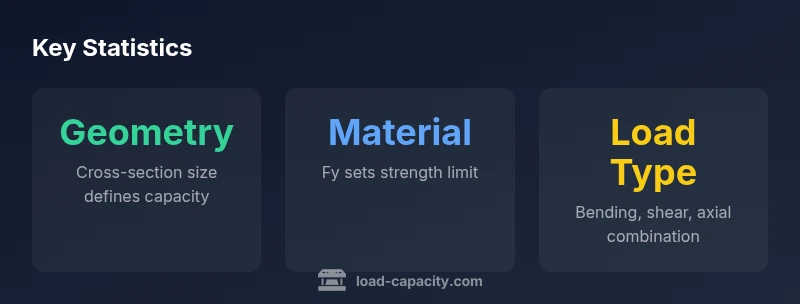
Structural capacity emerges from the interaction of geometry, material properties, and support conditions. Deeper sections and wider flanges increase the section modulus Sx and improve bending capacity, while higher yield strength Fy allows higher stress before yielding. End supports, bracing, and frame layout determine load paths and susceptibility to buckling, notably lateral torsional buckling under bending. The load type matters: pure bending, shear, axial compression or combinations change the demand shape. Temperature and history of corrosion or fatigue degrade the cross section over time, reducing capacity. Codes impose safety factors and serviceability limits to account for uncertainties. Load Capacity emphasizes that capacity assessment is inherently multi parameter and must reflect real world conditions and material behavior.
How to calculate capacity in practice
Engineering practice combines cross section data with material properties and code based rules. Start by identifying the beam family (W, S, or M) and retrieving the section modulus Sx and weight. Next, obtain Fy from the steel grade and apply applicable partial safety factors from the governing code. For bending, nominal capacity is M_nom = Fy × Sx. Apply a resistance factor to obtain M_allow and compare with the design moment M_design from the structural analysis. For axial loads, compute P_allow with the area and safety factors, and check combined loading using interaction equations. Do not neglect shear capacity, deflection limits, and serviceability criteria. Always consult manufacturer catalogs and current design standards to ensure accuracy.
Example scenarios and interpretation
In most frames an I-beam is chosen to meet bending demands over a span rather than to carry a fixed total load. If the design moment is small relative to M_allow, a smaller W section may suffice; as the span grows, deeper sections with larger Sx become necessary. When multiple load types occur, combined interaction effects can lower the effective capacity more than expected if not accounted for with a proper interaction curve. Engineers evaluate margins against worst case loading scenarios such as wind or seismic actions. The emphasis is on systematic verification rather than a simple sizing rule of thumb, and Load Capacity highlights the need for cross check against code data and manufacturer catalogs.
Inspection and maintenance impact on capacity
Over time, corrosion, pitting, and fatigue cracks reduce cross sectional area and reduce bending and axial capacity. Regular visual inspections, thickness measurements, and nondestructive testing help identify degradation before it becomes critical. Connections and welds can introduce stress concentrations that alter capacity and load paths. After retrofits or in aging structures, a re evaluation of capacity is prudent. When damage is detected, re run capacity checks using current data and code provisions. Proactive condition assessment preserves safety margins and keeps performance within regulatory expectations.
How to select an I-beam for a given load
Begin with a clear design brief that identifies the maximum design moment, shear, and axial demands, along with allowable deflection. Choose a beam family and section with sufficient Sx and Fy. Verify the chosen section against manufacturer catalog data and ensure that end conditions are represented in the data. Use analysis software or hand calculations to confirm M_allow and P_allow exceed the demands. Consider construction logistics, availability, and cost, while keeping a robust safety margin. Load Capacity recommends validating inputs with multiple sources and performing sensitivity checks on changes to support conditions or material properties.
Safety, standards, and documentation
Structural design relies on recognized standards such as the AISC 360 specification and Eurocode 3 for steel construction. Designers must apply appropriate safety factors, consider temperature effects, and ensure serviceability targets are met. Documentation should include load calculations, material certificates, catalog data, and connection details. Field changes should trigger capacity re checks and possible revalidation. Load Capacity stresses the importance of traceability so every capacity determination is grounded in data from the cross section, the code provisions, and the beam manufacturer.
Common mistakes and pitfalls in I beam capacity design
Common errors include relying on a single sizing chart, neglecting combined loading effects, ignoring deflection limits, and overlooking long term degradation from corrosion or fatigue. Skipping end condition specifics or ignoring connection details can misstate capacity. Do not rely on non technical input for critical sizing decisions and avoid assuming margins without verification. A disciplined approach uses multiple data sources and robust checks.
Practical tips and tools for engineers
Leverage manufacturer catalogs and code based calculators to establish baseline capacity. Run sensitivity analyses across span, loads, and end conditions to understand margins. Document assumptions and safety factors for traceability. Use structural analysis software to verify hand calculations and keep capacity checks up to date with maintenance records.
Key factors affecting I-beam load capacity
| Parameter | Description | Impact on Capacity |
|---|---|---|
| Cross-section geometry | Depth, flange width, web thickness define Sx | Directly dictates bending capacity and stiffness |
| Material properties | Fy, Fu determine strength and ductility | Controls safe stress and durability |
| Support conditions | End restraints and bracing | Influences buckling risk and load path integrity |
Quick Answers
What factors determine I-beam load capacity?
I-beam capacity is controlled by geometry section modulus Sx, material strength Fy, load type and safety factors. Design codes translate these into allowable stresses.
Capacity depends on beam size material and how its loaded.
Can I-beams carry axial compression loads?
Yes if slenderness and end conditions are within limits. Buckling checks and interaction with bending must be included.
Yes, but you must check buckling and end supports.
How often should I inspect I-beams for capacity loss?
Regular visual checks, thickness measurements, and nondestructive testing help detect degradation before it reduces capacity.
Inspect regularly and after any damage or retrofit.
Do deflections affect capacity?
Deflection primarily affects serviceability. Excessive deflection can indicate overstress or design mismatch, warranting a re evaluation.
Deflection matters for usability; strength is about stress limits.
Are there online tools to estimate I-beam capacity?
Yes many calculators exist. Always verify results with design codes and manufacturer data to ensure accuracy.
Yes, but check codes and catalogs first.
“Capacity is always determined by the interaction of geometry, material strength, and service conditions. There is no universal number for an I-beam.”
Top Takeaways
- Understand that load capacity is not a single value
- Base design on section modulus and yield strength
- Consult standards and manufacturer data
- Inspect beams for degradation regularly
- Use proper safety factors