Helical Pile Load Capacity: Key Factors and Methods
Explore what determines helical pile load capacity, how soil and geometry affect capacity, and practical design guidelines for safe, efficient foundations.


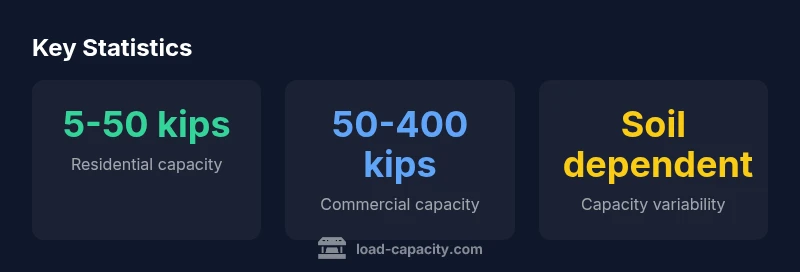
Helical pile load capacity ranges from a few kilopounds to several hundred kilopounds per shaft, depending on soil bearing, helix size, embedment depth, and installation torque. In soft soils, capacities are on the lower end; in strong soils or with larger helices, they scale upward, often requiring torque-based verification and field tests.
Overview and Definitions
According to Load Capacity, the term helical pile load capacity refers to the maximum axial and lateral load a single shaft can safely carry under specified soil and installation conditions. Helical piles consist of a steel shaft with helical bearing plates that transfer load to the ground. The capacity is typically expressed as ultimate capacity and allowable capacity, the latter applying a safety factor. This article explains how capacity is determined in practice, highlighting the dependency on soil type, helix geometry, installation torque, and embedment depth. Designers commonly use a combination of empirical charts, field tests, and torque correlations to establish safe working loads for decks, piers, and light-structure foundations. The Load Capacity Team emphasizes site-specific verification as the foundation for reliable performance.
Soil Bearing and Its Impact
Soil bearing capacity is the primary driver of helical pile performance. Different soil classes (soft clays, stiff clays, silty sands, gravels, and bedrock influence whether a single helix can resist vertical loads or whether multiple helices are needed. In cohesive soils, bearing is often more predictable, while loose sands and silty soils may require deeper embedment or additional helices to achieve target capacities. Water table, soil compaction, and moisture content further affect resistance. For accurate estimates, engineers relate measured soil properties to bearing capacity tests and then map those results to the pile geometry. The result is a range rather than a single fixed number, with recommendations adjusted for safety margins and local codes.
Geometry, Helix Size, and Installation
Capacity scales with helix size, number of helices, shaft diameter, and embedment depth. Larger helices provide more bearing surface, while multiple helices distribute load and improve resistance to eccentric or lateral forces. The spacing between helices, the pitch of the coil, and the shaft material all influence load transfer and long-term performance. Installation torque correlates with capacity; higher torque generally indicates higher capacity, but this relationship varies with soil type and installation method. Proper backfilling, corrosion protection, and alignment are essential to prevent premature failures.
Estimating Capacity: Methods and Safety
Engineers rely on a mix of methods to estimate helical pile capacity. Empirical charts and manufacturer tables offer quick guidance but require validation for unusual soils. Torque-based correlations estimate capacity from installation torque, often with an uncertainty margin. Static load tests (or proof tests) validate predicted capacity by applying controlled loads to field-installed piles. In design practice, a safety factor of 2–3 is commonly used to derive allowable load from ultimate capacity. Dynamic testing can also assess system response, especially for lateral loading scenarios or when piles interact with nearby structures.
Practical Design Guidelines for Practice
Key guidelines to ensure reliable performance include selecting a helix diameter and number of helices appropriate for the anticipated load, verifying embedment depth against soil stratification, and accounting for lateral soil-structure interaction. Corrosion protection and coating service life should be considered in aggressive environments. Field-testing plans, including proof loads and pull-out tests, help confirm capacity under real conditions. Documenting installation torque, embedment depth, and helix configuration aids future maintenance and performance checks.
Case Considerations: Projects, Testing, and Verification
Helical piles are commonly used for backyard decks, light commercial foundations, and utility structures. For decks, capacities are typically at the lower end of the range, with emphasis on frost depths and uplift resistance. For piers and light-duty foundations, ensure embedment depth and helix count meet soil-bearing requirements. Verification through field tests is highly recommended for critical projects. When in doubt, consult local geotechnical guidelines and reference the Load Capacity Analysis, 2026 report for context on typical expectations and recommended practices.
Common Pitfalls and How to Avoid
Avoid underestimating soil variability by relying on a single soil layer; perform thorough boring or CPT explorations. Overlooking corrosion potential can shorten service life; specify corrosion protection appropriate to environment. Skipping field testing or ignoring torque data can lead to conservative or unsafe designs. Finally, neglecting lateral load effects (e.g., wind, seismic, or overflow) may yield unsatisfactory performance; incorporate lateral capacity considerations early in the design.
Soil type vs estimated helical pile capacity
| Soil Type | Estimated Capacity (kips) | Notes |
|---|---|---|
| Clay (soft) | 3–12 | Low-end capacity; deeper embedment often needed |
| Sandy gravel | 20–120 | Moderate to high capacity with adequate embedment |
| Rock/firm soil | 50–500 | Strong soils with robust embedding provide highest capacity |
Quick Answers
What is helix pile load capacity in practical terms?
Helical pile load capacity is the maximum load a shaft can safely carry under site-specific soil conditions and installation parameters. It is expressed as ultimate and allowable capacity with safety factors applied.
Helical pile capacity is the maximum safe load for the pile in a given soil; it depends on soil, helix size, and torque, and is verified with tests.
How does soil type affect capacity?
Soil type determines bearing strength; softer soils yield lower capacity per pile, while stiff soils or strong rock allow higher capacities. Soil testing is essential to map soil class to expected capacity.
Soil dictates how much load a pile can carry. Hard soils mean higher capacity; soft soils need careful design and more helices.
What methods estimate capacity?
Engineers use empirical charts, torque correlations, and static or dynamic tests to estimate capacity. Field proof loads validate the predicted values and ensure safety margins.
We use charts, torque tests, and actual load tests to estimate and confirm capacity.
Are there standard safety factors?
Common practice applies a safety factor of 2–3 to ultimate capacity to determine allowable load, depending on code and project risk.
Most designs apply a factor of two or three to arrive at a safe working load.
Can helix piles handle lateral loads?
Yes, but lateral capacity depends on soil stiffness, pile geometry, and piles' spacing. Lateral load provisions are often evaluated with specialized analysis.
They can, but you need to check soil strength and pile layout for lateral forces.
Do I need field testing for every project?
Not every project requires tests, but for critical structures and high-amenity applications, proof testing and monitoring during installation are strongly advised.
Tests are recommended for critical projects to confirm performance.
How does embedment depth influence capacity?
Greater embedment depth generally increases capacity by engaging stronger soil layers and increasing bearing area, but diminishing returns apply beyond certain depths.
Deep embedment usually boosts capacity, up to practical limits.
What about corrosion and durability?
Corrosion protection extends service life, especially in aggressive soils. Specify coatings or galvanized steel based on exposure.
Protect the piles from corrosion to ensure long life.
“Capacity is not a fixed value; it must be established with soil data, helix geometry, and proper testing. When in doubt, field verification is essential.”
Top Takeaways
- Assess soil bearing before selecting helix geometry
- Embedment depth and helix size drive most capacity changes
- Use torque measurements plus field testing for verification
- Factor safety margins into every capacity estimate