GI Pipe Load Capacity: Engineering Guide
Discover how gi pipe load capacity depends on diameter, wall thickness, and support conditions. Load Capacity provides calculations and guidance for engineers to ensure safe, compliant installations.


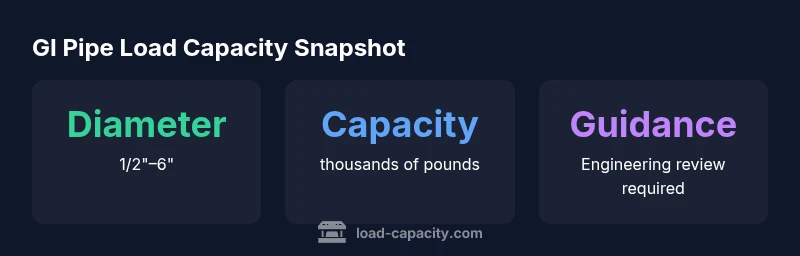
GI pipe load capacity varies widely depending on diameter, wall thickness, grade, and how the pipe is supported. For common galvanized iron pipe sizes used in light structural framing, axial capacity can range from a few thousand pounds up to tens of thousands of pounds in larger diameters or thicker walls. Always design with a margin and verify calculations with a qualified engineer to avoid overloading supports.
Why GI Pipe Load Capacity Matters
According to Load Capacity, GI pipe load capacity is a function of geometry, boundary conditions, material properties, and installation details. Galvanized iron pipe (GI) is often selected for its corrosion resistance and strength, but its capacity depends on more than just the nominal size. Engineers must account for how the pipe is oriented, how it is supported, and what kinds of loads (static, dynamic, or impact) it will face in service. When GI pipe is used in structural roles or as part of a temporary support system, misjudging capacity can lead to catastrophic failure. This is why a disciplined approach—combining mechanical theory with field verification—is essential. In practice, the Load Capacity team emphasizes documenting load paths, identifying critical connections, and applying appropriate safety factors.
- The reader should recognize that GI pipe load capacity is not a single fixed value but a spectrum influenced by several interacting variables.
- Early-stage design should include a rough sizing exercise to compare alternatives (e.g., steel tube, structural sections, or fabricated members) before committing to GI pipe installations.
- Compliance with standards and best practices reduces risk and helps ensure predictable performance across environmental conditions.
Key Parameters That Determine Load Capacity
The gi pipe load capacity is governed by multiple interrelated parameters. Diameter and wall thickness directly affect the cross-sectional area available to resist loads, while the pipe material grade determines allowable stress before yielding occurs. The pipe’s schedule (e.g., Schedule 40 vs. Schedule 80) implicitly captures wall thickness, which in turn affects capacity. Support conditions—whether ends are fixed, pinned, or freely sliding—alter the effective length and sway response. Length, orientation (vertical vs. horizontal), and the presence of joints or fittings also modify capacity. Temperature, corrosion, and long-term service factors can degrade capacity over time, especially in aggressive environments. Practically, engineers translate these factors into a conservative capacity estimate by applying a factor of safety and performing checks for axial, bending, and combined loading scenarios. The result is a design that accounts for potential misalignment, load redistribution, and uncertainties in material properties. This holistic view is essential for reliable GI pipe applications in structural framing, scaffolding, and temporary supports.
Axial Loads, Bending, and Buckling in GI Pipe
GI pipe experiences different failure modes depending on the loading direction and boundary conditions. Axial loads compress the pipe along its length and can lead to yielding if the stress exceeds the material limit, or to Euler buckling if the slenderness ratio is high. Bending loads create curvature and stress concentration at the outer fiber, with the maximum moment determined by the span and support stiffness. Lateral-torsional buckling becomes a concern for long, horizontally oriented runs with inadequate lateral restraint. Designers manage these risks through proper end restraints, stiff connections, and by selecting wall thicknesses that reduce slenderness. Understanding the interaction between axial and bending loads is critical in applications such as frame members, supports, and light-trade scaffolds using GI pipe.
End Connections, Supports, and Installation Practices
End connections and supports have a disproportionate impact on GI pipe load capacity. Simple couplings, flanges, or welds can become bottlenecks if they transfer more load than the surrounding pipe can safely carry. Supporting details—such as bearing surfaces, bolt patterns, and interface with other materials—control local stress concentrations and can alter effective capacity. Proper alignment and secure fastening minimize dynamic responses from vibration and movement. In many installations, adding intermediate supports or bracing reduces deflection and distributes loads more evenly, improving overall capacity. Surface coatings and corrosion protection should be maintained to prevent strength degradation over time, which would undermine long-term performance.
Practical Design Approaches and Calculation Methods
A practical route to estimating gi pipe load capacity starts with a conservative cross-sectional area and allowable stress concept. A rough estimate uses an equivalent axial capacity P_allowable ≈ A_eff × σ_allowable × SF, where A_eff is the effective cross-sectional area (accounting for any reductions from bored or cut sections), σ_allowable is determined by material yield and primary allowable stress, and SF is a chosen safety factor. For structural framing or supports, combine axial and bending checks to verify combined loading scenarios. When possible, refer to manufacturer data and consult codes or standards for guidance on safe loads, installation methods, and inspection requirements. Always document assumptions and perform field measurements to validate theoretical calculations against actual geometry and mounting conditions. The key is to keep a margin to accommodate construction tolerances and potential material aging.
Testing, Verification, and Documentation
Field verification is a critical step for GI pipe load capacity in real projects. Non-destructive testing or simple proof-load tests can validate critical members where feasible. Document all load paths, boundary conditions, and tested results in a design notebook or report. Take photographs of joints, bracing, and bearing surfaces to support the as-built record. Record environmental conditions that could affect performance, such as temperature and corrosion exposure. Periodic re-verification is prudent for temporary installations or long-service equipment, especially when the use-case changes or the surrounding structure undergoes modification.
Common Mistakes and How to Avoid Them
Common mistakes include assuming a single capacity value for GI pipe without considering wall thickness, mischaracterizing loads as purely axial when bending or lateral loads are present, and neglecting boundary conditions and end restraints. Underestimating dynamic loads or the effects of vibration can lead to unexpected failures. Another frequent error is ignoring corrosion or environmental degradation that reduces capacity over time. To avoid these issues, adopt a conservative approach, document all assumptions, and engage a qualified engineer for critical load-bearing roles. Regular inspection and maintenance further reduce risk in long-term applications.
GI pipe load capacity ranges by nominal size (qualitative).
| Diameter (in) | Nominal OD (in) | Load Capacity (approx) | Notes |
|---|---|---|---|
| 1/2 | 0.625 | varies | Light-duty framing; capacity depends on wall thickness |
| 1 | 1.315 | varies | General structural uses; thicker walls increase capacity |
| 2 | 2.375 | varies | Heavier loads; consult engineer |
| 4 | 4.500 | varies | Industrial applications; end connections matter |
Quick Answers
What factors influence GI pipe load capacity?
Multiple factors govern GI pipe load capacity, including diameter, wall thickness, material grade, end connections, and boundary conditions. Environment and load type (static or dynamic) also play a role. A holistic assessment that accounts for these variables yields a safer, more reliable design.
GI pipe load capacity depends on size, wall thickness, grade, connections, and how it's supported, plus environmental factors.
Can GI pipe be used for structural framing or scaffolding?
GI pipe can be used in some structural framing or scaffolding contexts, but its capacity is not fixed. Each installation must be analyzed for loads, deflection, and safety factors. Where uncertainty remains, prefer dedicated structural members designed for such service and involve a licensed engineer.
GI pipe can be used in some frames, but you need an engineer to verify it’s safe for your loads.
How do I estimate the load capacity for a GI pipe in a given configuration?
Estimate by identifying the dominant load case (axial, bending, or combined), the pipe diameter, wall thickness (schedule), material yield, and end restraints. Use a conservative factor of safety and consult standards or a structural engineer for final verification.
Identify loads, sizes, and supports, then apply a safety factor and get engineering verification.
What standards or codes govern GI pipe load capacity?
Standards for pipe materials and structural use typically come from national building codes, industry specifications, and manufacturer data. Check relevant codes for your jurisdiction and consult the pipe manufacturer for allowable loads and installation guidance. Engineering judgment is essential for critical applications.
Refer to local codes and manufacturer specs; verify with an engineer.
What mistakes should be avoided when using GI pipe for load-bearing roles?
Avoid assuming a single capacity value, neglecting boundary effects, ignoring dynamic loads, and overlooking corrosion. Document all assumptions, perform field verification, and prefer engineered solutions for safety-critical loads.
Don't assume one capacity; verify with calculation and professional guidance.
How do end connections affect GI pipe load capacity?
End connections are critical stress transfer points. Poorly designed or worn connections can become limits to capacity. Use proper fittings, torque, and mounting practices, and ensure joints are compatible with the pipe’s schedule and material.
Connections matter—choose the right fittings and secure them properly.
“GI pipe load capacity is not a single fixed value; it depends on geometry, boundary conditions, and installation details. Always verify with engineering analysis.”
Top Takeaways
- Define load paths early in the design.
- Choose diameter and wall thickness to meet expected loads.
- Apply an appropriate safety factor and verify with calculations.
- Engage a qualified engineer for critical load-bearing roles.