How to Determine Soil Bearing Capacity
Learn how to determine the bearing capacity of soil using field tests (SPT/CPT), plate load data, and lab analyses. This engineer-focused guide covers methods, calculations, and reporting best practices for safe foundations.


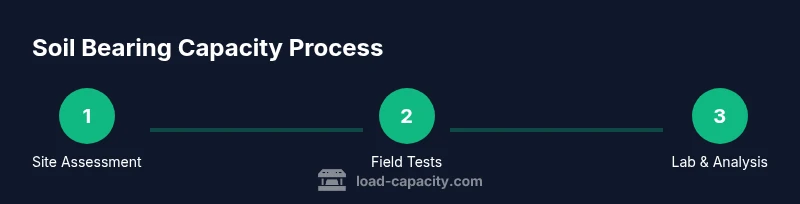
To determine bearing capacity, start with site data, select tests (SPT/CPT/plate load), perform analyses with appropriate equations, integrate lab and field results, apply safety factors, and document soil layers, groundwater, and footing sizes.
Why bearing capacity matters
Knowing how to determine the bearing capacity of soil is essential for safe and economic foundations. When a structure transfers load to the ground, the soil must be able to support that load without excessive settlement or failure. This block explains the fundamental concepts, the relationships between soil properties, and how you approach a reliable assessment. According to Load Capacity, understanding bearing capacity starts with proper site classification, soil type, moisture regime, and historical investigation. Briefly, bearing capacity is the maximum load per unit area that the soil can safely carry; it is influenced by soil type (granular vs cohesive), effective stress, groundwater, and the presence of fines. For engineers, early estimates guide decisions about footing size, depth, and whether ground improvement is needed. A conservative approach reduces risk and potential remediation costs later in the project life cycle. In practice, you combine field observations, laboratory tests, and analytical methods to arrive at a defensible capacity value. This creates a clear basis for design and communicates expectations to clients and regulators.
Tools & Materials
- Field data collection toolkit (survey equipment, tape, notebook)(Used for site conditions and footing locations)
- SPT hammer and split-spoon sampler(Standard field test setup per guidelines)
- Soil specimen containers and labels(For lab testing and traceability)
- Digital scale and moisture test device(For in-lab property determinations)
- Calibrated penetrometer or CPT device (if available)(Optional; improves data richness)
Steps
Estimated time: 2-3 weeks
- 1
Prepare field plan and safety measures
Define test locations, establish access, and review safety plans. Confirm equipment readiness and coordinate with site personnel. Document environmental constraints and risk controls before any digging or testing begins.
Tip: Pre-brief the team on hazards and emergency procedures. - 2
Collect soil samples from planned test locations
Use boreholes or trenches to collect representative samples at target depths. Label each sample with depth, location, and observed conditions. Record soil color, texture, moisture, and any signs of disturbance.
Tip: Avoid cross-contamination between horizons; maintain sample integrity. - 3
Perform field tests (SPT, CPT) according to standard procedures
Conduct SPT and/or CPT in designated horizons, following local codes. Record blows per foot (SPT) or cone resistance (CPT) and pore pressure data when applicable.
Tip: Calibrate equipment and note any anomalies during testing. - 4
Document soil layers, groundwater, and drainage observations
Create a detailed log of layer thicknesses, transitions, and groundwater conditions. Note perched water zones or rapid changes in moisture, which influence effective stress.
Tip: Use borehole logs or logger photos to support later calculations. - 5
Transport and prepare lab samples for index tests
Seal samples to prevent moisture loss and transport to the lab promptly. Label correctly and record depths and test conditions.
Tip: Minimize sample disturbance to preserve in-situ properties. - 6
Determine index properties in the lab (moisture, density, Atterberg limits)
Run moisture content, dry density, grain-size distribution, and Atterberg limits for cohesive soils. These parameters feed strength estimates and drainage assumptions in design.
Tip: Maintain consistent testing standards to enable reliable correlations. - 7
Select bearing-capacity approach and check soil type
Choose an appropriate method (Terzaghi, Meyerhof, or others) based on footing geometry, soil type, and drainage. Determine whether drained or undrained assumptions apply.
Tip: Match the method to the most critical soil layer identified in the field. - 8
Calculate ultimate bearing capacity (base resistance, surcharge)
Compute base resistance from soil strength parameters and add the surcharge from overlying soils. Combine with the chosen method’s factors for an ultimate value.
Tip: Document simplifying assumptions and data sources used in calculations. - 9
Apply safety factors and assess settlement
Divide the ultimate capacity by a suitable factor of safety to obtain allowable capacity. Evaluate predicted settlements against serviceability limits for the structure.
Tip: Use multiple settlement models if soil is heterogeneous. - 10
Document results and prepare the engineer’s report
Assemble borehole logs, test results, calculations, and a clear conclusion. Provide actionable footing recommendations, contingencies, and QA/QC references.
Tip: Include sensitivity analysis showing how parameter uncertainty affects results.
Quick Answers
What is the difference between ultimate and allowable bearing capacity?
Ultimate bearing capacity is the maximum pressure the soil can resist before failure. Allowable bearing capacity applies a safety factor to that value to account for uncertainties and long-term settlement.
Ultimate capacity is the max load soil can bear; allowable capacity includes safety margins for practical design.
Which tests are most common for determining bearing capacity in the field?
SPT and CPT are the most common field tests to estimate soil strength. Plate load tests are used for direct measurements, especially in critical projects.
SPT and CPT are standard field tests for estimating soil strength; plate load tests give direct measurements.
How does groundwater affect bearing capacity?
Groundwater reduces effective stress, often lowering shear strength and ultimate capacity. It can also change settlement behavior, so monitoring water conditions is essential.
Groundwater lowers effective stress and can increase settlement risk, so it must be considered in calculations.
Can you estimate bearing capacity without lab tests?
Yes, preliminary estimates can be made from field tests, empirical correlations, and site history, but lab data improve accuracy and reliability for design decisions.
You can estimate it from field data, but lab data make the design more reliable.
How should settlement influence capacity calculations?
Settlement is a serviceability concern; capacity calculations should be paired with settlement predictions to ensure the structure remains within limits.
Settlement matters; it should be evaluated alongside capacity to avoid serviceability issues.
What safety factors are typical in bearing-capacity design?
Common factors of safety range from 2.0 to 3.0, depending on soil variability, consequence of failure, and project codes.
Most projects use a safety factor between 2 and 3, depending on risk and local standards.
Watch Video
Top Takeaways
- Learn the sequence from field data to lab results to bearing-capacity calculations
- Differentiate drained vs undrained conditions based on soil type and water status
- Use multiple methods and conservative safety factors for reliability
- Document uncertainties and present clear recommendations to stakeholders
- Base decisions on a transparent, traceable geotechnical report