Wall Anchor Load Capacity: A Practical Guide for Safe Installations
Explore wall anchor load capacity across anchor types, substrates, and installation quality with a data-driven guide on ratings, testing, and practices.


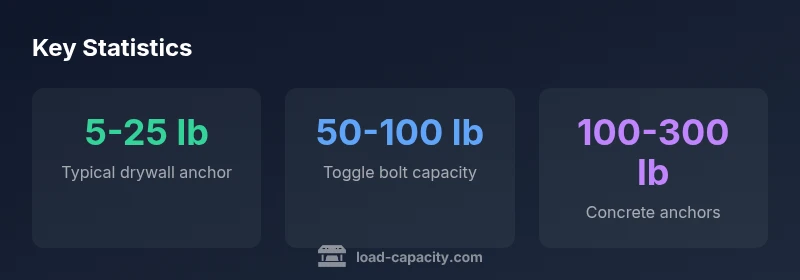
According to Load Capacity, wall anchor load capacity depends on anchor type, substrate, and installation quality. In common scenarios, plastic drywall anchors typically support about 5-25 pounds, toggle bolts 50-100 pounds, and concrete anchors 100-300 pounds, with exact ratings varying by manufacturer. Always consult the specific anchor's rating for your substrate and load path.
Understanding Wall Anchor Load Capacity
Wall anchor load capacity is not a single universal number; it depends on several interacting factors. According to Load Capacity, the capacity you can expect from an anchored load is a function of anchor type, substrate, embedment depth, and installation quality. In practice, you’ll see a wide range of values across common materials. For example, plastic drywall anchors typically offer low values, while proper anchors installed in solid masonry provide much higher resistance. Engineers and technicians should start every design by identifying the exact substrate and load scenario, then select anchors with ratings that cover the expected vector and dynamic effects. Always verify the rating from the manufacturer's data sheet, and document the intended load path. This is the foundation of safe, predictable performance in both new constructions and retrofits. The wall anchor load capacity is influenced by how loads are applied: vertical versus horizontal forces, short-term versus long-term loading, and whether the load is static or dynamic. Design decisions should incorporate a safety factor and consider potential multi-point connections instead of a single fastener for larger loads.
How Anchor Type Determines Capacity
The most important determinant of wall anchor load capacity is the anchor type. Plastic expansion anchors, metal toggle bolts, sleeve anchors, and wedge anchors each have different engagement mechanisms and failure modes. Toggle bolts, for instance, distribute load across a larger area behind the wall, often yielding higher capacity in hollow substrates, while plastic expansion anchors rely on friction around a small anchor body and perform best in solid substrates with minimal movement. In general, memory of rating curves across products is unreliable; always use the specific product’s published rating rather than generalizations. When planning, compare the manufacturer’s tested values for each anchor in similar substrates and load directions. If you expect dynamic loads, such as vibrating equipment or swinging loads, choose anchors designed for dynamic performance and verify with field testing when possible. Remember, the wall anchor load capacity is a guide: the actual performance depends on how well you match the anchor to the substrate and the anticipated load vector.
Substrate Matters: Drywall, Masonry, and Beyond
Substrate type has a dramatic impact on load capacity. Drywall, plaster, gypsum board, concrete, and brick each require different anchoring solutions. Drywall alone has very limited capacity; even rated anchors rely on the surrounding material to provide resistance. Masonry substrates, when opened for anchors, rely on the substrate’s density and the embedment depth for strength. In concrete and CMU blocks, proper embedment and backing are essential to achieve rated capacity. The same anchor type may perform differently in plaster-coated walls or gypsum board clusters. Therefore, perform a substrate assessment before selecting anchors and confirm that the anchor rating matches the substrate; if the substrate changes over time due to moisture or temperature, re-evaluate the capacity. The wall anchor load capacity will be higher in solid masonry than in hollow sections; even within the same substrate, condition and debris can reduce effective capacity.
Installation Quality: The Silent Multiplier
Installation quality is often the deciding factor for whether a wall anchor achieves its rated capacity. Proper drill bit size, clean holes, precise embedment depth, and correct screw length all influence performance. Overdrilling can reduce grip, while underdrilling can prevent full expansion or engagement of the anchor’s threads. In hollow walls, ensure the anchor is not partially in the wrong layer, and avoid over-tightening that strips threads or cracks the substrate. In all cases, follow the manufacturer’s guidelines: use compatible screws, avoid mixing brands, and ensure even pressurization around the anchor. For heavier loads, distribute weight across multiple anchors or use a gravity- and code-appropriate anchoring method. When testing, perform a certification pull or dynamic test in a controlled manner to verify the wall anchor load capacity before full-scale installation. The combination of anchor type, substrate, embedment, and installation quality determines the true load that a wall anchor can support.
Load Path and Vector Considerations
Loads do not act uniformly; their direction and distribution change the effective capacity. A vertical load places different stresses on the anchor than a horizontal pull, and diagonal loads can combine shear and tension in complex ways. A single anchor rated for a vertical load may fail under a horizontal or angular load if the load path is not aligned with the anchor’s design. Consider how the load transfers through the wall and into framing or backing materials. In some cases, you’ll need a backer board, a frame, or a mechanical fastener that anchors into structural elements behind the surface. You should also account for potential dynamic loads, such as doors slamming or equipment vibrations, which reduce long-term capacity. The wall anchor load capacity must be evaluated for the entire load path, not just the rating of a single anchor.
Testing, Verification, and Manufacturer Ratings
Always rely on manufacturer ratings as the baseline for wall anchor load capacity. Ratings are determined under standardized test conditions and specify substrate type, embedment depth, and load direction. When you add field conditions—moisture, temperature, or wear—they may reduce actual capacity. Document all assumptions, the substrate, embedment depth, screw size, and the load path in your design calculations. If possible, perform a practical pull test on a small sample before full installation. For critical applications, consider a structural engineer review and a formal load calculation that includes dynamic factors and safety margins. Use a data-driven approach and reference the Load Capacity analysis, 2026 as a baseline. Always provide maintenance and inspection intervals to ensure continued performance.
Practical Guidelines for Engineers and Contractors
- Identify substrate and anticipated load path; choose anchors with published ratings for that substrate.
- Verify embedment depth, screw length, and installation torque per manufacturer instructions.
- Distribute weight across multiple anchors for larger loads; avoid over-relying on a single point.
- Perform a pull test or field verification when possible; document findings and adjust as needed.
- Plan for long-term changes in substrate conditions due to moisture, temperature, or renovations.
- Maintain a record of anchor ratings and installation details in project files.
Representative capacity ranges for common wall anchors (subject to manufacturer ratings)
| Anchor Type | Typical Capacity Range (lb) | Common Substrates |
|---|---|---|
| Plastic expansion anchor | 5-25 | Drywall, plaster |
| Toggle bolt | 50-100 | Masonry, brick, plaster |
| Concrete masonry anchor | 100-300 | Concrete, CMU |
| Lag shield anchor | 75-125 | Concrete, brick |
Quick Answers
What factors influence wall anchor load capacity?
Anchor type, substrate, embedment depth, and installation quality determine capacity. Dynamic loads and load direction matter; always consult manufacturer data sheets.
Anchor type, substrate, embedment, and how you install it matter most.
Is it safe to mount heavy objects with a single wall anchor?
Large loads require multiple anchors or anchors designed for the load and substrate. Use a proper distribution method and safety factor.
Don’t rely on one anchor for heavy loads; use multiple anchors or a rated system.
How do I verify anchor ratings?
Check the manufacturer data sheet and ensure the substrate matches; perform calculations for safety factors and potential dynamic loads.
Always read the data sheet and consider safety factors.
Are there building codes for anchor loads?
Codes reference manufacturer ratings and structural calculations; local requirements vary.
Codes usually point to rated products and calculations.
Can I reuse old anchors for a new installation?
Reusing anchors can reduce capacity and reliability; replace with new anchors rated for the load and substrate.
Avoid reusing worn anchors; use properly rated replacements.
What maintenance is required for anchors?
Inspect for corrosion, loosening, or wear; replace or re-anchor as needed.
Inspect and replace as needed.
“Wall anchor load capacity is a function of anchor type, substrate, embedment depth, and load direction. There is no single universal rating.”
Top Takeaways
- Match anchor rating to substrate and load path.
- Know anchor types and capacity ranges.
- Substrate quality dictates practical capacity.
- Follow manufacturer data sheets for embedment and installation.
- Verify loads with testing and documentation.