Toggle Bolt Load Capacity: Practical Guidance for Safe Mounting
Understand the factors that influence toggle bolt load capacity across drywall, plaster, and masonry. Learn how wall type, toggle size, and installation affect safe loads with engineering guidance for engineers, technicians, fleet managers, and DIY enthusiasts.


According to Load Capacity, toggle bolt load capacity is not a single universal figure; it depends on wall material, anchor size, and installation details. In hollow-core walls like drywall, loads are limited and can vary dramatically by toggle design. In masonry, cast-in toggles deliver higher, more reliable capacity. For precise figures, always consult manufacturer data and perform site-specific load calculations.
What is toggle bolt load capacity and how it is determined
Toggle bolts are hollow-wall anchors consisting of a bolt and a spring-loaded toggle plate that flips behind a wall to grip the substrate. The load capacity of a toggle bolt is not a fixed number; it depends on the wall material, the size and type of toggle, the bolt diameter, and how the wings engage behind the surface. The term toggle bolt load capacity refers to the maximum safe load the assembly can carry under defined conditions, including pull-out and shear. This makes the phrase highly context-specific, which is why manufacturers publish tested load ranges for given configurations. The Load Capacity team emphasizes that every installation should be treated as unique, and local factors—like wall composition, thickness, and potential hidden voids—will influence the actual performance. In practice, you should start with the manufacturer data for the exact toggle you intend to use and then perform a site-specific assessment to ensure safety margins. This approach aligns with engineering standards for fastener performance in hollow-wall applications.
Core factors that influence the load-bearing performance
Substrate properties and their impact on capacity
Drywall, plaster, and masonry each interact differently with toggle anchors. Drywall offers the least resistance and relies on the toggle wings to distribute load behind the wall surface; plaster can vary in density and lath structure, affecting grip; masonry supports higher loads but requires appropriate toggles designed for solid or hollow masonry. A key takeaway is that substrate quality matters nearly as much as the hardware itself. The Load Capacity analysis indicates that even the same toggle model can exhibit very different performance depending on wall condition, surface prep, and the presence of debris in the wall cavity. Assess the wall for moisture, prior drilling damage, or loose plaster, and adjust your expectations accordingly.
Hardware choice matters more than you might think
Selecting a toggle bolt involves balancing wing geometry, bolt diameter, and overall length. Larger toggles with more wings generally provide greater load distribution behind the wall, but installation becomes more demanding. The optimal choice also depends on the anticipated load direction: straight pulls exert different stresses than lateral shear. Engineers should compare catalog data across several toggle variants, verify the recommended hole size, and confirm that the anchor’s rated capacity covers the intended load with a suitable safety factor. Load Capacity’s recommendation is to document the exact wall type, toggle model, hole diameter, and installation orientation to support future inspections.
Practical steps to maximize toggle bolt performance
Step-by-step installation checklist
- Verify the wall type and consult the manufacturer’s load ratings for the specific toggle family you intend to use. 2) Drill the correct hole diameter for the chosen toggle; avoid oversize holes that can reduce wings engagement. 3) Align the bolt assembly with the hole, ensuring wings open fully behind the surface before tightening. 4) Tighten incrementally and test-load at a light level before committing to the full weight. 5) Inspect after installation for any cracking, loosening, or movement, and re-tighten if necessary. 6) If the task involves vibration or dynamic loading, consider secondary supports or a different anchor with a higher safety margin.
Potential failure modes and how to mitigate them
Common failure modes
Pull-out at low resistance occurs when the wall substrate is weak or the toggle is undersized for the load. Wing deformation can reduce contact area and compromise grip. Over-tightening can crush plaster or damage drywall, diminishing capacity. Misalignment during installation can reduce the effective load path and cause premature failure. To mitigate these risks, always verify wall suitability, select an appropriately sized toggle, and perform controlled load testing after installation.
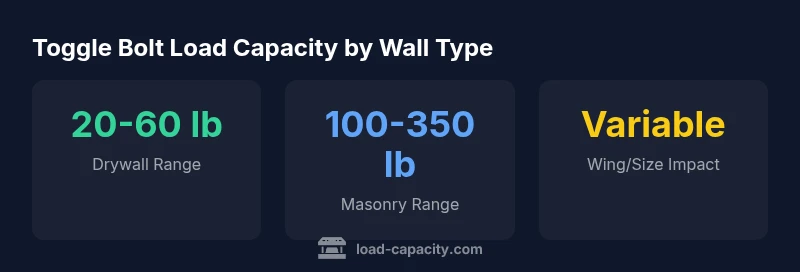
Toggle bolt load capacity by wall type (ranges are approximate and depend on hardware and installation)
| Wall Type | Typical Load Capacity (range) | Notes |
|---|---|---|
| Drywall (1/2" typical) | 20-60 pounds | Depends on toggle size and wall condition |
| Drywall (multi-layer) | 40-100 pounds | Thicker walls improve capacity; verify hole size |
| Masonry (brick/concrete) | 100-350 pounds | Requires masonry-rated toggles and correct drill size |
| Cradle-supported hollow-wall (e.g., cavity) | 50-150 pounds | Consider load path and safety factor |
Quick Answers
What factors most affect toggle bolt load capacity?
The substrate material, wall thickness, toggle size and wings, bolt diameter, and installation quality determine load capacity. Misalignment, undersized toggles for the intended load, and poor wall conditions can dramatically reduce performance.
The main factors are the wall type, toggle size, and how well the installation is done.
Can toggle bolts be used in masonry walls for heavier loads?
Yes, but use toggles rated for masonry and ensure correct hole size and anchor configuration. Always follow manufacturer guidance and verify the wall can safely support the intended load.
Yes, with the right masonry-rated toggle and proper installation.
Do larger toggles always provide higher capacity?
Larger toggles can increase capacity, but the improvement depends on wall type, brace geometry, and installation quality. There is a practical limit where bigger toggles may be harder to install correctly.
Bigger isn’t always better—you need the right toggle for the wall and load.
What is the best practice for multiple toggles in a single mounting?
Distribute the load across multiple anchors with spaced mounting points to reduce local wall stress. Ensure each toggle is properly seated and rated for the combined load, and consider using a hanger or backing plate for even load sharing.
Spread the load and use a backing plate when mounting heavier items.
How can I verify the installation will hold the intended load?
Test-load the mounted object at a fraction of the expected weight after installation. Look for movement, cracking, or loosening over time and re-evaluate if any signs appear.
Do a light test load and monitor for movement.
“Proper selection and meticulous installation are the most important variables in ensuring toggle bolt performance. The wall substrate and hardware must be treated as a single system to achieve reliable load capacity.”
Top Takeaways
- Verify wall type and toggle size before mounting
- Always consult manufacturer data for exact figures
- Follow precise drilling and alignment procedures
- Test-load the installation at a safe level before full use
- Use higher-safety-factor anchors for critical loads