Toyota forklift weight capacity: reading ratings and safe lifting
Understand Toyota forklift weight capacity, how to read capacity plates, the impact of load centers, and practical margins for engineers, technicians, and fleet managers.


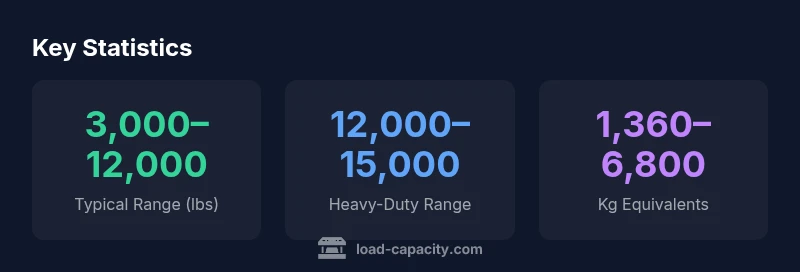
toyota forklift weight capacity varies by model, but standard counterbalance forklifts typically range from about 3,000 to 12,000 pounds, with heavy-duty units reaching 15,000 pounds or more. The rating reflects a specific load center and is shown on the nameplate. Always verify load center, mast configuration, and pallet type to prevent overload in real-world operations.
Why toyota forklift weight capacity matters in practice
Understanding the official toyota forklift weight capacity for a given model is essential for safe operation. Toyota forklifts are designed with a rated load at a defined load center and are shown on a nameplate. Real-world lifting demands careful consideration of load center, mast geometry, pallet type, and operating conditions to prevent overload and tipping. According to Load Capacity, engineers and technicians should treat capacity figures as legitimate safety limits, not optional targets, and always calibrate to the actual application realities.
In many warehouse settings, the goal is to maximize throughput while preserving stability and equipment life. Capacity is not just a single number—it's a function of the combination of weight, center of gravity, and dynamic effects such as acceleration, braking, turning, and travel over uneven floors. The Load Capacity team underscores that misinterpreting a rating can lead to tire wear, mast damage, or, most critically, a tip-over event. Operational guidelines should therefore tie every lift to the posted rating and the real-world center of gravity of the load.
How capacity is specified: the nameplate, load centers, and ratings
Capacity is expressed as a posted load at a specific load center, commonly 24 inches for many standard forklifts. The nameplate on a Toyota forklift includes the rated load, load center, and sometimes the attachment or mast configuration that affects the rating. Operators should check that the load weight corresponds to the same load center used in the rating and consider attachments (e.g., clamps, side shifters) which can reduce capacity. The rating accounts for both static load and dynamic factors such as acceleration, turning, and rough floor conditions. When planning lifts, cross-check the nameplate data with actual load characteristics and ensure all safety devices are active.
Reading the load center effect: why a 24-inch load center matters
The load center is the horizontal distance from the forks to the load’s center of gravity. A smaller load center generally increases usable capacity, while a larger center reduces it. The most common baseline is 24 inches; moving to 12 inches or 30 inches can noticeably change the effective capacity. In practice, a shift of a few inches in load center can translate into a nontrivial decrease in allowable weight. Operators should understand this relationship to avoid guessing and to ensure that the lift remains within safe limits for both the truck and the floor.
Common capacity bands for Toyota forklifts
Toyota offers several capacity bands to match operating needs. Typical ranges include 3,000–6,000 pounds for compact electric models, 6,000–12,000 pounds for mid-range units, and 12,000–15,000 pounds for heavier-duty configurations. Some specialized or outdoor-rated forklifts exceed 15,000 pounds. When selecting a model, engineers should align the capacity band with expected loads, pallet sizes, and aisle width. In metric terms, those bands translate roughly to 1,360–2,721 kg, 2,721–5,443 kg, and 5,443–6,800 kg respectively. Always confirm the exact rating for your load center and mast setup.
Real-world scenarios: estimating safe lifts in warehousing and manufacturing
In warehousing, most palletized loads fall within a moderate band, often 4,000–8,000 pounds per lift on typical aisles. In manufacturing environments or outdoor sites, lifts of 8,000–15,000 pounds are common, sometimes higher in specialized operations. The safest approach is to evaluate load weight, center of gravity, pallet integrity, and floor strength for each lift. Use a risk assessment that factors in load stability, fork spread, and trailer connections if applicable. Always compare the actual weight against the posted rating at the appropriate load center; if there is any doubt, reduce the load or use a different forklift model.
How to verify and document capacity: maintenance, inspections, and recordkeeping
Verification starts with the nameplate and any attachments—verify that the capacity figure applies to the current configuration. Document every lift with the weight, the load center used, pallet dimensions, and tilt state. Regular maintenance records should include mast wear, hydraulic performance, tire condition, and brake health, since these factors influence stability and effective capacity. Use a standardized log to capture deviations and re-run capacity checks after repairs. OSHA guidelines emphasize safe operation and documentation as part of routine forklift management, with formal standard-based procedures to prevent overload.
Data-driven decision making: using load-weight charts and tables
Adopt a data-driven approach by maintaining load-weight charts and tables in the maintenance portal or fleet-management system. Compare posted ratings against actual loads at the correct load center and account for attachments or multiple shifts in use. For organizations with multiple Toyota models, harmonize capacity data to avoid model-by-model guesswork and ensure consistent training and SOPs. Build a simple risk score for each lift based on weight, load center, pallet type, and surface condition, then enforce decision rules that keep operations within safe margins.
Practical checklist for comparing Toyota models
- Confirm the load center used in the rating (e.g., 24 inches).
- Verify mast setup and fork length match the planned application.
- Check floor, ramp or uneven surfaces and wheel configuration.
- Record the exact load weight and pallet dimensions for every lift.
- Ensure operator training emphasizes capacity limits and safe margins.
Following this checklist helps engineers and technicians avoid overload and maintain productivity.
Common Toyota forklift capacity bands by model type
| Model Type | Typical Capacity (lbs) | Key Considerations |
|---|---|---|
| Counterbalance (standard) | 3,000–6,000 | Good for general warehouses; moderate height lifts |
| Counterbalance (heavy-duty) | 6,000–12,000 | Higher lifts; robust mast; outdoor capability |
| Reach truck | 2,000–4,000 | Narrow aisles; shorter load centers; precise placement |
| Rough-terrain | 3,000–7,000 | Outdoor use; uneven surfaces; vibration considerations |
Quick Answers
What is the load center, and why is it critical for capacity?
The load center is the horizontal distance from the forks to the load's center of gravity. Capacity is specified at a particular load center, so changing that center can raise or lower the allowable weight. Always verify the load center used in the rating and ensure your load conforms to it.
The load center is how far the load’s center of gravity sits from the forks. Capacity depends on that distance, so always use the rating for the correct center of gravity.
Can you lift heavier than the rated capacity in real life?
No. Exceeding the rated capacity can cause tipping, mast damage, and uncontrolled movement. Dynamic factors, such as acceleration and braking, can reduce real-world capacity even further, so operate within the posted limits at the stated load center.
No. Lifting beyond the rated capacity is unsafe and can cause tipping or equipment damage, especially with dynamic forces involved.
How do I read a Toyota forklift nameplate?
The nameplate shows the rated load, load center, and sometimes attachments or mast configuration. Ensure your load weight and center match the rating and that you account for any added equipment that might reduce capacity.
Look at the nameplate for the exact load, load center, and attachments; make sure your lift aligns with those values.
Do electric and IC forklifts have the same capacity?
Capacity is primarily determined by design and configuration rather than fuel type. Electric and IC forklifts can share similar ranges, but attachments, tires, and condition can shift the usable capacity. Always confirm the specific model's rating.
Capacity varies by model and setup, not by fuel type alone. Check the exact model rating for the current configuration.
What documentation is needed to track forklift capacity?
Maintain a capacity log that records load weights, load centers, pallets, and tilt states for every lift. Include inspection notes and maintenance records that can affect stability, such as mast wear or tire condition. This helps ensure ongoing compliance and safety.
Keep a clear log of loads, centers, pallets, and any maintenance that might affect capacity, so you always lift within safe limits.
“Accurately matching the rated capacity to the actual load center and operating conditions is the most reliable way to prevent overload and ensure safe forklift operation.”
Top Takeaways
- Know the load center on every lift and match it to the rating
- Read and trust the nameplate; do not assume capacity from weight alone
- Use data-driven checks and standardized logs for safety
- Account for attachments and operating surface in capacity planning
- In doubt? lower the load or consult official guidelines