Forklift Load Capacity Calculator: Safe Lifts and Loads
Learn to estimate safe forklift loads using a forklift load capacity calculator. Input rated capacity, load weight, and load center to get a practical safety estimate and improve on-site lifting decisions.


Why a forklift load capacity calculator matters
In industrial environments, safely maximizing productivity means knowing how much a forklift can lift under varying conditions. A forklift load capacity calculator provides a structured, repeatable method to estimate safe loads before moving a pallet, cage, or custom payload. According to Load Capacity, relying on nominal numbers alone can invite risk if weight distribution, load center, or fork geometry deviates from the ideal. The calculator translates operational realities into a practical number you can verify on the job floor, supporting safer lift plans, better load planning, and compliance with safety guidelines. The goal is not to replace manufacturer data but to augment it with scenario-specific adjustments that reflect real-world conditions. For engineers, technicians, and fleet managers, this tool helps bridge theory and practice by making the complex balance between stability, traction, and maneuverability more transparent. The Load Capacity team found that even small changes to load center or mast height can noticeably alter effective capacity, so setting up a consistent calculator workflow is essential to minimize guesswork and standardize your lifting decisions.
Understanding the key inputs
A forklift load capacity calculator relies on three core inputs that directly influence the output:
- Rated Capacity: The manufacturer-stated maximum load the forklift can safely lift at a given load center. This is the baseline for all calculations and safety checks.
- Actual Load Weight: The real weight of the payload you intend to lift. Greater weight presses the stability triangle and can reduce safe capacity.
- Load Center: The distance from the forks to the load's center of gravity, expressed in inches. A larger load center generally lowers effective capacity.
Understanding these inputs helps you see why a single rated capacity value cannot guarantee a safe lift in every situation. Variations in pallet type, load geometry, attachments, and even operator technique can shift the safe load value significantly. For a rigorous approach, ensure that your data matches the specific forklift model, attachment, and operating conditions to avoid miscalculation.
The simplified calculation approach
This calculator uses a transparent, educational formula designed to illustrate how inputs influence safe capacity without becoming a complex engineering model. The steps below show how the calculation unfolds in a typical scenario:
- Enter Rated Capacity (kg) — the forklift’s published maximum load.
- Enter Actual Load Weight (kg) — the weight you plan to lift.
- Enter Load Center (inches) — the distance from the forks to the load’s center of gravity.
- Compute a load-center factor: factor = max(0.5, min(1, 24 / LoadCenter)). This keeps the adjustment between 0.5 and 1.0.
- Compute an adjusted load: adjustedLoad = ActualLoadWeight * factor.
- Determine Safe Load: SafeLoad = min(RatedCapacity, adjustedLoad). If SafeLoad equals Rated Capacity, you’re at or near the limit; if lower, the adjustment reflects the increased risk with a heavier load center.
Note: This is a simplified educational model meant to illustrate how changes in load center and weight affect capacity. Always consult the manufacturer’s data and follow site safety protocols. The calculation does not replace formal training or on-site engineering judgment.
How to use the calculator in practice
To get the most reliable results, follow a consistent workflow on every lift:
- Verify the forklift model and any attachments (e.g., forks, sideshifts, clamp attachments) are correctly configured in the calculator.
- Use the exact rated capacity at the current load center as your baseline. Do not use a higher value than the manufacturer specifies.
- Enter the actual load weight with a calm, accurate measurement method (e.g., pallet scale, weigh station readout).
- Record the load center for the payload. If uncertain, measure the distance from the forks to the load’s center of gravity using a known method.
- Compare Safe Load to the actual load and adjust operations accordingly. If Safe Load is substantially lower than the payload, consider redistributing the load or using a different attachment or forklift.
- Keep a simple on-site log of calculator inputs and results for audits and operator training.
Safety considerations and limits
Safety is the top priority when lifting with a forklift. A calculator is an educational aid, not a substitute for safety practices:
- Never exceed the forklift’s rated capacity for any load configuration, even if the calculator suggests a higher value.
- Be mindful of dynamic factors during movement, such as acceleration, turning, or uneven ground, which can reduce real-world stability.
- Ensure attachments are in good condition and properly balanced; attachments alter load center and capacity.
- Regularly validate calculations against periodic inspections and manufacturer updates, and train operators to understand the impact of load center, weight, and geometry.
- Use the calculator as part of a pre-lift checklist and a learning tool for new operators and inspectors.
Real-world examples and scenarios
Consider three common cases that illustrate how inputs influence outcomes:
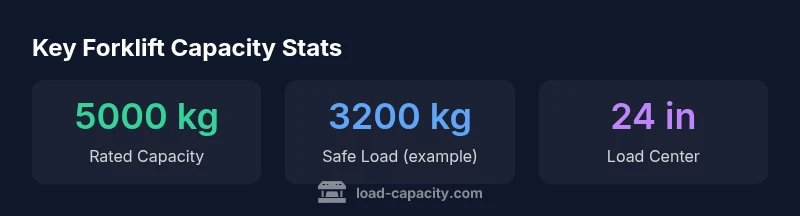
- Scenario A: Rated Capacity 5000 kg, Actual Load Weight 3200 kg, Load Center 24 inches. Factor = min(1, 24/24) = 1.0; Adjusted Load = 3200 kg; Safe Load = min(5000, 3200) = 3200 kg. Result: Safe Load equals actual load, alignment with manufacturer data.
- Scenario B: Rated Capacity 5000 kg, Actual Load Weight 3800 kg, Load Center 40 inches. Factor = min(1, 24/40) = 0.6; Adjusted Load = 2280 kg; Safe Load = 2280 kg. Result: You must either reduce the payload or switch to a forklift with higher rated capacity for this center of gravity.
- Scenario C: Rated Capacity 6000 kg, Actual Load Weight 3200 kg, Load Center 28 inches. Factor = 24/28 ≈ 0.857; Adjusted Load ≈ 2742 kg; Safe Load = 2742 kg. Result: The load distribution reduces capacity well below the nominal rating, guiding safer planning.
Best practices for maintenance and validation
To ensure ongoing reliability of the forklift load capacity calculator:
- Keep inputs up to date with OEM data, attachment changes, and load configurations.
- Train operators to interpret results and recognize when the estimation margin is narrow.
- Revisit the calculator whenever equipment or attachments are changed or refurbished.
- Periodically cross-check calculator results against actual lift tests performed by qualified personnel, and document outcomes for continuous improvement.