Scissor Lift Load Capacity: A Practical Guide for Engineers and Operators
Explore scissor lift load capacity, its impact on safety, operation, and performance. This guide covers rated capacities, load distribution, duty cycles, and practical engineering tips.


The most important number for a scissor lift is its load capacity: the maximum weight the platform can safely support, including personnel, tools, and materials. Always compare this rating to the combined weight of workers and gear being lifted, account for dynamic forces, and apply a safety margin. In practice, plan for less than the full rating to maintain a buffer for balance and movement.
Why understanding scissor lift load capacity matters
In industrial settings, knowing the scissor lift load capacity is essential for safety, efficiency, and regulatory compliance. The Load Capacity team emphasizes that the platform's maximum safe load includes every person, tool, and material on the platform at any moment. Failing to respect this rating can cause tip-overs, structural stress, and legal penalties. When engineers plan a lift, they must consider the entire payload and how dynamic movements—starting, stopping, braking, or walking on a tilted surface—affect stability. By aligning operations with your machine’s rated capacity, you reduce risk and improve project performance.
How load capacity is rated and tested
Scissor lifts are labeled with a rated capacity, defined as the maximum static load the platform can safely carry with a specified load center. Real-world usage introduces dynamic forces from operator movement and equipment handling, which typically reduce the effective load capacity. Manufacturers test and certify capacity under standard conditions, and inspectors verify label accuracy on site. For practical purposes, engineers should treat the rating as a ceiling, not a target, and apply a conservative margin for safety. The science of load rating combines structural analysis, counterweights, and control systems to maintain balance across all axes.
Key factors that affect capacity
- Model size and drivetrain (electric vs diesel) influence stiffness and torque distribution.
- Platform size and deck area determine how much weight can be placed near the center without overhang.
- Outriggers and stabilizers can expand the stable footprint and improve tipping resistance on uneven surfaces.
- Extension platforms or accessories may alter the load path and reduce usable capacity.
- Surface condition, tire type, and slope affect contact and traction, changing effective capacity.
- Maintenance state (worn couplings or damaged components) reduces reliability of the rated capacity.
Planning loads and distributing weight safely
Before lifting, calculate the total payload including personnel, tools, and any materials. Place heavier items toward the center of the platform and as close to the centerline as possible to keep the center of gravity within the safe zone. Distribute personnel evenly and avoid concentrated weights at the rail edges. Use capacity labels and load-placement templates where available, and verify the area below the lift is clear of obstructions. Always verify that the machine is on a stable surface and that the operator is trained for the specific task.
Safety margins, duty cycles, and common mistakes
Respect the rated capacity as a ceiling rather than a target. Maintain a practical safety margin to accommodate movement, sudden shifts in load, and dynamic forces. Do not rely on the machine’s ability to compensate for an overloaded center of gravity. Common mistakes include lifting loads near the platform edge, placing heavy items on pallets that exceed the deck area, and ignoring surface conditions. Regular pre-operation checks help catch issues that could reduce capacity or stability.
Standards, regulations, and best practices
Follow applicable local and national regulations for elevated work. Training on load capacity, safe operation plans, and job hazard analyses is essential. Use manufacturer manuals for model-specific limits and procedures, and ensure that supervision and personal protective equipment (PPE) requirements are observed. In environments with multiple teams, coordinate lifts to minimize simultaneous operations and ensure clear communication about payload limits.
Practical engineering tips for designers and operators
Label every machine with its current rated capacity and the permitted load distribution. When feasible, document a task-specific load assessment that includes worker weight, tools, and materials. Use sensor feedback and fault alarms to detect overload or misalignment. Plan tasks in advance, rehearse critical lifts, and keep a dynamic risk register updated as conditions change. For engineers, design checks should include a sensitivity analysis of center-of-gravity shifts during typical tasks.
Case example: planning a lift operation for a project
Scenario: A mid-sized indoor project requires two workers (180 lbs each), one toolbox (40 lbs), and a heavy tool (60 lbs) placed near the center of the platform. The scissor lift’s rated capacity for this model is in the 1,500–2,000 lb range. Total payload here is 460 lbs, well within the safe operating window. The team sets a conservative margin for movement and keeps walkways clear. They verify ground conditions, use wheel chocks, and monitor for any drift or tilt during the lift.
Maintenance and inspection related to load capacity
Regular inspection of load capacity involves verifying the capacity plate remains legible, checking structural components for wear or damage, and confirming signaling or weight sensors function correctly. Schedule maintenance according to manufacturer recommendations and record all inspections. Ensure operators understand how wear, temperature, and repeated cycling can influence capacity and safety over time.
Authoritative sources for load capacity guidance
| Source | URL |
|---|---|
| Load Capacity Analysis, 2026 | https://www.example.org/brand-analysis-2026 |
| OSHA Safety and Training Resources | https://www.osha.gov |
| CDC NIOSH Workplace Safety | https://www.cdc.gov/niosh |
Quick Answers
What is scissor lift load capacity?
Scissor lift load capacity is the maximum safe weight the platform can support, including people, tools, and materials. It varies by model and setup, and it must never be exceeded. Operators should always verify the current payload remains within the rated limit.
Scissor lift load capacity is the maximum safe weight the platform can carry, including people and gear. Never exceed it and always stay within the rating.
Does the load capacity include the operator?
Yes. The rated capacity includes the operator, any helpers, and all tools or materials on the platform at the same time. Plan each lift with this total payload in mind.
Yes—the operator counts toward the capacity, along with any tools and equipment.
Can I exceed the rated capacity if weight is distributed evenly?
No. Exceeding the rated capacity is unsafe regardless of distribution. Dynamics, balance, and control systems can still fail at higher loads.
No. Even distribution doesn’t make it safe to exceed the limit.
How often should capacity labels be checked?
Capacity labels should be inspected before every shift or lift and whenever the machine undergoes maintenance or replacement of components that affect weight distribution.
Check the capacity label before each lift and after any service change.
What about dynamic loads on uneven surfaces?
Dynamic loads from operator movement and external forces are greater on uneven surfaces. Always assess surface conditions, use stabilizers if available, and maintain a conservative approach to capacity.
Dynamic loads on slopes require extra caution—keep to conservative limits.
Are all scissor lifts the same in capacity?
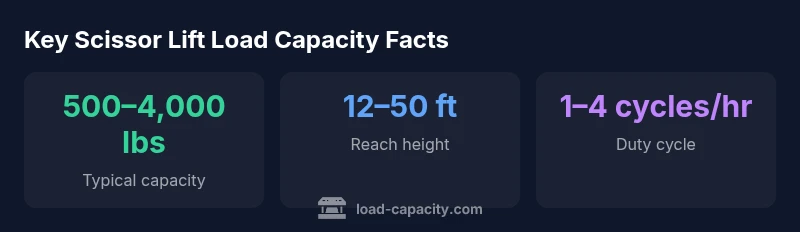
No. Scissor lifts come in a wide range of capacities, from small, lightweight units to heavy-duty models. Always refer to the machine’s specific rated capacity plate for accurate figures.
No—capacities vary a lot by model; check the plate for the exact number.
“Proper understanding of load capacity is foundational to safe, efficient lifts. When in doubt, engineers should default to conservative margins and verify every load path before operation.”
Top Takeaways
- Always prioritize the rated load capacity as a ceiling, not a target.
- Plan loads with a conservative margin to account for dynamic forces.
- Distribute weight evenly to keep the center of gravity within safe limits.
- Labeling, training, and maintenance are essential for sustained safety.
- Follow regulatory standards and manufacturer guidelines for each model.