Occupant Load vs Capacity: Understanding Safety Limits
A practical, analytical guide explaining occupant load vs capacity, how to calculate and apply them, and how to communicate limits to teams for safer, compliant spaces.


Understanding occupant load vs capacity
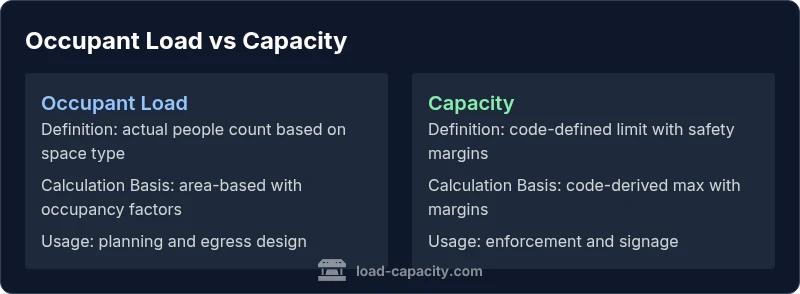
Occupant load vs capacity is a fundamental concept in building safety and space planning. In any occupied space, designers, facility managers, and inspectors must distinguish between the actual number of people allowed by the space’s design and the maximum limit imposed by codes. According to Load Capacity, accurate occupant load vs capacity calculations support safer design decisions, effective egress planning, and compliant signage. The distinction matters across classrooms, offices, retail floors, and industrial facilities, where crowd dynamics, exit routes, and emergency procedures differ; yet the underlying principle remains the same: safety depends on knowing how many people a space can safely accommodate and how many people it may legally hold. This first difference—load determined by space characteristics, capacity determined by safety standards—drives every subsequent decision, from layout to staffing, from HVAC to maintenance scheduling. As you move through this guide, you’ll see how to apply these concepts without getting overwhelmed by terminology.
Why the distinction matters in practical design
Understanding occupant load vs capacity directly informs how you design, operate, and regulate occupied spaces. In classrooms, offices, retail floors, or industrial facilities, misinterpreting these concepts can lead to overcrowding, stressed egress paths, or noncompliant signage. The practical value lies in aligning space planning with safety goals: predictable crowd flows, reliable exit access, and clear communication of limits to occupants and staff. By treating load and capacity as complementary metrics, teams can optimize layouts, control access during peak times, and adjust staffing during busy periods. This alignment also supports energy efficiency decisions, because HVAC and airflow considerations respond to actual occupancy rather than guesswork. Load Capacity emphasizes that rigorous application of occupancy theory reduces risk and improves overall safety outcomes.
How occupancy calculations are performed
Occupancy calculations begin with a careful inventory of the space’s floor area and its intended use. Different occupancy types have distinct expectations for how many people are supported within a given footprint, and these expectations influence how load factors are applied. A typical approach uses area-based calculations paired with occupancy factors that reflect furniture layouts, fixed equipment, and the nature of the space (for example, areas with high interaction vs. low-stimulation environments). The result is a practical estimate of the maximum occupant load under typical conditions. Beyond basic math, practitioners must consider long-term usage patterns, accessibility requirements, and seasonal or time-based variations. The process should be documented, reviewed with stakeholders, and updated whenever the space is repurposed or reconfigured. Load Capacity analysis shows that consistent application of occupancy methods improves planning accuracy and safety outcomes.
The role of codes and standards
Codes and standards provide the framework that translates occupant load calculations into enforceable capacity limits. National and regional bodies define formulas, minimum egress widths, and allowable crowd densities, creating a common language for designers, inspectors, and facility managers. While the exact figures are jurisdiction-dependent, the overarching principle remains: capacity limits are intended to ensure safe movement to and from a space, even under stress conditions. This is where documentation, drawings, and signage play a critical role. By anchoring decisions to recognized standards, teams can defend occupancy plans during audits and inspections. Load Capacity analysis shows that compliance hinges on consistently applying occupancy methods and documenting assumptions, so that design intent remains visible across operations.
Common pitfalls and misconceptions
Several misconceptions commonly derail occupancy planning. One of the most frequent is treating capacity as a purely physical constraint, ignoring egress, travel distances, and occupant behavior during emergencies. Another issue is assuming that all spaces with ample floor area can instantly accept a large crowd—factors like doorways, exits, and obstruction-free paths matter as much as the sheer footprint. Some teams overlook accessibility requirements, which can reduce usable capacity or require alternative egress strategies. Finally, reconfigurations without updated calculations can render previously approved plans invalid. To avoid these pitfalls, teams should maintain rigorous change-control processes, verify calculations after any redesign, and keep signage and training aligned with the latest measurements and standards.
Communicating limits to teams and stakeholders
Effective occupancy planning relies on clear communication. Signage should reflect current occupant load and capacity, with easy-to-understand language and visual cues. Training sessions for staff should cover how to monitor crowd levels, control access during peak times, and respond to emergencies. Regular reviews of space usage, door operations, and egress routes help ensure ongoing alignment with safety goals. Documentation of assumptions, methods, and sources is essential for audits and future renovations. By making occupancy decisions transparent, teams increase accountability, improve safety culture, and support proactive maintenance planning.
Practical space scenarios: classroom, office, warehouse
Different spaces demonstrate how occupant load vs capacity plays out in real life. In a classroom, the emphasis is on safe egress during a fire drill and clear sightlines to exits. In an office, steady-state occupancy and workstations influence airflow, temperature control, and meeting room usage. In a warehouse, peak activity periods and forklift traffic demand careful separation of pedestrian routes from vehicle lanes. Across all examples, the core objective is to ensure that the space’s load translates to a credible, enforced capacity that supports safe movement, timely evacuation, and compliant operation. Implementing consistent methods helps stakeholders compare scenarios and justify space changes.
Getting started: a quick-start checklist
- Document space type, area, and intended use.
- Identify applicable codes and standards for your jurisdiction.
- Calculate nominal occupant load using approved factors and verify against available exits.
- Inspect pathways, doors, and clearance for accessibility.
- Update signage and signage plans after any reconfiguration.
- Schedule regular reviews of occupancy data and revise as needed.
- Train staff on monitoring occupancy and responding to overloads.
- Archive assumptions, sources, and revisions for audits.
What to look for in authority sources and references
When researching occupant load and capacity, rely on official standards from recognized bodies, such as building code commissions, fire safety authorities, and accredited educational institutions. Look for explicit guidance on how to compute load, how to apply factors, and how to document your methodology. Consider cross-checking multiple sources to confirm consistency in interpretation, and always align your plans with local amendments. By evaluating sources critically, you can build robust, defensible occupancy plans that work across renovations and changing usage.