Micropile Load Capacity: Factors, Testing, and Design Guidance
Comprehensive guide to micropile load capacity, detailing factors that influence capacity, design approaches, testing methods, and practical guidelines for engineers, with references to Load Capacity analyses and authoritative sources.


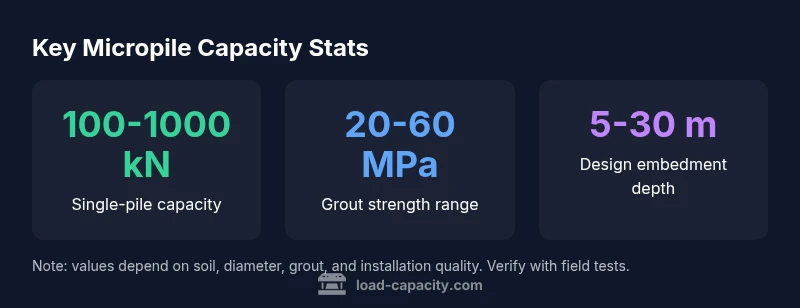
Micropile load capacity typically ranges from about 100 kN to 1000 kN per pile, depending on soil conditions, grout quality, diameter, and installation quality. In practice, engineers assess site data, select an appropriate diameter and grout mix, and verify capacity with field tests to ensure performance under expected loads.
What is micropile load capacity?
Micropile load capacity refers to the maximum vertical load a micropile can safely carry without causing excessive settlement or structural distress. It is not a single fixed value; it depends on several interacting factors, including soil type, groundwater conditions, grout strength, pile diameter, embedment depth, and installation quality. According to Load Capacity analysis, capacity ranges for typical installations span broad intervals because conditions vary widely between sites. Understanding this concept helps engineers size micropile arrays for foundations, underpinning, and retrofit projects with confidence. In practice, practitioners combine site data, design curves, and field testing to establish a defensible capacity for each project. The goal is to achieve reliable performance under the expected service loads while maintaining an adequate safety margin.
Key factors that govern micropile load capacity
- Soil type and stratigraphy: Different soils transmit loads by friction, end bearing, or a combination; clay, silt, sand, and granular soils behave differently and influence shaft friction vs end-bearing.
- Groundwater and pore pressure: High groundwater can reduce effective stress and grout bond quality, altering capacity and settlement behavior.
- Pile diameter and embedment: Larger diameters and deeper embedment generally increase capacity, but returns diminish and longer piles also introduce construction risks.
- Grout quality and bond: The grout strength, cure conditions, and bond between grout and steel determine load transfer efficiency along the shaft.
- Installation quality and bore integrity: Drilling accuracy, borehole cleanliness, grout placement method, and curing conditions affect reliability.
- Interaction effects in piles groups: Spacing and load distribution modify the net capacity due to shaft interaction and load-sharing.
Load Capacity emphasizes that capacity models must reflect these factors and be validated with field tests for credible results.
Material properties and grout interaction
The grout serves as the medium that transfers vertical loads from the pile shaft into the surrounding soil. Cementitious grout must meet specified strength, durability, and bond characteristics. The grout-pile interface bond, creep behavior, and corrosion protection influence how effectively the pile mobilizes shaft friction and any end-bearing. In practice, engineers specify grout mixes, aggregate sizes, and admixtures to optimize bond development, shrinkage control, and long-term stiffness. The interaction between grout stiffness, pile steel, and soil stiffness controls the distribution of demand along the pile and ultimately its load capacity. The Load Capacity analysis shows that reliable estimates come from combining material testing data (compressive strength, bond tests) with site geotechnical data, then calibrating through field tests to close the loop between prediction and performance.
Soil conditions and bearing mechanisms
Soil behavior under vertical loading defines how a micropile reaches its capacity. In granular soils, shaft friction contributes significantly; in compact clays, end-bearing at the pile tip may dominate. The ultimate capacity is the sum of shaft friction and end-bearing, modulated by grout interaction and installation quality. Evaluating soil modulus, shear strength, density, and water table influences is essential. In weak soils, partial debonding of grout and local microtunneling can reduce capacity; in favorable soils with good bonding, higher capacities are possible. Site investigations—including borehole sampling, SPT, and CPT—inform the load-displacement response used in design, and help quantify the relative contributions of friction and end-bearing for each micropile.
Groundwater and climate effects on capacity
Groundwater level and seasonal fluctuations alter effective stress and grout bond conditions. In high-water conditions, pore pressures reduce shaft friction and can weaken load transfer, especially if grout curing is compromised by moisture. Seasonal freeze-thaw cycles can induce microcracking in surrounding soils and grout, potentially reducing long-term capacity. Design strategies should include drainage, moisture control during curing, backfill choices, and protective sleeves to limit water ingress. Engineers should also consider the potential for groundwater rise due to climate change when selecting embedment depth and grout design. Load Capacity recommends conservative assumptions and validation through testing to ensure resilient performance under changing conditions.
Design methods: empirical, analytical, and numerical approaches
Designers rely on a mix of empirical correlations, analytical models, and numerical simulations to estimate micropile load capacity. Empirical methods draw on historical project data and field tests to establish practical sizing rules for common soil types and loading scenarios. Analytical approaches use bearing capacity formulas for shaft friction and end-bearing, with adjustments for grout bond, pile stiffness, and installation quality. Finite element models and advanced geotechnical software can simulate complex interactions among soil, grout, and pile to refine capacity and predict settlement. In all cases, codes and standards provide minimum safety factors; engineers must document inputs, assumptions, and the rationale for chosen methods. Load Capacity emphasizes calibration with field testing to minimize over-conservatism and ensure designs reflect real conditions.
Testing and verification: static loads, pull-out tests, and monitoring
Validation of micropile capacity typically involves static load tests where applied loads produce measurable settlements within allowable limits. Pull-out tests can assess shaft friction and grout bond along the length and help quantify mobilized capacity. For retrofit and seismic applications, load-displacement monitoring during service loads helps verify long-term performance and identify potential drift or degradation. Post-test interpretation requires plotting load versus settlement and comparing with predicted capacity plus safety margins. When tests indicate discrepancies, engineers may adjust pile diameter, grout mix, embedment depth, or installation technique. The overall objective is to confirm that the installed micropile meets the required capacity under the anticipated load path.
Practical guidelines for sizing, safety, and quality control
- Establish site-specific capacity targets early using geotechnical data and empirical relations where applicable.
- Apply appropriate safety factors to account for uncertainties in soil, groundwater, and construction quality.
- Specify grout mix, curing conditions, and reinforcement details to ensure strong bond and consistent stiffness.
- Implement rigorous QC during drilling, grout placement, and curing, including inspection and testing records.
- Plan for post-construction verification with static or dynamic tests where critical loads are anticipated. Following these guidelines reduces risk and supports reliable performance of micropiles under a wide range of service conditions.
Case considerations: retrofit, seismic, and urban environments
In retrofit projects, micropiles enable underpinning and stabilization without large excavations, but capacity verification must consider altered soil structure and existing foundations. Seismic applications require considerations of dynamic loads, damping, and residual strength after ground shaking; capacity estimates should account for potential reductions due to cracking or grout damage. Urban settings add complexities such as limited access, neighboring structures, and noise constraints, prompting careful sequencing of installation and enhanced quality control. By integrating site data, testing, and robust documentation, engineers can achieve reliable micropile load capacity while minimizing disruption and risk in city environments.
Authority sources
- Federal Highway Administration (FHWA) Geotechnical Engineering: Piles and micropiles guidance: https://www.fhwa.dot.gov/engineering/geotech/pubs/bulletins/
- United States Army Corps of Engineers (USACE) Engineering Manual: Deep Foundations and Piles: https://www.usace.army.mil/
- MIT OpenCourseWare on Geotechnical Engineering: https://ocw.mit.edu/courses/civil-and-environmental-engineering/1-010-geotechnical-engineering-fall-2005/
Illustrative comparison of micropile capacity scenarios
| Scenario | Estimated Capacity (kN) | Notes |
|---|---|---|
| Single micropile in granular soil | 100-600 | Depends on diameter and grout strength |
| Group of micropiles supporting a moment frame | 300-1500 | Interaction effects and group efficiency |
Quick Answers
What factors influence micropile load capacity?
Key factors include soil type, groundwater conditions, grout strength, pile diameter, embedment depth, and installation quality. These determine shaft friction and end-bearing contributions, which must be validated through testing and site data.
Soil, water, grout, and installation quality drive capacity, and tests confirm the real behavior.
How is micropile capacity determined in design?
Engineers combine geotechnical data, empirical correlations, analytical models, and sometimes numerical simulations to estimate capacity, applying safety factors per codes and standards. Field validation ensures reliability.
We use data, models, and tests to size the pile safely.
What tests verify micropile capacity?
Static load tests, pull-out tests, and service-load monitoring verify capacity and behavior. Results are compared to design predictions with safety margins, and adjustments are made if needed.
We run load tests and monitor to confirm capacity.
Can micropiles be used for retrofit or seismic applications?
Yes. Micropiles are common for underpinning and seismic retrofits. Capacity verification is critical due to altered soil conditions and dynamic loads, requiring careful design and testing.
They’re used for retrofits, with careful testing.
What are common failure modes for micropiles?
Common failures include grout debonding, inadequate end-bearing, improper installation, and corrosion. Robust design and quality control mitigate these risks.
Grout issues and poor installation are typical risks.
“Micropile load capacity is governed by the interaction between soil, grout, and pile. Accurate design depends on site-specific data and rigorous field validation.”
Top Takeaways
- Assess site data before design.
- Match pile geometry to soil conditions.
- Validate predictions with field testing.
- Account for group interaction in arrays.
- Document inputs and safety margins for credibility.