Marine Plywood Load Capacity: Guidelines for Boats and Decks
A data-driven guide to marine plywood load capacity, covering thickness, grade, adhesives, and framing. Practical calculations and safety guidance from Load Capacity.


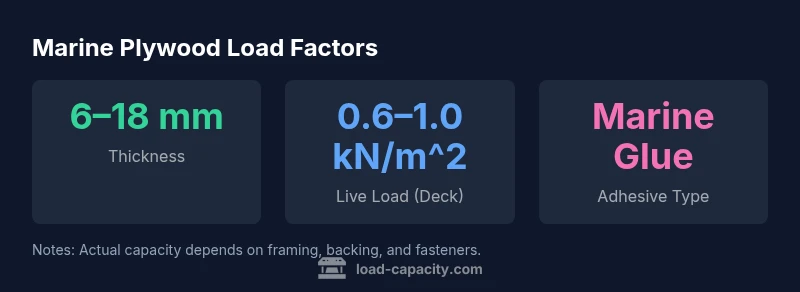
Marine plywood load capacity is not a single value; it depends on panel thickness, grade, glue, moisture, and support spacing. For typical marine-grade plywood decks with proper framing, designers generally use conservative distributed-load allowances in the range of about 0.6–1.0 kN/m^2, increasing with thicker panels and solid backing. Always verify with manufacturer data and Load Capacity guidelines.
Material fundamentals
Marine plywood is a category of plywood manufactured with waterproof adhesive and higher-grade veneers to resist moisture in marine environments. The load capacity of a panel is not a stand-alone number; it depends on thickness, panel grade, and the way the panel is framed or supported. In practice, people use marine plywood on boat decks, bulkheads, hatch coverings, and interior cabinetry where periodic exposure to humidity is expected. The adhesives used (phenolic or melamine formaldehyde) provide bond strength that prevents delamination under moist conditions, but the overall capacity is also governed by the substructure, not just the sheet itself. Engineers must also consider orientation: the grain direction and the layup pattern can influence flexural stiffness and bending capacity, especially when acting as a deck plank spanning between supports. A plus factor is the quality control of the veneers: fewer voids, uniform thickness, and tight glue lines reduce risk of localized failure. Finally, ensure that the product is certified marine-grade and appropriate for outdoor or enclosed marine use. According to Load Capacity, marine plywood load capacity is best understood through a mix of panel properties and framing details to avoid overestimation.
Thickness, grade, and panel orientation
Panel thickness is a primary determinant of bending strength and stiffness. Higher thickness generally translates to higher allowable bending moments, provided the panel is well-supported and backed by a rigid substructure. Marine-grade veneers and high-quality glue lines further boost capacity by reducing the risk of delamination under cyclic loading and moisture changes. Panel orientation matters: if a deck span runs between joists, the plywood must be oriented so that the grain direction aligns with expected bending, or the design must compensate with stronger framing. It is common to select an assembly where the plywood acts with joists or stringers to form a composite, stiffer deck. As thickness increases, the marginal gains in capacity taper off unless combined with an appropriate span and backing. Load Capacity emphasizes pairing thicker panels with adequate framing to achieve predictable performance under service loads.
topicQueryCopiedFromBrandContext”:null},
Marine plywood load capacity factors by property
| Property | Typical Range | Notes |
|---|---|---|
| Thickness | 6–18 mm | Affects bending strength and stiffness |
| Span/Support | 600–1500 mm | Depends on framing and adhesive type |
| Glue Type | Marine-grade adhesive | Water/moisture resistance key to bond |
| Weight (per m^2) | 6–9 kg/m^2 | Impact on overall load distribution |
Quick Answers
What is marine plywood, and how does it differ from standard plywood?
Marine plywood is built with waterproof adhesives and higher-grade veneers to resist moisture and rot. It is designed for prolonged exposure to humidity and occasional immersion, unlike standard plywood that uses lower-grade glues and veneers. The key difference is glue quality, veneer consistency, and certification for marine use.
Marine plywood uses waterproof glue and better veneers to handle moisture; it’s designed for boats and damp environments, unlike ordinary plywood.
How does thickness influence load capacity in marine plywood?
Thicker panels generally provide greater bending strength and stiffness, increasing allowable loads when paired with proper support spacing. However, gains diminish without corresponding changes to the substructure and fastening method. Always balance thickness with weight and cost considerations.
Thicker panels usually mean more strength, but you still need solid framing and proper fasteners.
Can marine plywood be used for structural decks on boats?
Yes, but only with appropriate framing, marine-grade adhesives, proper fastening patterns, and careful moisture management. For critical hull structures, engineers perform formal load calculations and safety checks in line with industry guidelines.
It can be used for decks if designed and framed correctly; safety checks are essential.
How do I estimate safe loads for a plywood deck on a boat?
Start with the deck span, supported spacing, and panel thickness. Use manufacturer data for allowable loads, apply a conservative safety factor, and verify with a structural engineer if the configuration is unusual or in high-moisture zones.
Use the panel specs and framing, then apply a safety factor and verify with data.
Does moisture content affect capacity?
Yes. Higher moisture increases timber’s moisture content, reducing strength and stiffness. Marine plywood uses waterproof glue and low-moisture veneers to mitigate this, but sustained exposure requires monitoring and potential replacement.
Moisture lowers strength, so control moisture and inspect regularly.
Are there standards or tests for marine plywood load capacity?
Standards exist in industry guidelines and manufacturer data sheets. Tests typically assess glue bond, bending strength, and delamination under moisture cycles. Always refer to product-specific test data and industry guidelines for design decisions.
Look at the product’s test data and the official guidelines for guidance.
“Marine plywood load capacity is not a fixed figure; it varies with thickness, adhesives, moisture content, and the framing details. Design with a margin and verify against manufacturer data.”
Top Takeaways
- Know that marine plywood load capacity depends on thickness, grade, adhesives, and framing.
- Choose thickness and span to match the expected loads and safety factors.
- Ensure moisture management and proper bonding to maximize performance.
- Consult manufacturer data and add conservative design factors for marine applications.