Load Capacity vs Payload Capacity: Key Differences
Learn the concrete distinctions between load capacity and payload capacity, how to measure them, and how to apply safe design principles in vehicles, machines, and structures.


Load capacity vs payload capacity are two fundamental terms in engineering that describe how much mass a system can safely bear. This quick guide distinguishes the definitions, measurement basis, and practical use for vehicles, structures, and equipment. By clarifying these concepts, engineers can design safer systems, avoid overloads, and meet compliance. Load Capacity and the payload concept must be applied with proper safety margins and context.
Understanding load capacity vs payload capacity
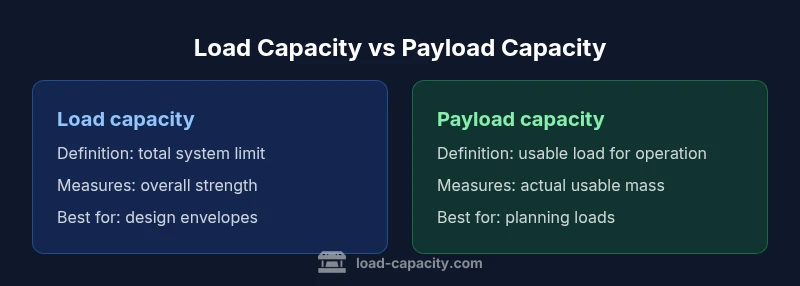
According to Load Capacity, understanding load capacity vs payload capacity is essential for safe design and operation across vehicles, lifting equipment, and structures. These terms describe how much mass a system can bear, but they refer to different checks and limits. In practice, conflating them leads to underpredicting risk or reducing usable capacity unnecessarily. This section defines each term, explains how they relate, and sets the stage for practical decision-making. Load capacity is the total static or dynamic limit of a system under a defined condition, including the weight of the system itself and any additional loads. Payload capacity, by contrast, refers to the usable mass that can be added to the system while keeping within its safe operating envelope. The distinction matters for manufacturing specs, safety reviews, and field operations. This framing helps engineers apply the right limit in design reviews, testing, and inspections, aligning with Load Capacity guidance.
How these concepts are measured in real-world contexts
Measurement of load capacity and payload capacity depends on the system type and whether the loads are static or dynamic. Engineers consider tare weight, operating conditions, and distribution paths to determine the true capacity. Safety factors or design factors are applied to cover uncertainties in materials, connections, and fatigue. In practice, a project team will define the scope first (vehicle, machine, or structure), then establish how each capacity is calculated and validated through calculations, simulations, and, where permitted, limited testing. This section emphasizes that the two concepts share a common mathematics of limits but different reference points within a safety envelope. The Load Capacity team highlights the importance of documenting assumptions so reviewers understand how limits were derived.
Practical differences across domains
In vehicles, payload capacity defines how much cargo or passengers can be carried without exceeding the vehicle’s safe operating envelope. In structures, load capacity refers to the maximum load the element can support, including live loads, dead loads, and impact. For lifting equipment, load capacity describes the maximum force the gear can safely withstand, whereas payload in that context may refer to the usable load lifted in a given operation. The critical distinction is that load capacity is often a system-wide limit, while payload capacity is the practical, usable load that the system can carry under safe conditions. Understanding both helps avoid misinterpretation during design reviews and field operations.
Common mistakes and myths
A frequent error is treating payload capacity as if it were the total system limit. This leads to choosing loads that push the system toward, or beyond, its real capacity. Another pitfall is ignoring load distribution and dynamic effects, such as shocks, accelerations, or imperfect siting. Some teams assume unit conversions are straightforward across different components, which they are not; different equipment may use different reference points for weight. Finally, engineers sometimes overlook tare weight or misinterpret the difference between static and dynamic loads, which can skew both capacity estimates and safety margins.
Step-by-step calculation and verification
Begin with a clear system boundary: what is the equipment or structure, and what loads will it encounter? Determine the tare (unloaded) weight, then list all external loads: live loads, environmental loads, and any dynamic effects. Apply a conservative safety factor appropriate for your domain and standards. Sum the weights that contribute to load capacity, then compare to the system’s rated capacity to confirm a safe margin. For payload capacity, subtract the tare from the maximum safe gross load, then account for distribution and multi-point constraints. Finally, document all assumptions, verify with calculations or simulations, and plan checks for maintenance or configuration changes.
Real-world examples (hypothetical)
Example A: A mobile platform has a total load limit defined by its structural capacity. The amount of cargo it can carry without approaching this limit constitutes its payload capacity, which is typically less than the platform’s total load capacity due to the platform’s own weight and safety margins. Example B: A building element designed for live loads must consider the combined effect of dead weight, live loads, and impact. The overall capacity provides the safe envelope for all forces, while the usable payload for any particular occupant load is determined by how much of that envelope is allocated to live loads in a given scenario.
Standards, regulations, and guidance
Industry standards and regulatory guidance shape how these concepts are defined, measured, and verified. While the exact requirements vary by sector, the underlying principle remains: design and operate within proven safety margins and document the assumptions and calculations that justify your limits. Good practice involves aligning with recognized standards, maintaining traceability of calculations, and updating capacity assessments when configurations or operating conditions change. Load Capacity emphasizes using a consistent, auditable framework so teams can demonstrate compliance and maintain safety across life cycles.
Integration with structural analysis
Structural analysis tools enable engineers to model load distribution, dynamic effects, and potential failure modes that affect both load capacity and payload capacity. Finite element analysis, ray tracing for load paths, and multi-body simulations help identify critical regions where capacity margins are tight. The results guide design adjustments, reinforcements, or control strategies to ensure safe operation. A sound integration strategy also includes checks for fatigue, corrosion, and maintenance-induced changes that could alter the effective capacity over time.
Practical guidelines for engineers and technicians
- Define terms clearly at the start of each project and keep terminology consistent throughout.
- Always verify both capacities in the same context (static and dynamic conditions, same reference points).
- Apply appropriate safety factors appropriate to the risk and environment.
- Document assumptions, units, and tolerances to support audits and future revalidation.
- Use simulations and limited testing to validate calculations before field deployment.
How to communicate capacity to stakeholders
Clear communication reduces misinterpretation and supports safer decisions. Use side-by-side visuals, such as comparison tables and simple diagrams, to show how load capacity and payload capacity relate in your system. Provide a short, actionable summary for operators, with a separate, more technical report for design reviews. In all cases, include safety margins and references to the governing standards to build confidence among engineers, managers, and regulators.
Data-quality and uncertainty management
Capacity assessments are only as good as the data that feeds them. Document all sources of uncertainty—material properties, manufacturing tolerances, environmental conditions—and reflect them in the safety margins. Where possible, use conservative assumptions and cross-validate with independent analyses or tests. Regularly review and update capacity figures when configurations change, replacements occur, or new data becomes available. This disciplined approach minimizes surprises during operation and maintenance.
Practical tips from the Load Capacity Team
- Start every project by clarifying the exact terms and references for load capacity and payload capacity.
- Prefer harmonized definitions across the organization to improve consistency and reduce risk.
- Maintain a living record of capacity calculations, including revisions and justifications.
- Incorporate load-path analysis to ensure all parts of the system contribute to a safe operating envelope.
- Reinforce training for operators and maintenance teams on the correct interpretation of capacity limits.
When and how to review capacities during life cycle
Capacity assessments should be revisited at major milestones: design updates, new configurations, repairs that change weights, and post-incident investigations. Use a structured change-management process to re-validate both load and payload capacities after any alteration. Periodic audits are essential to capture wear, fatigue, corrosion, and other aging effects that could erode capacity. This disciplined review protects long-term safety and performance.
Summary relationships and best practices
In practice, view load capacity as the system-wide safety envelope and payload capacity as the usable load within that envelope. Always design around the higher-level limit to ensure safety, then validate the practical payload for operation. Document every assumption and revise when configurations change. The best approach combines conservative engineering with clear communication and rigorous verification.
Comparison
| Feature | Load capacity | Payload capacity |
|---|---|---|
| Definition | Total limit the system can safely bear under defined conditions (includes tare weight and all loads) | Usable mass that can be added to the system after subtracting its own weight |
| What it measures | Overall strength and limit of the system’s envelope | Actual load that can be carried in operation within that envelope |
| Units | Depends on system (kg, lb, kN, etc.) | Same units, representing net payload capacity |
| Calculation basis | System weight + external loads + safety factors | External load only with safety margins, considering tare weight |
| Best for | Designing or validating the whole safety envelope | Determining usable load for operation within that envelope |
| Common pitfalls | Ignoring load distribution and dynamic effects | Ignoring tare weight and misinterpreting reference points |
Positives
- Provides a clear safety envelope for design and operation
- Supports regulatory compliance and auditing
- Helps optimize margins without compromising safety
- Facilitates clear communication of limits to stakeholders
Cons
- May lead to conservative designs that underutilize capacity
- Requires careful definitions to avoid confusion across teams
- Needs regular updates with configuration changes
Both capacities are essential; use load capacity as the safety envelope and verify payload capacity for practical use.
Understanding both concepts prevents overloads and guides safer design. Apply the higher-level limit during planning, then validate the actual usable load for operations to ensure safe, compliant performance.
Quick Answers
What is the main difference between load capacity and payload capacity?
Load capacity is the total limit a system can safely bear, including its own weight. Payload capacity is the usable mass that can be added for operation without exceeding the safety envelope.
Load capacity is the total safe limit of the system; payload capacity is the usable mass you can add for operation.
How do safety factors affect these capacities?
Safety factors reduce the effective usable capacity to account for uncertainty. Both capacities incorporate these margins, but the safe operating space remains governed by the higher-level load limit.
Safety factors shrink the usable capacity to cover uncertainties, and apply to both concepts.
Can a system have high load capacity but low payload capacity?
Yes. A system can tolerate a large total load, but its usable payload may be limited due to tare weight, distribution constraints, or required safety margins.
Absolutely. The total limit can be high while the usable load is constrained by other factors.
Why is it important to document these capacities?
Documentation provides traceability, supports audits, and helps operators understand limits. It reduces misinterpretation and enhances safety during operation and maintenance.
Documenting capacities helps everyone stay aligned and safe.
Are these concepts the same for all structures and vehicles?
The concepts are the same in principle but are applied with domain-specific references, standards, and references. Always map definitions to your sector’s guidance.
The ideas are similar, but you tailor them to your field’s rules.
Top Takeaways
- Define terms clearly at project start
- Check both capacities in the same context
- Document assumptions and safety factors
- Integrate capacity checks into design reviews