Load Capacity of 3/8 Threaded Rod: Calculation Guide
Estimate the load capacity of a 3 8 threaded rod with guidance on material grades, WLL calculations, safety factors, and practical design tips for engineers and technicians.


The load capacity of a 3 8 threaded rod depends on material grade, thread engagement, and the applied safety factor. For common steel grades, working load limits typically fall in the range of roughly 600 to 1,200 pounds-force per rod in tension, assuming standard engagement and dry conditions. Always verify with material specs and a professional analysis.
What affects the load capacity of 3 8 threaded rod
Engineers must account for several interacting variables when estimating the load capacity of a 3 8 threaded rod, including material grade, thread form, engagement length, and environmental conditions. The nominal diameter is fixed, but the actual load-bearing capacity can vary by a factor of two or more depending on these inputs. For a baseline, most practitioners rely on material properties and a chosen safety factor to derive an applicable working load limit (WLL). This section explains the main drivers and how to apply them in practice.
Material options and their impact on capacity
Common options for a 3/8" threaded rod include carbon steel grade 2, higher-strength alloy steel (grade 5), and stainless steel (304/316). Carbon steel Grade 2 often provides adequate capacity for general purposes, with a tensile strength in the lower range. Grade 5 alloy offers higher strength and greater WLL potential, but requires careful selection of safety factors. Stainless steel improves corrosion resistance, which matters in humid or chemical environments. The tensile strength ranges vary by material, and the exact WLL is a function of both strength and safety factor.
Thread engagement, nut engagement, and installation considerations
The capacity gains from engagement are real: more threaded engagement into the nut or base material generally yields higher effective cross-sectional area engaged in resisting tension. Ensure the nut and termination accept the rod diameter without stripping threads. Avoid cross-threading and use proper lubricants where appropriate to maintain thread integrity. Temperature and corrosion can degrade engagement behavior over time, so installation should account for service conditions and inspection intervals.
Calculating working load limit (WLL) for 3/8 rod
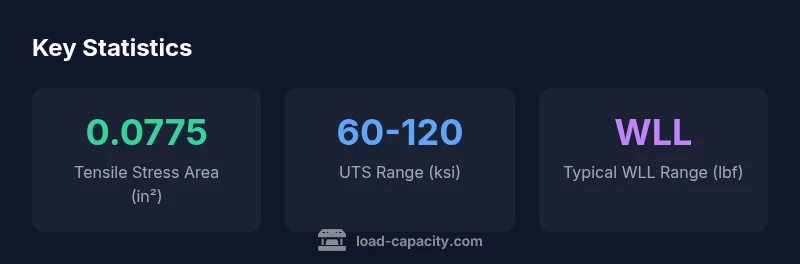
A practical WLL calculation starts with the tensile stress area for 3/8-16 UNC threads, which is 0.0775 square inches. Next, select a material UTS (ultimate tensile strength) from the material grade data; common values range from roughly 60–70 ksi for carbon steel to 75–90 ksi for stainless steel. The nominal tensile capacity is UTS × A. Apply a safety factor (SF) appropriate to the application; for non-critical uses a SF of 4:1 to 5:1 is typical. Formally, WLL = (UTS × A) / SF. For example, a 3/8 carbon-steel rod with UTS around 60–70 ksi and SF of 4 yields a WLL in the neighborhood of 900–1,200 lbf.
Environmental factors: temperature, corrosion, and aging
Material strength and behavior change with temperature. Elevated temperatures generally decrease strength and long-term performance; cryogenic or extreme low temperatures can alter ductility. Corrosion initiates material loss and may reduce effective cross-section, especially in aggressive environments. Aging and wear from repeated loading cycles can degrade threads and nut engagement. In such cases, conduct periodic inspections and consider protective coatings or corrosion-resistant materials.
Safe design practices and common pitfalls
- Use the correct material grade for the service environment and load profile.
- Apply an appropriate safety factor based on risk, consequences of failure, and redundancy.
- Verify thread engagement length and ensure proper installation procedures, including torque control where applicable.
- Inspect for corrosion, galling, or wear that could reduce capacity over time.
- Avoid using damaged or deformed rods; replace promptly.
Practical tips for field and workshop use
- Maintain clean threads and use compatible lubricants to minimize galling and wear.
- Keep the rod clean and protected in corrosive or harsh environments; choose stainless or coated options when possible.
- Document WLL calculations and the assumed SF for each installation, especially in critical applications.
- Perform periodic inspections and torque checks to ensure continued performance.
Verification and testing methods for threaded rod assemblies
Where safety or critical performance is involved, verification through testing is prudent. This can include torque-tension checks, static load tests on representative samples, and non-destructive inspection of threads. Compare measured results against calculated WLL, and document discrepancies for future design adjustments.
Material options for 3/8 threaded rod and their relative load capacity
| Material/Grade | Tensile Strength (ksi) | Tensile Stress Area (in^2) | Estimated WLL (lbf) | Notes |
|---|---|---|---|---|
| 3/8'' Carbon Steel Grade 2 | 60-70 | 0.0775 | ~900-1250 | Baseline rod; common in non-critical uses |
| 3/8'' Grade 5 Alloy Steel | 105-120 | 0.0775 | ~1500-2100 | Higher strength, requires careful safety factor |
| 3/8'' Stainless Steel (304/316) | 75-90 | 0.0775 | ~1200-1600 | Corrosion resistant |
Quick Answers
What is the load capacity of a 3/8 threaded rod in tension?
It varies with material grade and the chosen safety factor. For common steel rods, the working load limit generally falls within the 600–1,200 lbf range per rod under standard conditions.
Depends on material and safety factor; typical WLL lies between six hundred and twelve hundred pounds-force.
How does temperature affect load capacity?
Material strength changes with temperature. Higher temperatures usually reduce strength and long-term performance; see material data and factor adjustments for your service range.
Temperature can change strength; use temperature-adjusted factors in calculations.
What safety factor is typical for non-structural uses?
Common practice uses a safety factor around 4:1 to 5:1, depending on load type, consequences of failure, and codes or standards.
A typical safety factor is 4:1 to 5:1.
Does coating or corrosion affect load capacity?
Coatings mainly improve corrosion resistance; in severe corrosion, capacity can be reduced. Choose appropriate material and inspection for the service environment.
Coatings help with corrosion; severe corrosion can lower capacity.
How do you calculate WLL for a 3/8 rod?
Use WLL = (UTS × A) / SF, where UTS is material strength and A is the tensile stress area (0.0775 in² for 3/8-16 UNC). Apply a suitable safety factor.
WLL is UTS times area divided by a safety factor.
“Threaded rod load capacity is governed by material strength, thread engagement, and safety factors; always verify with established calculations and standards before use.”
Top Takeaways
- Identify material grade to estimate WLL accurately
- Apply correct safety factors per application
- Engagement length and thread quality affect capacity
- Temperature and environment can alter strength
- Use formal calculations or professional guidance for critical loads