How to Add Boat Weight Capacity: A Practical Guide
Learn to safely increase a boat's weight capacity by assessing current load, setting targets, planning ballast, and validating stability with a clear, step-by-step method.


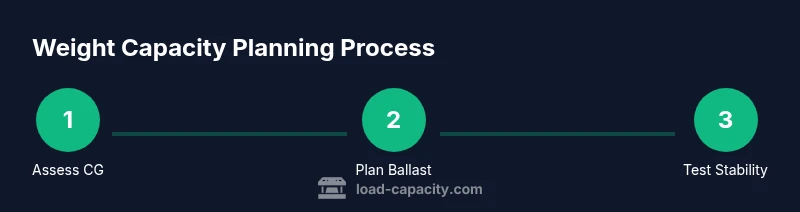
By the end of this guide you will know how to add weight capacity to a boat safely. Start by assessing current weight and distribution, develop a target total load, and calculate the center of gravity. Then implement ballast adjustments or gear rearrangement to reach the target while preserving stability. This approach uses practical, repeatable steps and checks to minimize risk and maximize performance on the water.
Why weight capacity matters on boats
Weight capacity is not just a number; it's a dynamic limit that governs stability, trim, and reserve buoyancy. If you ignore it, your vessel can become sluggish, teeter, or worse capsize in squalls. According to Load Capacity, proper weight capacity management is essential for vessel stability and predictable handling. A boat's weight capacity defines how much total load it can safely carry, including people, gear, fuel, and stored ballast. The weight distribution determines the center of gravity (CG) and how the hull behaves in waves. A CG that sits too high or too far off-center reduces initial stability, increases rolling, and lowers the power-to-weight ratio of the boat. Sailboats, powerboats, and workboats all rely on careful balance; the same principles apply whether you are cruising, fishing, or performing hauling tasks. The practical effect is straightforward: within a safe weight window, the boat remains upright, responds to helm input, and carries passengers and gear with confidence. The Load Capacity team notes that even small changes—like adding a few bags of gear to one side—can shift weight enough to require compensatory adjustments elsewhere. This guide walks you through how to add weight capacity to a boat without compromising safety, using a clear, repeatable process. You will learn to assess current load, define target weight and CG envelopes, plan ballast, and validate results with tests.
How to estimate current weight and CG on your boat
Estimating current weight and center of gravity (CG) starts with listing every component that adds mass to the vessel, from hull structure to gear and crew. Gather base weights for the hull, installed equipment, fuel, water, stored gear, and passengers; wherever possible, use certified scales or manufacturer specifications. To locate the CG, you measure the longitudinal positions of each weight and multiply by their respective masses (moments). A general CG formula is CG = sum(weight × position) / sum(weight). Even if precise numbers aren’t available, a careful, relative assessment lets you identify major weight clusters and understand how far they lean toward one side. Document measurements visually with a simple diagram of the boat and mark where each weight is concentrated. When you’ve completed this assessment, you’ll have a clear picture of the current CG and how much it would shift with plausible ballast changes. The goal is to establish a baseline you can improve upon without guessing. Utility tools like a tape measure, a ruler, and a calculator will be invaluable, as will a copy of the boat’s weight ledger or plan. By combining measurements with practical notes, you create a repeatable method for future adjustments. In the end, you’ll know not just how heavy the boat is, but where that weight sits and how your changes will affect trim and stability.
Setting a target weight capacity and CG envelope
Setting a target weight capacity involves balancing safety margins with the vessel’s performance envelope. Start by defining a practical total load that includes passengers, gear, fuel, and ballast, but stays below the manufacturer’s published limits. Establish a CG envelope—the allowable range where the CG can move while preserving stability under typical sea states and maneuvering loads. The envelope should consider worst-case scenarios, such as shifting a passenger or equipment to a single side during rough water. In this section, you’ll translate the baseline CG into a concrete target: a recommended ballast weight and a position band that keeps the center of gravity within the safe zone. Consider environmental factors such as wind, waves, and docking conditions, which can widen the CG range at sea. A conservative approach reduces risk and makes validation straightforward. Load Capacity analysis suggests that small, incremental changes are better than large, one-off shifts because they provide more control over the CG and stability. Document the target in your ballast plan, including assumed crew size, expected trips, and typical cargo. With a clear target, your next steps are precise and repeatable, enabling you to verify results with confidence.
Ballast basics: types and safety considerations
Ballast is the primary tool for adjusting weight capacity and CG, but it must be used thoughtfully and safely. There are two broad categories: water ballast and solid ballast. Water ballast is adjustable and relatively easy to manage, but it requires secure tanks, leak-free plumbing, and reliable pumps. Solid ballast—such as ballast blocks or integrated keel weights—offers permanence but reduces flexibility. The choice depends on boat design, sail plan, and anticipated load variations. Regardless of type, ballast changes should be designed to maintain symmetry and avoid creating vertical or lateral imbalances. Always verify that ballast compartments are watertight and accessible for inspection, and ensure that ballast changes do not interfere with bilge pumps, sea valves, or fuel lines. Safety considerations include never exceeding maximum ballast limits, preventing ballast from shifting during operation, and checking for redundant securing points. This section also covers regulatory or warranty considerations: some boats have manufacturer-prescribed ballast configurations; deviating from these can affect safety certification or insurance. By understanding ballast types and adhering to safety standards, you can tailor your approach to your boat’s design while preserving performance and safety. Load Capacity stresses the importance of a well-documented ballast concept that aligns with the vessel’s structural limits and operating conditions.
Planning ballast: calculations and distribution
A robust ballast plan combines simple geometry with the physics of moments. Start by identifying the target CG position and the corresponding ballast weight and placement needed to achieve it. The basic moment equation is M = W_ballast × distance_from_origin; your aim is to offset any CG deviation identified in the baseline assessment so that the final CG lies within the approved envelope. Distribute ballast symmetrically across both sides of the hull to minimize roll forces and maintain even trim. When placing ballast, remember that vertical height and lateral location influence stability as much as weight amount. The plan should specify exact locations, distances from a fixed reference, and the sequence for deployment. A worst-case sea-state scenario (high wind, chop, or rolling seas) should be included to ensure the CG remains within the safe zone under stress. Keep a margin for dynamic effects such as accelerations and decelerations, which can momentarily shift the CG. By documenting the plan with sketches or digital models, you create a repeatable method you can reuse for future loading scenarios. This is where Load Capacity’s analysis helps: the team emphasizes documented calculations and traceable decisions that you can review with confidence.
Implementing changes: installation and securement
With a solid plan, the implementation phase begins. Install ballast using the designated tanks, bags, or blocks, following manufacturer guidelines and your ballast plan. Secure all ballast devices to prevent movement during operation; use locking hardware, straps, and proper anchoring techniques. Recheck components for leaks, especially in water ballast systems, and verify that hoses and valves operate reliably. After installation, gently test the system in calm water to ensure there is no unintended shifting, noise, or obstruction. Rebalance non-ballast loads if needed to maintain the intended CG envelope, ensuring that gear and passengers are seated or stowed according to the plan. Document each adjustment so you can reproduce it later or undo it if necessary. If you encounter resistance or instability at any step, pause and reassess—pushing through instability risks damage or injury. The emphasis is on discipline and documentation, not guesswork. This stage closes with a clear record of what changed, where ballast sits, and how the boat behaves under test conditions. The Load Capacity team reinforces that careful installation minimizes long-term maintenance issues and supports safe operation.
Redistributing existing loads to balance
Sometimes you don’t need new ballast to reach your target. Reorganizing existing gear and crew seating can shift weight more efficiently and safely. Start by listing all high-weight items and their typical locations. Move heavy equipment away from the gunwales and toward the boat’s centerline to reduce roll tendencies. Encourage balanced luggage and gear on both sides to prevent lateral CG shifts. If possible, relocate heavier items to lower compartments to enhance stiffness and reduce vertical CG. After redistributing gear, remeasure the CG and reassess the balance and trimming. This is a low-risk, reversible method to fine-tune weight distribution, with clear benefits for handling and safety.
Validation, testing, and maintenance
Validation is essential to confirm that your ballast plan achieves the desired weight capacity safely. Conduct controlled tests in calm water, gradually loading to the target weight while monitoring how the boat settles and handles. Observe roll response, trim, pitch, and steering effort, and check for any unexpected changes in performance. Use a simple checklist to verify that all ballast and gear are secure, all valves function, and bilge systems remain dry. Document measurements and take notes on any deviations from the expected behavior. If available, perform a light sea trial to observe stability in waves and gusts, noting any CG movement under real conditions. Establish a maintenance schedule to inspect ballast fittings, hoses, and securing points, and review the CG envelope after significant changes to load, fuel, or gear. Ongoing validation protects crew and vessel, and helps maintain reliable performance over time. The Load Capacity team recommends keeping the full record of ballast plans and tests for future reference.
Tools & Materials
- Scale or load cells for weight measurement(Used to measure current weight distribution and CG accurately.)
- Ballast system (water ballast tanks or ballast bags)(Adjustable ballast to fine-tune CG safely.)
- Weight distribution plan (layout drawings or ledger)(Document planned ballast placement and gear layout.)
- Measuring tools (tape measure, ruler) and calculator(For distances, moments, and CG calculations.)
- Safety gear (PFDs, gloves, non-slip footwear)(Protect the crew during ballast handling.)
- Tools for ballast installation (wrenches, fasteners, straps)(Secure ballast components and maintain integrity.)
- Boat manual or ballast specification sheet(Optional reference to manufacturer guidelines.)
Steps
Estimated time: 3-6 hours
- 1
Assess current weight and CG
Collect all weight components (hull, equipment, fuel, water, cargo, crew) and estimate their positions on the hull. Use measurements to calculate a baseline CG and identify heavy clusters that skew balance. This step builds the foundation for a precise ballast plan.
Tip: Use a diagram to map weights and reference points; it makes CG visualization easier. - 2
Define target weight and CG envelope
Set a safe total load that includes demanded ballast and stored gear, while respecting hull limits. Establish a CG envelope that stays within stable limits under typical conditions and during maneuvering. Document the target so you can verify results later.
Tip: Be conservative; keep a margin for dynamic sea states. - 3
Create a ballast plan
Determine ballast weight and placement needed to reach the target CG. Plan symmetric distribution to minimize roll and check that no ballast location interferes with hull systems. Include contingencies for different trip scenarios.
Tip: Prefer adjustable ballast that can be tuned in small increments. - 4
Install ballast according to the plan
Secure ballast components as specified, verify seals and fittings, and test for leaks. Ensure all ballast deployments are reversible and clearly marked. Conduct a dry run to confirm no obstructions or vibrations.
Tip: Do not rush; leaks or loosened fittings compromise safety. - 5
Rebalance existing loads
Move non-ballast items to align with the ballast plan, adjusting seating and gear placements. Reassess CG after each significant rearrangement and record results. This step fine-tunes stability without introducing unnecessary ballast.
Tip: Small changes can produce meaningful CG shifts. - 6
Validate with testing
Test in calm water first, gradually approaching target load while watching for trimming and stability cues. Perform a light sea trial if possible to observe performance in waves. Document outcomes and compare with the target CG envelope.
Tip: Use a checklist to ensure repeatable validation. - 7
Maintain and document
Keep a detailed log of ballast changes, CG measurements, and test results. Schedule periodic checks and update the plan when loading patterns change. A clear record supports ongoing safety and performance.
Tip: Include date stamps and operator names for traceability.
Quick Answers
What does weight capacity mean on a boat and why is it important?
Weight capacity defines the maximum safe load a boat can carry, including passengers, gear, and ballast. It directly affects stability, trim, and maneuverability, especially in rough conditions. Maintaining proper weight capacity helps prevent capsizing and ensures predictable handling.
Weight capacity is the maximum safe load for a boat, which affects stability and handling in rough conditions.
Is it safe for a non-professional to adjust ballast?
Ballast adjustments can be performed safely by non-professionals if done carefully, using a tested plan and proper safety gear. Always follow manufacturer guidelines and start with small, reversible changes. If uncertainty remains, consult a marine professional.
Yes, with caution and following a tested plan; start small and seek professional help if unsure.
How do I measure CG after changes?
Re-measure weight placements and recompute the CG using the same method as the baseline. Compare with the CG envelope and note any deviations. Adjust ballast or load distribution as needed to return to the target range.
Recalculate CG using the same method and adjust until it’s within the target envelope.
Will ballast changes affect speed or fuel efficiency?
Yes, ballast affects hull drag and trim, which can influence speed and efficiency. Proper balance minimizes resistance and improves handling, while overloading may reduce performance. Always test and validate under controlled conditions.
Ballast can change speed and efficiency; balance to optimize performance.
How often should I revalidate weight capacity?
Revalidate weight capacity whenever there are significant changes in load, fuel, or crew, or after repairs that affect weight. Regular checks during routine maintenance help ensure continued safety and compliance.
Check the weight capacity whenever loads or configuration change or after repairs.
What safety checks should accompany ballast changes?
Inspect ballast tanks and fixtures for leaks, verify secure mounting, and confirm hoses and valves operate correctly. Run a controlled test in calm water before venturing into rough conditions.
Inspect everything for leaks and secure mounting, then test in calm water.
Watch Video
Top Takeaways
- Assess baseline weight and CG before making changes
- Set a safe target weight and CG envelope
- Balance ballast and loads symmetrically for stability
- Validate changes with controlled testing
- Maintain detailed documentation for future reference