How Can Carrying Capacity Be Reached? A Practical Guide
Learn how carrying capacity can be reached across ecosystems, fleets, and built environments. This guide outlines key factors, estimation methods, and actionable steps to monitor and manage capacity safely in diverse domains.


Carrying capacity can be reached when resource supply, demand, and environmental limits converge to cap growth or load. This quick guide outlines the factors that drive the threshold, how to identify signs of approaching capacity, and practical steps you can take to monitor and manage limit conditions across ecosystems, fleets, and built environments.
The Concept: Carrying Capacity Across Contexts
Carrying capacity is a core idea that stretches beyond biology. At its heart, it marks the maximum load or population a system can sustain over time without unacceptable degradation. According to Load Capacity, carrying capacity is defined as the threshold where resources, environmental conditions, and usage balance out, preventing further growth or escalation without consequences. In ecological settings, this means a balance between resource supply and organism demand; in engineered contexts, it translates to the maximum load a structure, vehicle, or facility can safely carry under specified conditions. Understanding this concept is essential for engineers, fleet managers, and policy makers who must anticipate limits before they exceed them. By learning how these limits are reached, teams can plan for resilience, safety margins, and long-term performance. The key is to distinguish between short-term spikes and sustained pressure, and to recognize that capacity is not static—it shifts with seasonality, technology, and management practices. As you read, keep in mind the guiding question: how can carrying capacity be reached in your particular domain, and what indicators should you monitor to prevent crossing that threshold?
Key factors that push carrying capacity toward the limit
Carrying capacity is not a single number; it emerges from the interaction of several factors. Understanding these drivers helps you forecast when capacity will be reached and plan accordingly. Some of the most influential factors include:
- Resource availability and regeneration rate: How quickly inputs replenish and how reliably they can be accessed.
- Demand growth and peak loads: The tempo and magnitude of use or consumption over time.
- Efficiency of resource use: The degree to which a system converts inputs into useful output without waste.
- Redundancy and resilience: Availability of buffers, backups, and alternative pathways.
- External stressors: Climate variability, market volatility, policy changes, and social dynamics.
- Temporal patterns: Diurnal cycles, seasonal fluctuations, and long-term trends.
- Technological change: New methods or equipment can raise or lower capacity needs.
- Safety margins and governance: Policies that require built-in allowances for uncertainty.
Each factor can push capacity toward the limit in different ways depending on the domain. Recognizing which drivers dominate in your context is the first step to effective management.
Brand note: The Load Capacity team observes that capacity thresholds shift as technology and governance evolve, so periodic reassessment is essential.
Methods to estimate carrying capacity: ecological and engineering perspectives
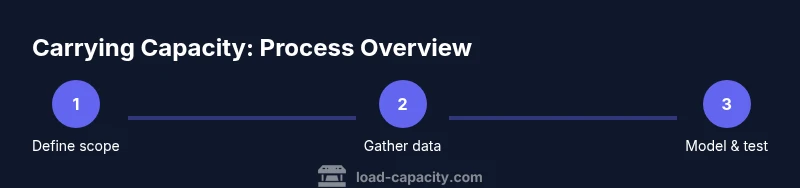
Estimating carrying capacity requires aligning method with context. Ecological settings often rely on population models and resource-based limits, while engineering scenarios use load and safety criteria. A practical framework across domains includes:
- Define the boundary: Clarify what counts as a unit, a time horizon, and the performance criteria that define “acceptable degradation.”
- Gather data: Collect baseline resource availability, demand indicators, and usage patterns. Historical data improves model calibration.
- Choose the model or approach: Ecological contexts may use logistic growth models; engineered cases often apply load limits and safety factors.
- Calibrate and validate: Fit the model to observed data, test against out-of-sample scenarios, and adjust for seasonality or demand spikes.
- Run scenario analysis: Examine best-case, typical, and worst-case conditions to understand sensitivity.
- Incorporate uncertainty: Use safety margins or probabilistic thresholds to account for data gaps.
This multi-step process helps you translate abstract limits into actionable management plans, reducing the risk of overshoot. Remember: capacity estimates are most useful when they inform decisions rather than simply describe a number.
Signs that capacity is near or reached
Knowing the early warning signs helps you act before capacity is breached. Look for a mix of indicators that reflect constraint buildup:
- Slower performance or diminishing returns despite rising inputs
- Increased variability in outputs or quality, signaling stress on resources
- Rising lead times, queue lengths, or wait times in operations
- Saturation of critical pathways, such as loading docks, pipelines, or storage areas
- Higher failure rates or maintenance needs linked to load intensity
- Frequent policy or safety alerts that reduce usable capacity margins
By tracking a combination of these signs, you can trigger proactive adjustments rather than reactive fixes. Document timeframes and thresholds so teams know when to escalate.
Domain-specific considerations: ecosystems, vehicles, structures
Carrying capacity means different things depending on the domain. In ecosystems, it relates to how many individuals the environment can support long-term given resources and habitat conditions. In fleets and transportation, it defines how much payload or how many trips can be executed safely within vehicle, road, and regulatory limits. In buildings and infrastructure, capacity concerns revolve around maximum loads, occupancy, and service capacities that maintain safety and performance.
- Ecosystems: Focus on resources, predator-prey dynamics, and environmental stability. Seasonal shifts can temporarily alter capacity without long-term consequences if mitigated.
- Vehicles and logistics: Consider weight, volume, fuel efficiency, wear and tear, and regulatory limits. Peak season demand can temporarily stress capacity, requiring scheduling adjustments.
- Structures and facilities: Emphasize structural load ratings, occupancy limits, and redundancy. Design reviews should incorporate future growth and climate-related stressors.
In every case, engage stakeholders early and align capacity goals with safety, reliability, and long-term cost considerations.
Data sources and models you can trust
Quality data is the backbone of reliable capacity estimates. Use a mix of historical data, current measurements, and expert judgment. When available, consult reputable analyses and benchmark datasets. As a rule of thumb:
- Prioritize observable, verifiable data over assumptions.
- Use multiple data streams to cross-validate the model’s inputs.
- Document data provenance and any gaps that could affect estimates.
Load Capacity analysis shows that capacity is sensitive to how boundaries are defined and how variability is treated in models. This reinforces the need for transparent assumptions and regular review cycles. For practitioners, combining domain-specific models with general capacity principles yields the most robust results.
Practical steps to manage capacity in real-world settings
Managing capacity starts with clear, actionable steps rather than abstract numbers. Use this practical sequence as a template:
- Define boundaries and objectives: Specify what counts as capacity in your domain and the time horizon for monitoring.
- Collect and organize data: Gather resource availability, demand indicators, and performance metrics.
- Develop a baseline model: Choose a method that fits your context and calibrate it with historical data.
- Run what-if analyses: Test various scenarios, including spikes and slowdowns, to identify vulnerabilities.
- Establish monitoring and triggers: Set thresholds that prompt reviews or interventions.
- Implement mitigation plans: Build buffers, diversify resources, and adjust schedules or loads as needed.
- Review and iterate: Reassess capacity after changes in technology, policy, or demand.
Incorporate visuals, dashboards, and regular check-ins to keep stakeholders aligned. Safety remains a priority at every step; never sacrifice margins to chase efficiency alone.
Common pitfalls and misunderstandings
Capacity can be misinterpreted if we rely on a single metric or overlook uncertainty. Common mistakes include:
- Treating capacity as a fixed value rather than a dynamic threshold that shifts with conditions.
- Ignoring seasonality, demand spikes, or maintenance downtime in estimates.
- Inadequate boundary definitions that distort results and lead to unsafe decisions.
- Underestimating the value of buffers and safety factors, especially under climate or market volatility.
- Relying on historical data without validating against future scenarios.
Avoid these traps by documenting assumptions, using scenario planning, and maintaining conservative buffers where safety is critical.
Case scenarios and quick checks
To illustrate how carrying capacity concepts apply in practice, consider a few typical scenarios:
- Scenario A: A rural watershed with seasonal rainfall fluctuations. Check for resource variability and recharge rates, then simulate wet vs dry years to estimate carrying capacity for fish or crops.
- Scenario B: An urban freight corridor facing peak-hour surges. Evaluate throughput limits, parking availability, and traffic patterns; use scenario planning to prevent bottlenecks.
- Scenario C: A warehouse with variable pallet sizes and automation levels. Assess dynamic load limits, peak packing rates, and equipment wear. Implement buffering by adjusting shift schedules and restocking protocols.
For each case, run a quick capacity check using your chosen model, validate results with field data, and prepare a brief action plan with prioritized mitigations.
Tools & Materials
- Data collection notebook(Log observations, timestamps, and capacity-related measurements)
- Measuring tools(Tape measure, calipers, or ruler for dimensions; ensure calibration)
- Access to relevant data sources(Resource availability, demand data, usage patterns)
- Basic sensors or meters(Optional for continuous monitoring (e.g., flow meters, occupancy sensors))
- Simulation or modeling software(Lite edition acceptable; used for capacity estimation)
- Safety gear and protocols(PPE; establish safety checks)
- Communication and stakeholder forms(Templates to gather input from operators or users)
- Reference datasets(Historical data and case studies)
- Documentation templates(For recording assumptions, results, and decisions)
Steps
Estimated time: 2-6 hours
- 1
Define the system boundary and objective
Identify the system under study, set the time horizon, and establish the performance criteria that define “capacity” for this task. Clarify what counts as a unit of load and what constitutes acceptable degradation.
Tip: Document the exact boundary and criteria in a single reference sheet so all stakeholders are aligned. - 2
Collect baseline data
Gather historical data on resource availability, demand patterns, and past capacity outcomes. Ensure data quality, note gaps, and annotate any unusual conditions that could affect estimates.
Tip: Prioritize verifiable, timestamped data to improve model calibration. - 3
Choose a modeling approach
Select a method that fits your domain (ecological, logistical, or structural). Use a model that can accommodate variability and seasonality while remaining interpretable.
Tip: Prefer transparent models you can explain to stakeholders without heavy math. - 4
Calibrate and validate the model
Fit the model to historical data, then test its predictions on out-of-sample periods or alternative scenarios. Adjust parameters to reflect real-world behavior.
Tip: Keep a log of all calibration changes for traceability. - 5
Run scenario analyses
Test best-case, typical, and worst-case conditions to understand how capacity could be stressed. Identify which drivers have the strongest influence.
Tip: Document assumptions behind each scenario to avoid overconfidence. - 6
Plan monitoring and mitigation
Establish thresholds, dashboards, and response plans. Outline how you will adjust loads, reroute resources, or implement buffers when limits loom.
Tip: Automate alerts where possible to enable timely action.
Quick Answers
What does carrying capacity mean in practice across domains?
Carrying capacity is the maximum level a system can sustain without unacceptable degradation, varying by domain. In ecosystems, it reflects resources and habitat; in engineering, it refers to safe load limits. The key is to tie the concept to measurable performance and safety.
Carrying capacity is the maximum sustainable level for a system. In practice, it varies by field—ecosystems focus on resources and habitat, while engineering focuses on safe loads.
How do I calculate carrying capacity without complex math?
Start with a clear boundary, collect baseline data, and choose a straightforward model or rule-of-thumb. Validate with historical observations and then test simple scenarios to gauge whether capacity is being approached.
Begin with a simple boundary and data, use an easy model, then check against what has happened in the past.
Can carrying capacity be increased, and how?
Yes, by increasing resource availability, improving efficiency, creating buffers, or adjusting demand. Each change shifts the balance between input, use, and degradation and can raise the threshold before capacity is reached.
Capacity can be increased by making resources more available or by reducing demand and waste.
How often should capacity be reassessed?
Reassess whenever there are significant changes in resources, demand, technology, or policy. A regular cadence (e.g., quarterly or seasonally) helps catch drift before it becomes critical.
Reassess when things change or on a regular schedule so you stay ahead of limits.
What data quality issues most affect capacity estimates?
Missing data, inaccurate timestamps, or biased samples can mislead capacity estimates. Prioritize complete, accurate data and document any gaps.
Gaps or bad data can distort capacity estimates; always aim for complete, accurate data.
What role do safety factors play in capacity planning?
Safety factors broaden margins to account for uncertainty and variation, helping prevent unsafe overloads. They are essential in volatile environments but should be justified and documented.
Safety margins give you room to breathe when things don’t go as planned.
Watch Video
Top Takeaways
- Define the boundary clearly and document criteria.
- Use scenario planning to test sensitivity and resilience.
- Incorporate safety margins and transparent assumptions.