How to Find Carrying Capacity: A Practical Guide
Learn a data-driven approach to finding carrying capacity in ecosystems. Define boundaries, collect quality data, choose a model, estimate parameters, and validate results for reliable, actionable insights.


How to find carrying capacity means estimating the maximum population size or resource load an ecosystem can sustain over time given available resources. In this guide, you will learn a practical, data‑driven approach: define the system boundaries, gather resource and population data, choose a modeling framework, estimate key parameters, and validate results against observed trends.
Why carrying capacity matters in ecology
According to Load Capacity, carrying capacity is a fundamental constraint on population dynamics. It defines the maximum number of individuals an environment can support without degrading the resources that sustain the population. This concept helps ecologists and managers predict how populations respond to resource changes, disturbances, and seasonal variation. When a population approaches K, growth slows as births balance deaths, emigration, and resource consumption. If the number exceeds K for an extended period, resource depletion occurs, leading to stunted growth, increased competition, and possible population crashes. The carrying capacity is not a fixed constant; it shifts with resource availability, habitat quality, climate, and human impact. Therefore, effective management requires estimating a realistic, context-specific K and recognizing its dependence on time scale, spatial boundaries, and species interactions. In practice, researchers combine field observations, experiments, and modeling to infer K. This section lays the groundwork for a practical workflow that engineers and scientists can adapt to many contexts. The Load Capacity team emphasizes that transparent assumptions improve both interpretation and communication.
Tools & Materials
- Notebook or data journal(Record field observations and data provenance)
- Access to time-series population data(Longitudinal counts or densities for target population)
- Resource supply data (food, water, nesting sites)(Quantitative or indexed measures)
- Modeling software (spreadsheet, R, Python)(Include plotting and basic statistical tools)
- Reference texts on carrying capacity(Helpful for theoretical grounding)
Steps
Estimated time: 4-6 hours
- 1
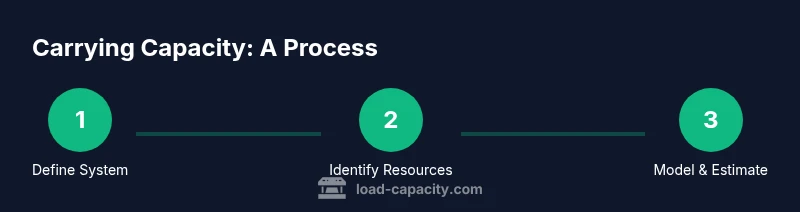
Define the system boundaries
Identify the spatial extent, time horizon, species included, and abiotic factors that influence resource supply. Clarify what counts as resources and what constitutes population changes. Document these decisions so that others can reproduce the analysis.
Tip: Create a decision log noting why each boundary was chosen and how it could shift under different scenarios. - 2
Identify limiting resources
List the resources that most constrain population growth: food, water, space, nesting sites, or other essentials. Quantify how these resources vary with seasons or disturbances and how they translate into growth or mortality effects.
Tip: Prioritize resources with the strongest, most consistent influence on population trajectories. - 3
Collect high-quality data
Assemble time-series data for population size and resource abundance. Include metadata about collection methods, units, and gaps. Ensure data quality and long enough time spans to capture variation.
Tip: Prefer multi-year data sets and document any biases or missing values. - 4
Choose an appropriate modeling framework
Select a model that matches the ecology: logistic, Gompertz, or other density-dependent forms. Decide whether to model continuously or in discrete time, and whether to allow carrying capacity to vary with time or conditions.
Tip: Consider starting with a logistic model to build intuition before exploring alternatives. - 5
Estimate parameters
Fit growth rate (r), carrying capacity (K), and any modifiers to your data. Use regression, maximum likelihood, or Bayesian methods. Check identifiability and document assumptions.
Tip: Use cross-validation or holdout data to assess predictive performance. - 6
Compute carrying capacity
From the fitted model, extract K as the asymptotic limit or equilibrium value under your assumptions. Interpret K in the context of your system and boundary conditions.
Tip: If K appears unstable, reassess boundaries and resource measures for hidden drivers. - 7
Validate with independent data
Test model predictions against unseen data or experimental results. Use residual analysis and goodness-of-fit metrics to judge reliability and adjust as needed.
Tip: Validation guards against overfitting and increases trust in the result. - 8
Interpret results and communicate
Translate model outputs into actionable guidance for managers or researchers. Clearly state assumptions, limitations, and recommended next steps for monitoring and updating the carrying capacity estimate.
Tip: Share a concise summary and a transparent methods appendix for audits.
Quick Answers
What is carrying capacity and why is it important?
Carrying capacity (K) is the maximum population size an environment can sustain over a given period under existing resources. It helps predict growth, resource use, and stability. Understanding K supports management decisions and conservation planning.
Carrying capacity is the environment’s limit on population size, guiding how populations grow and persist.
How do I choose a modeling approach for carrying capacity?
Start with the logistic model if growth slows as resources become scarce. If data show rapid shifts or seasonal changes, consider Gompertz or time-varying carrying capacity models. Match the model to the ecological context and data quality.
Pick a model that fits your data and what you know about resource limits.
Can carrying capacity vary over time?
Yes. Carrying capacity can change with resource availability, climate, seasonality, and disturbances. Time-varying carrying capacity models capture these dynamics better than static assumptions.
K isn’t fixed; it changes with conditions.
What data quality is needed to estimate carrying capacity reliably?
Reliable estimates require long-term, high-quality population and resource data, clear measurement units, and documentation of methods. Missing data should be addressed with transparent imputation or modeling choices.
Good data quality is essential for trustworthy estimates.
How do human activities influence carrying capacity estimates?
Humans can alter resources, habitat structure, and disturbance regimes, shifting K. Incorporate these changes in your model or conduct scenario analyses to explore possible outcomes.
Human actions can move the carrying capacity up or down.
Is there a single carrying capacity for a population?
Often no. K depends on spatial scale, time frame, species interactions, and resource definitions. Different contexts can yield different carrying capacities.
There isn’t one universal K; it’s context-specific.
Watch Video
Top Takeaways
- Define system boundaries before modeling
- Choose a model that matches ecological context
- Validate results with independent data
- Document assumptions and limitations
- Communicate findings clearly to stakeholders