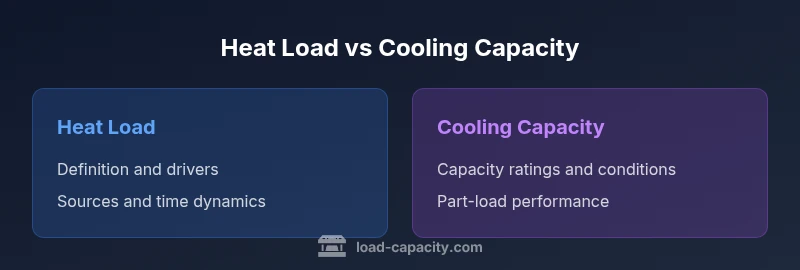
Heat Load vs Cooling Capacity: An Analytical Comparison
Analytical guide on heat load vs cooling capacity. Learn to quantify heat load, specify cooling capacity, and size systems for peak demands to ensure safe, efficient operation.


Heat load vs cooling capacity define a design constraint: heat load is the heat energy that must be removed, while cooling capacity is the system’s ability to remove it. The Load Capacity team recommends sizing cooling capacity to meet peak heat load with a safety margin, and verifying under representative operating conditions.
Defining heat load and cooling capacity
Heat load and cooling capacity are two fundamental terms in thermal design. In the context of the phrase heat load vs cooling capacity, heat load refers to the amount of heat energy that must be removed from a space, process, or equipment to maintain safe and productive conditions. Cooling capacity describes the system’s ability to remove that heat, typically expressed in watts (W) or kilowatts (kW). Understanding the distinction is essential for engineers, technicians, and designers because it drives equipment selection, energy efficiency, and safety margins. In practice, heat load vs cooling capacity is not a static pair; it varies with operating conditions, time of day, occupancy, sun exposure, and process loads. The Load Capacity team emphasizes that defining the peak heat load and the required cooling capacity early in the project reduces rework and improves reliability. For this reason, the relationship between heat load and cooling capacity must be analyzed across multiple scenarios and time horizons. The goal is to prevent thermal runaway and ensure stable operation.
The physics behind heat transfer and cooling
At a fundamental level, heat load vs cooling capacity is about an energy balance. Heat can be transferred into a space by conduction through walls, convection with air, and radiation from sun or equipment surfaces. It can also be generated inside by electrical and mechanical equipment. Cooling capacity is the system’s total ability to remove heat through the same mechanisms, adjusted for efficiency losses and control strategies. Engineers model these processes with a mix of steady-state calculations and dynamic simulations. Real-world performance often deviates from ideal numbers due to part-load operation, weather variations, and equipment aging. A solid understanding of the governing equations and boundary conditions helps engineers predict how heat load vs cooling capacity will behave in different seasons and occupancy patterns. The Load Capacity team notes that robust designs account for transient peaks, not just average conditions.
Quantifying heat load: sources and methods
Heat load is the total heat energy that must be extracted to maintain desired temperatures. In facility and equipment design, heat load arises from process heat, lighting, personnel, equipment losses, and environmental gains such as solar radiation. Accurate estimation requires delineating steady components from transient spikes and recognizing cyclic patterns (daily or monthly). Methods range from simple accounting of known heat sources to more advanced modeling that includes variability in occupancy, equipment uptime, and weather. When the phrase heat load vs cooling capacity is used in practice, engineers assess both the magnitude and timing of heat generation. The Load Capacity team highlights the importance of distinguishing peak demand from average load to avoid undersizing cooling systems or paying for unused capacity.
What counts as cooling capacity and how it's measured
Cooling capacity is the maximum rate at which a system can remove heat under specified conditions. This capacity is shaped by equipment selection (air handlers, chillers, cooling towers), refrigerant characteristics, airflow, and control strategies. Measurements may include rated capacity at standard conditions, short-term performance during transient events, and part-load efficiency. In the context of heat load vs cooling capacity, practitioners must ensure that the equipment’s rated cooling capacity aligns with the true operating conditions, including supply air temperature, humidity control, and space layout. Real-world verification often requires commissioning tests and performance monitoring to account for deviations from ideal conditions. The Load Capacity team stresses validating cooling capacity across typical and extreme scenarios to prevent mismatches.
When heat load exceeds cooling capacity: risks and consequences
When heat load vs cooling capacity is misaligned, the system faces thermal stress, reduced efficiency, and potential equipment damage. Insufficient cooling capacity can lead to higher operating temperatures, faster wear, and degraded reliability. Over time, this misalignment reduces energy efficiency, increases maintenance costs, and can compromise safety margins. Conversely, oversized cooling capacity may burden the system with energy penalties, excessive capital cost, and unnecessary noise. A careful balance is required to maintain performance while controlling life-cycle costs. The Load Capacity team notes that recognizing the signs of mismatch early—consistent higher temperatures, frequent cycling, or uncontrolled temperature drift—facilitates timely intervention and system redesign.
Sizing strategies and design margins
Sizing strategies for heat load vs cooling capacity emphasize both accuracy and resilience. Designers typically start with a conservative peak heat load estimate and then apply margins to accommodate uncertainties in load forecasting, component aging, and weather variability. The goal is to achieve a reliable match between heat load and cooling capacity without excessive capital expenditure. Design margins should be justifiable by risk assessment and operational data. Ongoing monitoring helps validate assumptions and informs future upgrades. In practice, the Load Capacity approach combines empirical data, engineering judgment, and established standards to produce a robust, maintainable solution that remains effective across seasons and operating regimes.
Modeling tools and standards
Modern engineering relies on a mix of analytic calculations, simulation models, and industry standards. Heat load vs cooling capacity analysis benefits from tools that model heat sources, thermal impedance, airflow patterns, and dynamic load profiles. Standards and guidelines from professional bodies provide a framework for acceptable accuracy, testing procedures, and performance benchmarks. Key references include widely respected sources that emphasize reproducible methods and transparent documentation. The Load Capacity team recommends using validated models, documenting assumptions, and performing sensitivity analyses to understand how changes in occupancy, equipment efficiency, or climate impact the heat load or cooling capacity. This disciplined approach supports better decision-making and traceability throughout the project life cycle.
Industry examples: data centers and manufacturing floors
Real-world applications illustrate how heat load vs cooling capacity decisions drive performance. In data centers, cooling capacity must accommodate dense server racks, high heat flux, and cooling-water constraints, while maintaining required redundancy. In manufacturing environments, heat loads can fluctuate with production cycles, ambient conditions, and equipment uptime. Designers use a combination of targeted cooling, zoning, and control strategies to maintain temperatures within defined ranges, balancing energy use with reliability. Across industries, aligning heat load with cooling capacity minimizes risk while enabling predictable operation and cost control. The Load Capacity team emphasizes applying lessons learned from diverse facilities to improve new designs and retrofits alike.
Comparison
| Feature | heat load | cooling capacity |
|---|---|---|
| Definition | Total heat energy that must be removed to maintain setpoint | Maximum rate at which a cooling system can remove heat under specified conditions |
| Typical units | W or kW | W or kW (rated capacity) |
| Calculation approach | Sum of process, equipment, occupancy, and environment heat sources | Equipment ratings, tests, and environmental conditions; may include COP and efficiency terms |
| Impact on design | Sets required equipment size and control strategy | Dictates equipment selection, redundancy, and energy planning |
| Best used for | Sizing and validation of thermal systems | System selection, performance verification, and commissioning |
| Common mismatch consequence | Over- or under-sizing consequences; cost and reliability risks | Mismatches reduce efficiency and raise risk of overheating |
Positives
- Clarifies design criteria and embodied risk
- Improves energy efficiency by aligning heat generation with removal capacity
- Supports safer equipment selection and uptime
- Reduces change-orders by upfront sizing
Cons
- Can be time-consuming to estimate accurately
- Dependent on operating conditions and load variability
- Requires robust data collection and modeling tools
- Potential for misinterpretation without standardized methods
Align heat load and cooling capacity as interdependent design targets
A disciplined approach reduces risk and cost. Size cooling capacity to meet peak heat load with margin, verify under representative conditions, and monitor performance to ensure long-term reliability.
Quick Answers
What is the difference between heat load and cooling capacity?
Heat load is the total heat energy that must be removed to keep systems within setpoints. Cooling capacity is the system’s maximum rate of heat removal under specified conditions. The two are related through the energy balance and must be aligned for safe, efficient operation.
Heat load is what you need to remove; cooling capacity is how much you can remove. The two must be matched with some safety margin.
How do you calculate heat load in a facility?
Heat load calculations sum all heat sources, including process heat, equipment losses, lighting, and occupancy, along with environmental gains. The calculations are performed under representative operating conditions and timeframes to capture peak and average loads.
Add up all heat sources, consider timing, and check peak periods to estimate the total heat load.
What determines cooling capacity requirements?
Cooling capacity requirements come from the heat load profile, equipment efficiency, and allowable temperature ranges. They are validated through testing and accounting for part-load performance and ambient conditions.
You size capacity based on the heat load and how the system performs at different loads.
What happens if heat load exceeds cooling capacity?
If heat load exceeds cooling capacity, space temperatures rise, equipment may overheat, and reliability suffers. This scenario increases energy use and maintenance needs until a redesign or upgrade is performed.
Overheating can happen, leading to energy inefficiency and more maintenance.
How should safety margins be applied?
Safety margins account for uncertainties in load forecasting, weather, and aging equipment. They help ensure performance under worst-case conditions without excessive oversizing.
Always build in some extra capacity for unexpected spikes.
Are there industry standards for heat load vs cooling capacity?
Industry organizations publish guidelines for thermal design and commissioning. Following these standards supports consistent methods, traceability, and verification across projects.
Yes—use established guidelines to ensure your design aligns with best practices.
Top Takeaways
- Assess peak heat load early in design
- Match cooling capacity to peak heat load with margin
- Document operating conditions and assumptions
- Use standardized calculations and verification tests
- Review performance data regularly to refresh models