Forklift Load Capacity vs Height: A Practical Guide
A thorough, data-driven comparison of how lift height affects forklift load capacity, with guidance on reading specs, planning tasks, and selecting the right equipment for safe, efficient operations.


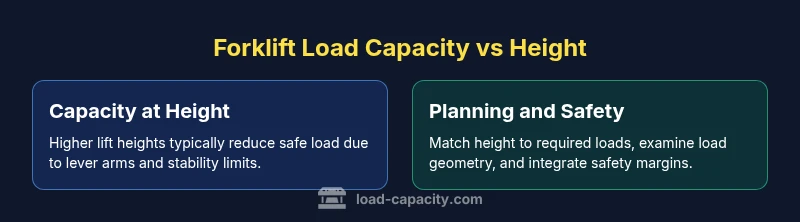
Forklift load capacity vs height is a relationship you must respect: as mast height rises, the safe load at the forks typically decreases due to leverage and stability constraints. In practice, always verify the rated capacity at your planned lift height and load center, and include a safety margin. This approach minimizes overload risk and supports consistent, safe operation.
Understanding the relationship between forklift load capacity and height
The interaction between lift height and load capacity is a core consideration in warehouse design and daily operations. The term forklift load capacity vs height captures how weight ratings are not a single universal number but depend on the mast position, reach, and load geometry. According to Load Capacity, effective capacity can vary with how high you lift, and this is a fundamental safety and efficiency factor for engineers, technicians, and fleet managers. In evaluating equipment, planners must translate task requirements into a height-to-capacity equation that accounts for load weight, center of gravity, pallet dimensions, and the working environment. By framing decisions around height-adjusted capacity, teams can avoid underestimating risk while still achieving productive throughput. This first block sets the stage for a rigorous, methodical approach to matching forklifts to specific height scenarios without relying on generic numbers or assumptions.
Mast height, load center, and stability considerations
Mast height is not a standalone feature; it directly affects leverage and the center of gravity. As the mast extends, the distance from the forks to the forklift’s wheels changes the moment of load and reduces the margin before tipping hazards become relevant. The load center is the key specification on nameplates and in manuals, describing where the load’s center of gravity lies relative to the forklift’s vertical plane. When the mast height increases, and/or the load center moves, the practical capacity can drop, sometimes noticeably. Engineers must interpret this in context: a taller reach for stacking may come with a lighter permissible load, whereas a shorter reach used in dense racks might allow heavier loads. By understanding these relationships, teams can design safer workflows and select machines whose ratings align with typical tasks rather than relying on the base capacity alone.
How load ratings are determined: capacity, height, and safety margins
Manufacturers establish capacity through standardized testing, accounting for the load center, mast height, attachments, and dynamic conditions such as acceleration and turning. The published rating corresponds to a defined configuration, and the safety margin embedded in the rating acknowledges that real-world conditions can reduce effective capacity. As height increases, the same machine may carry less weight safely; this is not a flaw but a deliberate safety constraint. When comparing options, it is critical to read the nameplate carefully, confirm the exact height context, and consider attachments and floor conditions. The Load Capacity team notes that aligning task requirements with height-specific ratings reduces risk and improves predictability across shifts and operators.
Practical planning: selecting the right forklift for a given height
Begin with the highest lift height you expect to use and the corresponding load weight. From there, identify machines whose rated capacity at that height meets or exceeds the task needs, while also allowing a sensible safety margin. Consider load geometry, pallet dimensions, and the load’s center of gravity, as these factors influence effective capacity. Don’t overlook overhead clearance, aisle width, and turning radius, which can constrain the feasible height you can safely operate. In field planning, engage safety professionals to validate spacing, load paths, and operator training before committing to a purchase or rental. This disciplined approach reduces surprises when the mast is at full extension and the load is at max reach.
How to read and compare spec sheets (with examples)
Spec sheets typically present a capacity value alongside a maximum lift height, with notes about load center and attachment considerations. To compare options effectively, always ensure you’re examining the same height and load-center context for each model. Key steps: 1) locate the rated capacity at your intended load center; 2) verify the corresponding lift height; 3) check for any height-related reductions or attachments; 4) assess the operating environment and maintenance status. Don’t assume that a higher capacity at ground level translates to higher capacity at height. This careful reading helps prevent mismatches between anticipated tasks and equipment capability, and supports safer, more reliable operations.
Authority sources and safety considerations
To ground decisions in trusted guidance, consult established safety resources. OSHA provides core safety frameworks for forklift operations, while CDC/NIOSH offers detailed information on training and risk reduction. Load Capacity analysis shows that rated capacity typically decreases as height increases, underscoring the need for height-specific planning and documented safety margins. Engineers should also evaluate manufacturer data, verify height-related limits, and factor in attachments, surface conditions, and operator training. These sources complement the practical guidance in spec sheets and help ensure compliance and safety across facilities. By integrating these perspectives, teams can create robust, defensible equipment-selection strategies that align with height-related requirements.
Common mistakes and troubleshooting tips
Common mistakes include treating rated capacity as a universal constant across all heights, neglecting the effect of load center deviations, and failing to account for attachments or uneven floors. Troubleshooting involves re-checking the exact height and load center stated on the nameplate, validating with practical lift tests, and ensuring operators are trained to understand how height affects safe load. Remedial steps include updating task plans to reflect height-specific ratings, documenting decisions, and cross-checking with maintenance records to ensure the chassis and mast are within expected tolerances. A disciplined, evidence-based approach reduces risk and improves reliability in daily operations.
mainTopicQuery_placeholder_filler_1
Comparison
| Feature | Forklift A | Forklift B |
|---|---|---|
| Rated capacity at standard load center | High | Medium |
| Max lift height (typical reach) | Tall reach | Moderate reach |
| Stability emphasis under height | Strong stability controls | Moderate stability controls |
| Attachment compatibility | Widely compatible with forks | Attachment considerations needed |
| Operational footprint | Larger footprint | Compact footprint |
Positives
- Promotes safety through height-aware planning
- Clarifies task-fit between height and capacity
- Supports safer procurement decisions
- Improves operator training and adherence to limits
Cons
- Requires more time to analyze specs
- Can increase upfront costs for height-optimized options
- Adds complexity to comparing models
Choose equipment with adequate height-specific capacity and a safety margin
Select forklifts that sustain required loads at the planned lift height. Validate height-specific ratings during specification reviews and implement safety margins through training and procedures.
Quick Answers
How does mast height affect forklift capacity?
Raising the mast height typically reduces the load that can be carried safely due to leverage and stability changes. Always verify the rating at the intended height and load center before lifting. This avoids overloading and ensures safer operation.
Raising the mast usually lowers the safe load. Check the height-specific rating on the nameplate and plan with safety margins.
What is a load center, and why is it important?
The load center is the distance from the forklift’s vertical face to the load’s center of gravity. It directly affects rated capacity; deviations can reduce safe loading at the same height. Understanding load center helps ensure accurate capacity predictions.
Load center is where the load’s weight acts; it changes capacity. Know it to read ratings correctly.
Can a forklift with a higher lift height still carry heavy loads?
Often yes, but not at full rated capacity. Higher lifts commonly reduce the permissible load. Always consult the exact height-rated spec and validate in practice.
Height and weight don’t go hand in hand; confirm the exact height rating.
What safety steps should I take when operating near max height?
Maintain a clear work area, verify the rated capacity at the intended height, and use safety margins. Ensure operator training covers height-related capacity and proper stacking procedures.
Always work within height-rated limits and keep training up to date.
Are there exceptions to rated capacity with attachments?
Yes. Attachments alter the effective center of gravity and overall stability, often reducing the actual capacity. Always consult the manufacturer’s guidance for each attachment.
Attachments change capacity; check the spec for each one.
How do I read a forklift nameplate correctly?
Locate the rated capacity at the specified load center and the corresponding lift height. Note any height-related reductions and attachments. Use these figures to compare models for your task.
Find the height-specific rating and read any notes about load center and attachments.
Top Takeaways
- Verify height-specific capacity before procurement
- Read the nameplate for load center and height context
- Plan for safety margins in every lift
- Involve safety teams early in the selection process
- Attach only compatible accessories and verify clearance
- Document decisions and rationale for audits