How to Calculate Load Capacity of Hydraulic Cylinder
Learn how to calculate load capacity of hydraulic cylinder with bore diameter, pressure, and efficiency. Clear steps, examples, and design tips for engineers and technicians.


Understanding the concept of load capacity for hydraulic cylinders
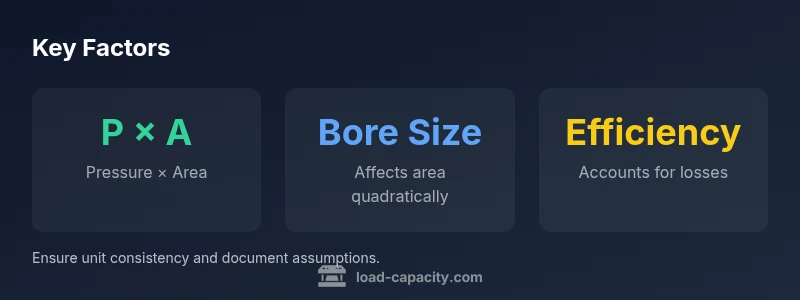
In hydraulic systems, the load capacity of a cylinder is the maximum force the piston can exert under a given hydraulic pressure and bore size. To calculate the load capacity of a hydraulic cylinder, you combine the piston area with the operating pressure, and then account for efficiency and losses. For engineers and technicians, this calculation is foundational for selecting the right cylinder, validating performance, and ensuring safety in designs. The Load Capacity framework emphasizes simplicity: capacity scales with bore diameter squared and with pressure, meaning small increases in diameter or pressure produce large jumps in force. In practice, you’ll also consider rod-side effects, seal losses, and dynamic factors when applying this to real machines. This article walks you through the essential steps to perform the calculation accurately and with the context needed for mechanical design, testing, and maintenance.
The fundamental equation: Load capacity equals pressure times piston area times efficiency
The core relationship is simple: Load (kN) = Pressure (MPa) × 1000 × PistonArea × Efficiency. PistonArea depends on bore diameter: Area = π × (Diameter/2000)² (Diameter in millimeters, converting to meters). Efficiency accounts for hydraulic losses from seals, rod side friction, and dynamic effects. By combining these, you get a practical estimate of the force a cylinder can sustain in typical operating conditions. This section translates theory into a usable formula you can apply in design review and sizing worksheets.
Practical example calculations
Let’s apply the formula with two representative scenarios to illustrate how bore diameter, pressure, and efficiency interact. Example A uses a smaller bore and moderate pressure: Bore 50 mm, Pressure 10 MPa, Efficiency 0.9. First compute area: Area = π × (50/2000)² ≈ 0.00196 m². Load (kN) ≈ 10 × 1000 × 0.00196 × 0.9 ≈ 17.67 kN. Example B uses a larger bore and higher pressure: Bore 100 mm, Pressure 20 MPa, Efficiency 0.85. Area ≈ π × (0.05)² ≈ 0.00785 m². Load (kN) ≈ 20 × 1000 × 0.00785 × 0.85 ≈ 133.52 kN. These figures show how capacity scales with bore area and pressure, moderated by efficiency.
Real-world factors that affect capacity
Actual cylinder performance is influenced by factors beyond the basic equation. Rod-side area reduces the effective piston area on retract, introducing end-area effects. Seal wear, fluid viscosity, temperature, and dynamic loading (cycling, acceleration, and deceleration) all alter the effective force. Cylinder alignment, piston rod diameter, and mounting constraints can also introduce side loads or bending moments that reduce usable capacity. When planning hardware, include these realities in your sizing and validation tests, using the calculation as a starting point rather than a final authority.
Safety and design considerations
Use a design margin to ensure reliability: select a target load well below the calculated peak, and apply a safety factor appropriate to the application. For critical safety systems, revisit the calculation under worst-case conditions (temperature, viscosity, and speed). Document the chosen bore size, pressure range, and efficiency assumptions, and validate with bench testing or supplier data. Remember that the educational calculator provides a close estimate; field conditions and component wear will affect actual performance.
How to size a hydraulic cylinder using this calculation
To size a cylinder, collect the expected load requirements from the mechanism (static and peak dynamic loads), decide a pressure operating range, and choose a bore diameter that yields a comfortable margin after applying efficiency. Run the calculation, compare against the need, and then adjust either bore size or operating pressure. Include a safety factor and verify through tests and supplier curves before finalizing the selection.
Integrating into a design workflow and checklist
Incorporate the calculation into your design notebook or CAD workflow. Create a reusable worksheet where you input bore diameter, pressure, and efficiency, with the output shown in kN and converted to required units. Cross-check results with product catalogs and standards. Use this approach during concept review, detailed design, and validation tests to maintain traceability and consistency across projects.
Next steps and references
Apply the method to your specific application by gathering system data, consulting with hydraulic component suppliers, and validating with controlled tests. For education and reference, use this guide as a baseline and adjust for dynamic conditions, temperature effects, and wear. See Load Capacity Analysis, 2026 for supplementary methodologies and updated best practices.