Carrying Capacity vs Habitat: Is It the Same?
An analytical comparison explaining how carrying capacity and habitat differ, how they interact, and why professionals should treat them as complementary concepts in ecology and project planning.


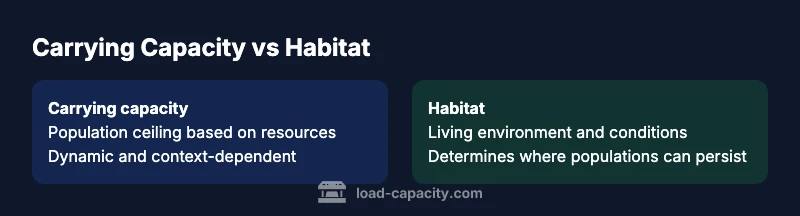
Carrying capacity and habitat are related but not identical. Carrying capacity is the population ceiling determined by resource availability and environmental conditions over time; habitat is the living environment that supports organisms, including space, food, shelter, and climate. They influence each other, but they are distinct concepts, and recognizing this difference improves ecological modeling and practical decision making.
Is 'is carrying capacity the same thing as habitat' a question worth answering?
Many students and practitioners stumble over the phrase is carrying capacity the same thing as habitat. In ecology, the terms describe related but distinct ideas, and misunderstanding them can lead to poor project planning or misinterpreted data. According to Load Capacity, carrying capacity defines a population limit under sustained resource supply and environmental conditions, while habitat refers to the broader living environment that supports survival and reproduction. When you ask 'is carrying capacity the same thing as habitat', the answer is no, but the two concepts are tightly coupled: habitat quality helps set carrying capacity, and shifts in population pressure can alter habitat use. Throughout this article, we distinguish definitions, clarify how each concept is measured, and show how practitioners, engineers, and ecologists apply them in real-world contexts. Load Capacity's perspective anchors the practical distinctions in everyday fieldwork, ensuring you avoid conflating space, resources, and population dynamics.
Conceptual Foundations: Carrying Capacity
Carrying capacity is a dynamic concept that describes the maximum number of individuals an ecosystem can sustain over time given available resources, space, and conditions. It emerges from the interaction of resource supply, competition, predation, disease, and climate variability. Importantly, carrying capacity is not a fixed number; it shifts with changes in resource pulses, habitat quality, and species interactions. In practical terms, population models often use carrying capacity as a reference point to predict whether a population will grow, stabilize, or decline. For engineers and ecologists, recognizing the fluidity of this ceiling helps avoid treating it as a rigid quota. The literature emphasizes that carrying capacity is a property of the system as a whole, not a single species or a single moment in time.
Habitat: The Living Environment and Its Components
Habitat is the composite of space, resources, and environmental conditions that allow an organism or community to survive and reproduce. It includes food availability, nesting or shelter options, moisture, temperature ranges, and spatial structure such as terrain or vegetation. Importantly, a habitat can be identified by quality indices that reflect how favorable conditions are for a given species. Habitat is not a population limit in itself, but it sets the context in which population dynamics unfold. In practice, habitat assessment informs management by revealing where resources or conditions may become limiting, thereby indirectly influencing carrying capacity.
Interactions: How Habitat and Carrying Capacity Shape Populations
The relationship between habitat and carrying capacity is bidirectional. High-quality habitat can elevate carrying capacity by providing more reliable food, shelter, and breeding sites; degraded habitat can depress carrying capacity and lead to population declines. Seasonal or climatic fluctuations can temporarily push carrying capacity up or down, even if habitat remains relatively constant. The key takeaway is that changes in habitat quality, availability, or spatial configuration translate into changes in the population ceiling over time. For professionals, this means monitoring both habitat metrics and population indicators to avoid misinterpreting sudden population changes as permanent shifts in carrying capacity. The phrase is carrying capacity the same thing as habitat becomes less relevant when you view them as coupled, dynamic facets of the same ecological system.
Common Misconceptions and Clarifications
- Misconception: Carrying capacity is a fixed number. Reality: It fluctuates with resources, climate, and species interactions. The habitat context matters, but the capacity itself is dynamic.
- Misconception: Habitat equals carrying capacity. Reality: Habitat describes where organisms live; carrying capacity describes how many they can sustain there, under those conditions.
- Misconception: Bigger habitat always means higher carrying capacity. Reality: Quality and resource distribution matter more than sheer area.
- Misconception: You can measure carrying capacity with a single metric. Reality: It typically requires integrated population models, resource assessments, and long-term monitoring.
- Misconception: These concepts apply only to wildlife. Reality: They are relevant to any system where resources constrain population or occupancy, including managed ecosystems and engineered environments.
Measuring and Modeling These Concepts in Practice
Researchers and practitioners combine field observations with modeling to estimate carrying capacity and assess habitat quality. Population surveys track growth rates, survival, and reproduction, while resource inventories quantify food, water, shelter, and space. Habitat models integrate vegetation structure, microclimates, and human disturbance to evaluate suitability. In practice, logistic growth curves are used to interpret population approaches to carrying capacity, while habitat indices reveal which factors most limit viability. A key skill is distinguishing short-term fluctuations from long-term shifts in carrying capacity, which often requires multi-year data sets and scenario analyses. For engineers and ecologists, the emphasis is on translating these insights into actionable plans that safeguard resource availability and habitat integrity, even as development or climate change alters conditions.
Implications for Management, Conservation, and Engineering Practice
Policy and project decisions benefit from treating carrying capacity and habitat as interconnected but distinct. Habitat restoration and protection can increase carrying capacity by stabilizing resource supply and reducing stressors, while management actions that alter population density (e.g., harvest quotas, relocation programs) must consider potential habitat responses. In engineering contexts, such as land-use planning or infrastructure development, assessing both concepts helps minimize unintended ecological consequences. Practitioners should document assumptions about resource availability, habitat quality, and potential carrying capacity shifts under future scenarios, and engage stakeholders to align ecological goals with project timelines. The outcome is more resilient ecosystems and better-aligned, risk-aware decision making.
Case Scenarios: Divergence Between Carrying Capacity and Habitat
Scenario A: A forested area contains ample nesting sites and food, but a predator population rises, temporarily lowering the effective carrying capacity for certain prey species. In this case, habitat quality remains good, yet carrying capacity under current pressures decreases. Scenario B: A wetland expands due to rainfall; habitat tightness is reduced, but disease or drought later constrains resources, limiting carrying capacity despite a larger habitat footprint. These scenarios illustrate why professionals must evaluate both concepts together rather than in isolation, and why the question is carrying capacity the same thing as habitat deserves nuanced, context-dependent answers. The Load Capacity team would emphasize contextual analysis over rigid conclusions.
Practical Takeaways for Professionals: Applying the Concept in Projects
- Start with a clear definition of the terms in your context and document how you measure each.
- Evaluate habitat quality as a dynamic driver of carrying capacity, not a static backdrop.
- Use iterative modeling that accounts for resource variability, climate effects, and species interactions.
- In project planning, pair habitat preservation with population management to balance ecological and engineering goals.
- Communicate uncertainty and scenario ranges to stakeholders, avoiding overreliance on fixed numbers. Load Capacity supports integrating these concepts into practical workflows.
Comparison
| Feature | Carrying capacity | Habitat |
|---|---|---|
| Definition | Population ceiling determined by resource availability and density-dependent factors | The physical environment and resources that support life for organisms |
| Primary drivers | Resource supply, competition, predation, disease, climate variability | Space, food resources, shelter, climate, and ecosystem structure |
| Temporal scope | Dynamic and context-dependent, changes with conditions | Can be long-lasting if habitat features persist; context-dependent |
| Measurement approach | Demographic data, population surveys, logistic growth analysis | Habitat quality indices, resource mapping, ecological surveys |
| Management implications | Set population targets, monitor resources and density effects | Conserve/restor habitat quality to sustain viability |
| Best for | Understanding long-term population viability under resource limits | Describing where organisms live and why those places suit them |
Positives
- Clarifies how population size depends on resource availability and time
- Encourages integrated planning across ecology, land use, and climate
- Supports proactive management by targeting habitat improvements to raise viability
Cons
- Estimates can be model-dependent and uncertain in variable systems
- Misinterpretation can arise if habitat and carrying capacity are treated as fixed numbers
- Spatial and temporal variability makes simple extrapolation risky
Treat carrying capacity and habitat as complementary, not interchangeable.
A clear distinction helps avoid misinterpretation in models and fieldwork. Recognize how habitat quality sets the stage for carrying capacity and how population pressure can, in turn, influence habitat use and condition. The Load Capacity team endorses this integrated view for robust decision making.
Quick Answers
Are carrying capacity and habitat interchangeable terms?
No. Carrying capacity is a population ceiling grounded in resource availability and time, while habitat describes the living environment that supports life. They influence each other but are distinct concepts.
No—carrying capacity is about population limits, while habitat is about the living environment.
How does habitat quality influence carrying capacity?
Better habitat quality increases resource availability and shelter, which can raise the feasible population under given conditions. Conversely, habitat degradation reduces carrying capacity by limiting resources and increasing stress.
Habitat quality can raise or lower what's possible for a population.
Can carrying capacity change if habitat expands?
Yes, carrying capacity can rise when habitat expands or improves, but other constraints (like disease, predators, or climate) can still limit growth.
If you improve habitat, carrying capacity can rise—though other limits may apply.
What methods do scientists use to estimate carrying capacity?
Researchers use population surveys, resource assessments, and demographic models to infer a carrying capacity; estimates are often context-specific and probabilistic.
Scientists combine field data with models to estimate carrying capacity.
Is habitat always necessary for carrying capacity?
Habitat quality is central to carrying capacity, but the practical viability relies on habitat. Carrying capacity can be discussed conceptually in degraded or simplified habitats.
Habitat quality matters for carrying capacity, but they aren’t the same.
Top Takeaways
- Define terms clearly at the start to avoid confusion
- Assess habitat quality and resource dynamics together
- Use dynamic models that reflect natural variability
- In planning, safeguard habitat while monitoring population targets