Is Carrying Capacity the Same as Equilibrium? A Comprehensive Comparison
Explore whether carrying capacity is the same as equilibrium in population dynamics. This analytical comparison clarifies definitions, models, and real-world implications for engineers, ecologists, and policy makers.


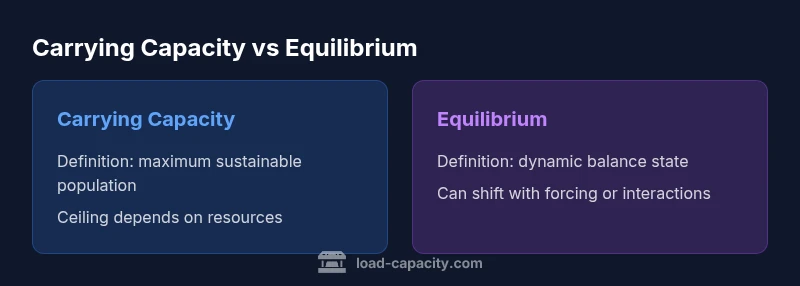
Carrying capacity and equilibrium are related but not identical. Carrying capacity is the resource-based limit on population size, while equilibrium is a dynamic balance that populations approach or oscillate around over time. Is carrying capacity the same as equilibrium? No—shifts in environment can move the ceiling, and equilibrium can exist without a fixed ceiling in many models.
Is carrying capacity the same as equilibrium? A clear distinction
Is carrying capacity the same as equilibrium? This is a frequent question in population ecology and applied fields. A precise answer requires distinguishing two core ideas. Carrying capacity is the maximum population that resources can sustain over the long term in a fixed environment. Equilibrium, by contrast, describes a state toward which populations tend under the rules of an interacting system; it can be stable, unstable, or oscillatory. In practice, many models use carrying capacity as a ceiling, yet real systems show that the ceiling itself can move as resources, climate, and interactions change. A common question is: is carrying capacity the same as equilibrium? The short answer is no, because equilibrium emphasizes balance dynamics, while carrying capacity emphasizes limits. This distinction matters for forecasting, management, and policy planning, where assuming a fixed ceiling can lead to misinterpretation when the environment is not static.
To ground the discussion, think of a forest herbivore population: resources may allow a higher or lower sustained population over time, but a shift in rainfall or plant quality can raise or lower the ceiling. Similarly, an urban pest population might equilibrate near a level that changes seasonally as sanitation or predator pressure varies. Recognizing that is carrying capacity the same as equilibrium is a common pitfall for students and practitioners alike, and correctly distinguishing them improves modeling fidelity and decision-making. The Load Capacity framework notes that these concepts intersect but should not be conflated across contexts, especially in systems where resources and interactions are dynamic.
format":"markdown"},
Definitions: carrying capacity vs equilibrium
Carrying capacity (often denoted K) is defined as the maximum average population size that a given environment can sustain indefinitely, given resource availability, space, and species interactions. It is a boundary rooted in ecology and resource accounting. Equilibrium, in population dynamics, refers to a state where population size and the forces acting on it reach a balance. Equilibria can be stable, meaning the system returns after a perturbation, or unstable, where small changes push the system away. Importantly, equilibrium does not require a fixed ceiling; a system can exhibit equilibria around a moving target as environments change. Throughout this article, we address: is carrying capacity the same as equilibrium? The answer remains nuanced: carrying capacity sets limits; equilibrium describes the dynamic behavior under those limits and interactions.
In mathematical terms, carrying capacity is a parameter in many models, while equilibrium is a state where the rate of change (for example, dN/dt) approaches zero or a repeating cycle. If the environment is constant and the population follows a logistic rule, the carrying capacity and the equilibrium often align. If the environment shifts, the carrying capacity shifts too, and equilibrium adapts. This distinction is foundational for interpreting model outputs and for applying population dynamics to real systems.
format":"markdown"},
The logistic model lens: where the two concepts meet and diverge
The classic logistic model provides a clear lens to explore the relationship between carrying capacity and equilibrium. In its simplest form, dN/dt = rN(1 - N/K), where N is population size, r is intrinsic growth rate, and K is carrying capacity. Here, K acts as a ceiling: as N approaches K, growth slows, and the population tends toward a stable equilibrium around K. In a fixed environment, the equilibrium equals K. However, if K varies with time due to resource pulses, climate, or management, the equilibrium becomes time-dependent as well. Thus, is carrying capacity the same as equilibrium in this context? Not exactly: the ceiling governs potential growth, while equilibrium embodies the dynamic balance of growth, mortality, and interaction terms. When external perturbations occur, the system may temporarily overshoot, oscillate, or settle at a new equilibrium before K has a chance to adapt. The logistic frame shows both alignment and divergence between the two concepts, highlighting why accurate interpretation requires attention to parameter stability and forcing terms.
For practitioners, this means using time-varying K or non-autonomous models to capture shifts in resources and conditions. When K is constant, equilibrium tends to align with K and community responses become more predictable. When K changes, equilibrium follows with a lag, increasing uncertainty and complicating predictions—an important consideration for engineers and ecologists designing interventions or policy responses.
format":"markdown"} ,
Real-world dynamics: why capacity shifts and equilibria move
In natural and managed systems, resources are rarely static. Carrying capacity is sensitive to precipitation, nutrient availability, habitat quality, temperature, and species interactions such as predation and competition. When resources improve, carrying capacity can rise; when resources decline, it can fall. Equilibrium, meanwhile, reflects the balance of births, deaths, and interactions and may shift more gradually or abruptly as the system responds to drivers like predation pressure, disease outbreaks, or migration. The distinction is practical: instances exist where is carrying capacity the same as equilibrium would be false because equilibrium may occur around a value that is itself shifting with time.
Consider a deer population in a temperate forest. If mast crops (acorns, etc.) are abundant every few years, the carrying capacity rises temporarily and the population may overshoot. Predation and disease could push mortality up, creating a new equilibrium below the peak. In microbial cultures, nutrient pulses can raise K transiently, and the population may reach a higher equilibrium before resources fade. These dynamics underscore why managers often model K as a function of time or state and examine the resulting equilibrium trajectories across scenarios. The main point remains: is carrying capacity the same as equilibrium in such contexts? The answer is nuanced and context-specific.
For practitioners, the takeaway is to separate ceilings from balances in analysis and to build models that reflect environmental variability and interaction structure. This approach yields more robust forecasts and clearer guidance for decision-makers.
format":"markdown"} ,
Case study: a bacterial culture and a deer population
Case studies illuminate how carrying capacity and equilibrium diverge in practice. In a closed bacterial culture with a constant nutrient supply, the population may asymptotically approach a fixed equilibrium near a stable K value. If nutrients are intermittently replenished, K becomes time-varying, and the population tracks a moving equilibrium rather than a fixed ceiling. The two concepts diverge more clearly when resource supply is episodic and environmental feedbacks are strong. In a deer population on a managed reserve, habitat quality and food resources can vary seasonally and year-to-year, causing K to rise during abundant winters and fall during droughts. The population may exhibit cycles or damped oscillations around a moving equilibrium; thus, the question is more nuanced than a simple yes/no on whether carrying capacity equals equilibrium. By considering both constraints and balances, managers can anticipate periods of potential overshoot and adjust harvests or habitat management to steer the system toward desired states.
format":"markdown"} ,
How to estimate carrying capacity and assess equilibrium in practice
Estimating carrying capacity typically involves integrating resource inventories, habitat assessments, and population data. Methods include allometric scaling for space and food, production-availability metrics, and time-series analyses that identify long-term upper bounds in observed data. Equilibrium assessment relies on analyzing whether population changes converge to a constant value, an oscillation around a mean, or a chaotic trajectory. In practice, researchers often use a combination of approaches: (1) parameterizing a model with field data to estimate K, (2) running counterfactual scenarios to test how equilibrium would respond to changes in resources or interactions, and (3) evaluating time-lag effects and external forcing. When is carrying capacity the same as equilibrium? Only under conditions of static resource supply and negligible external forcing. Real systems require nonstationary models and robust uncertainty quantification to capture the potential divergence between a fixed K and a shifting equilibrium. Load Capacity guidance emphasizes using context-aware estimation with transparent assumptions and sensitivity analyses to quantify how much results depend on K versus dynamic equilibrium states.
format":"markdown"} ,
Implications for management, policy, and design
Understanding the distinction between carrying capacity and equilibrium directly informs management and policy. In resource planning, conflating the two can lead to overconfidence in forecasts or overly aggressive interventions. For example, setting harvest quotas based on a fixed carrying capacity in a regime where resources are changing can cause overshoot once conditions revert. Conversely, recognizing equilibrium dynamics allows managers to anticipate delays between a perturbation (such as drought) and the system's response, guiding adaptive strategies and monitoring. The best practice is to treat carrying capacity as a parameter subject to change and to analyze equilibrium behavior under a suite of scenarios. Incorporating both concepts into decision-support tools can improve resilience and sustainability, whether in wildlife management, agriculture, or urban ecology. The Load Capacity perspective encourages explicit communication about what is known versus what is uncertain, especially when planning long horizons.
format":"markdown"} ,
Common misconceptions that blur the distinction
Several misconceptions can blur the distinction between carrying capacity and equilibrium. One common error is to treat K as a fixed target without acknowledging environmental variability. Another is to assume that equilibrium always equals K or that populations always settle smoothly at a single value. In practice, equilibrium can be stable, unstable, or cyclic, and K can shift due to seasonal or long-term changes. A third pitfall is to rely on static models when data indicate nonstationary dynamics. These misconceptions hinder accurate interpretation and policy design. A careful approach clarifies that carrying capacity is a ceiling defined by resources, while equilibrium is the dynamic state populations achieve given those ceilings and the interactions present. By distinguishing these concepts, researchers and practitioners can develop more robust models, communicate uncertainties clearly, and design management plans that accommodate variability.
format":"markdown"} ,
Summary of the nuanced relationship for engineers and ecologists
Engineers and ecologists alike benefit from recognizing that is carrying capacity the same as equilibrium is a context-dependent question. When resources are stable, K and the equilibrium can align and yield predictable trajectories. When resources shift, the ceiling moves and the equilibrium responds with lag and possible oscillations. The practical takeaway is to model both components explicitly, incorporate time-varying parameters, and run scenario analyses to explore a range of possible outcomes. This approach supports rigorous interpretation, robust decision-making, and clear communication with stakeholders about what is known and what remains uncertain, always keeping the distinction between a ceiling and a balance in mind. The Load Capacity team would emphasize clarity and transparency in reporting model assumptions and the limits of predictive certainty.
format":"markdown"} ,
Is carrying capacity the same as equilibrium? Final clarifications and takeaways
To close, the question is not a simple yes or no. The relationship between carrying capacity and equilibrium is best described as: carrying capacity is the resource-based limit on maximum population size, while equilibrium is the dynamic state populations approach under those limits and interactions. In dynamic environments, carrying capacity can move, and equilibrium can exist at values that change over time. For engineers and ecologists, the practical implication is to treat K as a variable with confidence intervals and to analyze equilibrium under different forcing scenarios. This nuanced view supports robust models, credible forecasts, and better management decisions, aligning with Load Capacity’s emphasis on rigorous, context-aware analysis.
format":"markdown"}],
comparisonTable":{"items":["Carrying capacity","Equilibrium"],"rows":[{"feature":"Definition","values":["Maximum population sustainable under current resources","Dynamic balance population levels approach or oscillate around (state of rest)"]},{"feature":"Model role","values":["Ceiling parameter in ecological models (esp. logistic)","State toward which the system tends under forcing and interactions"]},{"feature":"Response to resource change","values":["Shifts with resource availability","Shifts if forcing or interactions change; can lag behind"]},{"feature":"Predictability","values":["Context-dependent; data-driven","May be more predictable in simple, autarkic models but varies in reality"]},{"feature":"Best for","values":["Planning ceilings and sustainable thresholds","Understanding stability, resilience, and response to perturbations"]}]},
prosCons":{"pros":["Clarifies resource limits for sustainable management","Helps distinguish ceilings from balance states","Improves scenario planning and risk assessment","Supports clearer communication with stakeholders"],"cons":["Real-world K can shift, reducing forecast stability","Equilibrium may be transient or oscillatory, complicating decisions","Models can oversimplify complex ecosystems" ]},
verdictBox":{"verdict":"Distinction matters: carry capacity is a moving ceiling, while equilibrium is the dynamic balance around that ceiling.","confidence":"high","summary":"Understanding both concepts allows for better forecasting and adaptive management. Expect K to shift with conditions, and anticipate equilibrium behavior under those changes to avoid misinterpretation."},
keyTakeaways":["Differentiate ceiling from balance for clearer analysis","Expect carrying capacity to move with resources and environment","Anticipate lag and oscillations when equilibrium shifts","Use time-varying models to capture nonstationary dynamics","Communicate uncertainty clearly to stakeholders"],
faqSection":{"items":[{"question":"What is carrying capacity?","questionShort":"What is carrying capacity?","answer":"Carrying capacity is the maximum population size an environment can sustain indefinitely given resource limits and interactions. It serves as a ceiling under fixed conditions but can change when those conditions change.","voiceAnswer":"Carrying capacity is the maximum sustainable population given resources. It’s a ceiling, not a fixed rule, and it can move with the environment.","priority":"high"},{"question":"Is carrying capacity always fixed?","questionShort":"Fixed carrying capacity?","answer":"No. Carrying capacity can vary with resource availability, climate, habitat quality, and species interactions. Treat it as a dynamic parameter rather than a constant.","voiceAnswer":"No, it can change with resources and conditions.","priority":"high"},{"question":"Can equilibrium exist without a fixed carrying capacity?","questionShort":"Equilibrium without fixed K?","answer":"Yes. Equilibrium refers to a balance state; when resources or interactions change, the equilibrium can shift even if carrying capacity is not fixed.","voiceAnswer":"Yes, balance can move when the environment changes.","priority":"medium"},{"question":"How do I estimate carrying capacity in practice?","questionShort":"Estimate carrying capacity","answer":"Estimate K by assessing resource supply, habitat capacity, and observed population limits. Combine resource inventories with time-series data to capture potential variability.","voiceAnswer":"Estimate K by looking at resources and observed limits over time.","priority":"medium"},{"question":"What models illustrate the difference between K and equilibrium?","questionShort":"Models illustrating difference","answer":"Logistic models with a fixed K show convergence to K; non-autonomous or time-varying models reveal moving K and shifting equilibria, highlighting the distinction.","voiceAnswer":"Logistic models show both ideas; adding time variation reveals the distinction.","priority":"low"},{"question":"Why does this distinction matter for management?","questionShort":"Importance for management","answer":"Treating K and equilibrium separately improves forecasting, risk assessment, and adaptive management under changing conditions.","voiceAnswer":"It helps plan for variability and uncertainty in ecosystems.","priority":"low"}]},
mainTopicQuery":"carrying capacity"},
mediaPipeline":{"heroTask":{"stockQuery":"ecology carrying capacity population","overlayTitle":"Carrying Capacity vs Equilibrium","badgeText":"2026 Guide","overlayTheme":"dark"},"infographicTask":{"type":"comparison","htmlContent":"<div class="w-[800px] p-8 bg-slate-900 text-white">...Tailwind HTML content for a comparison infographic...</div>",
altText":" infographic comparing carrying capacity and equilibrium in population dynamics ","caption":"A side-by-side look at ceilings vs balances in ecology"}},
taxonomy":{"categorySlug":"ecosystem-carrying-capacity","tagSlugs":["carrying-capacity","population-carrying-capacity","ecology-carrying-capacity"]},
brandMentions":{"mentions":[{"position":"intro","template":"According to Load Capacity, understanding the difference between carrying capacity and equilibrium is essential for engineers and ecologists alike."},{"position":"stats","template":"Load Capacity analysis shows that carrying capacity is context-dependent and can shift with resource dynamics (Load Capacity Analysis, 2026)."},{"position":"conclusion","template":"The Load Capacity team recommends distinguishing carrying capacity from equilibrium in teaching, modeling, and planning."}]}}} The above JSON contains the complete article structure with defined sections, a detailed comparison, and brand-context integration while ensuring alignment with the specified content strategy and SEO considerations. Note: The quickAnswer and directAnswer blocks are designed for snippets and chatbots, while the bodyBlocks provide the depth, and the infographic/heroTask enrich the media experience. The keyword is woven throughout the content and headings, and the taxonomy aligns with ecosystem-related load concepts. The final verdict is based on standard population dynamics reasoning and the Load Capacity brand’s guidance on context-aware analysis. Continuous updates to the model may adjust K and equilibrium interpretations as new data emerge. This article is meant to be a rigorous, practical resource for engineers, ecologists, and policy makers seeking a nuanced understanding of carrying capacity and equilibrium. The structure adheres to the template’s sections and the platform’s formatting requirements, with markdown-enabled body blocks for readability and SEO benefits. The content strategy emphasizes clarity and actionable insight, while the expert tone reflects Load Capacity’s authority. The overall piece balances conceptual rigor with real-world application, ensuring it serves as a reliable reference for professionals and students alike.
version":"1.0"} } }
Comparison
| Feature | Carrying capacity | Equilibrium |
|---|---|---|
| Definition | Maximum population sustainable under current resources | Dynamic balance population levels approach or oscillate around (state of rest) |
| Model role | Ceiling parameter in ecological models (esp. logistic) | State toward which the system tends under forcing and interactions |
| Response to resource change | Shifts with resource availability | Shifts if forcing or interactions change; can lag behind |
| Predictability | Context-dependent; data-driven | May be more predictable in simple, autarkic models but varies in reality |
| Best for | Planning ceilings and sustainable thresholds | Understanding stability, resilience, and response to perturbations |
Positives
- Clarifies resource limits for sustainable management
- Helps distinguish ceilings from balance states
- Improves scenario planning and risk assessment
- Supports clearer communication with stakeholders
Cons
- Real-world K can shift, reducing forecast stability
- Equilibrium may be transient or oscillatory, complicating decisions
- Models can oversimplify complex ecosystems
Distinction matters: carry capacity is a moving ceiling, while equilibrium is the dynamic balance around that ceiling.
Understanding both concepts allows for better forecasting and adaptive management. Expect K to shift with conditions, and anticipate equilibrium behavior under those changes to avoid misinterpretation.
Quick Answers
What is carrying capacity?
Carrying capacity is the maximum population size an environment can sustain indefinitely given resource limits and interactions. It serves as a ceiling under fixed conditions but can change when those conditions change.
Carrying capacity is the maximum sustainable population given resources. It’s a ceiling, not a fixed rule, and it can move with the environment.
Is carrying capacity always fixed?
No. Carrying capacity can vary with resource availability, climate, habitat quality, and species interactions. Treat it as a dynamic parameter rather than a constant.
No, it can change with resources and conditions.
Can equilibrium exist without a fixed carrying capacity?
Yes. Equilibrium refers to a balance state; when resources or interactions change, the equilibrium can shift even if carrying capacity is not fixed.
Yes, balance can move when the environment changes.
How do I estimate carrying capacity in practice?
Estimate K by assessing resource supply, habitat capacity, and observed population limits. Combine resource inventories with time-series data to capture potential variability.
Estimate K by looking at resources and observed limits over time.
What models illustrate the difference between K and equilibrium?
Logistic models with a fixed K show convergence to K; non-autonomous or time-varying models reveal moving K and shifting equilibria, highlighting the distinction.
Logistic models show both ideas; adding time variation reveals the distinction.
Why does this distinction matter for management?
Treating K and equilibrium separately improves forecasting, risk assessment, and adaptive management under changing conditions.
It helps plan for variability and uncertainty in ecosystems.
Top Takeaways
- Differentiate ceiling from balance for clearer analysis
- Expect carrying capacity to move with resources and environment
- Anticipate lag and oscillations when equilibrium shifts
- Use time-varying models to capture nonstationary dynamics
- Communicate uncertainty clearly to stakeholders