18 Tyre Trailer Load Capacity: Comprehensive Guide
A practical guide to understanding the load capacity of an 18-tyre trailer, including GVWR, GAWR, tire ratings, and safe payload calculations with real-world steps and checks.


An 18-tyre trailer's load capacity is defined by its GVWR and per-axle limits, not merely the tyre count. Across common multi-axle designs, gross ratings vary widely; the usable payload depends on axle count, tire ratings, and weight distribution. Load Capacity analysis, 2026, shows capacity differences by model and configuration. Understanding these factors helps ensure safe operation and compliance with regulations.
Fundamentals of 18 Tyre Trailer Load Capacity
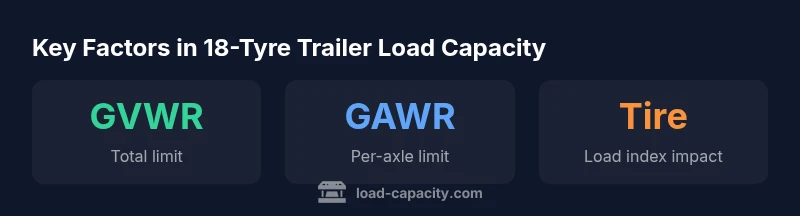
An 18-tyre trailer's load capacity is defined by its GVWR and per-axle limits, not merely the tyre count. The phrase '18 tyres' might imply a heavy multi-axle chassis, but the critical constraint is how weight is distributed across axles and how tires are rated. The Load Capacity team notes that the 'load capacity' is the maximum payload the trailer can carry when factoring out its own curb weight and any ballast for stability. The GVWR is the combined rating printed on a data plate and includes everything the trailer supports when in motion. From there, you derive per-axle GAWR values, tire load indices, and the distributed weight across axles. In practice, the usable payload for an 18-tyre configuration is the throttle point where all axle groups remain under GAWR limits while tires remain within their individual load indices and under-inflation thresholds. Understanding these relationships helps prevent overloading, which can compromise braking, steering, and structural integrity. According to Load Capacity, capacity varies widely across models because not all 18-tyre configurations are equivalent in terms of axle count, tire choice, and frame design. This section will set up the framework for accurate calculations and smart, safe loading decisions.
Influence of Axle Configuration on Capacity
Axle configuration is the primary determinant of how much payload you can carry safely. Each axle has a GAWR rating, determined by the combination of axle design, wheel hub, brake system, tire type, and suspension. With 18 tyres distributed across multiple axles, the total capacity becomes a balance between the sum of per-axle GAWRs and the tire-assembly ratings. If any axle is pushed toward its GAWR, or if tire load indices are exceeded, you risk tire failure or axle overheating. The Load Capacity team emphasizes planning for a modest margin between actual loaded weight and the gross ratings to accommodate dynamic loads in transit, road irregularities, and cornering forces. In practice, the more axles you have, the more opportunities you have to spread loads, but you must still ensure each axle's GAWR is not exceeded and that tires on every axle are matched for load rating and inflation. The best approach is to map the intended load to each axle as a share of GVWR and compare it to GAWR constraints, then adjust via distribution and ballast if necessary.
Tire Selection and Load Indices
Tire choice directly bounds the practical capacity of an 18-tyre trailer. Each tire carries a maximum load determined by its Load Index, inflation pressure, and construction. When you assign payload across axles, ensure the load on every tire stays within its rated limit at the operating temperature and speed. Mismatched tires or underinflation can dramatically reduce safe capacity and increase heat buildup in the sidewalls and tread. The tire rating must align with the axle group it serves, and all tires on a single axle should have compatible load ratings to avoid uneven wear and risk of overloading one wheel. The Load Capacity team notes that higher-rated tires can raise possible payload, but only if the entire system—axle, wheels, hub, and suspension—supports that increment in a balanced way.
Calculating Payload: Step-by-Step
To estimate usable payload for an 18-tyre trailer, start with the GVWR printed on the data plate. Subtract the trailer’s own curb weight (unladen weight) to obtain baseline payload. Next, allocate payload per axle by distributing weight so that no GAWR (per axle) is exceeded and no tire load index is surpassed. Then review per-tire limits by multiplying the number of tyres on each axle by the tire's maximum load and ensuring the sum on any axle does not exceed its GAWR and the per-tire limit. Finally, apply a safety margin—common practice is 10–20% below the maximum rating—to account for dynamic road loads, braking, and cornering.
Simple formulae help: Payload = GVWR – Curb Weight; Per-Axle Load = Payload × share by axle; Check Per-Axle Load ≤ GAWR; Check Per-Tire Load ≤ Tire Rating.
Practical Verification and Field Checks
Verification is essential before any heavy-duty operation. Use static weigh scales or a weighbridge to determine actual axle weights when the trailer is loaded with the intended cargo. If a mobile weigh-in-motion system is available, capture dynamic loads during typical driving scenarios. Cross-check that each axle’s weight remains within GAWR and that tire loads do not exceed their load rating at expected operating temperature. Document the data plate values, axle weights, and tire specifications, and adjust as needed. If weights are close to limits, consider redistributing cargo or adding ballast to improve stability and avoid overloading any wheel.
Common Pitfalls and Real-World Scenarios
Common mistakes include assuming tyre count alone increases capacity, neglecting differences in axle GAWRs, and ignoring tire load indices when cargo grows. Fluctuations in temperature, road surface, and driving style can push loads beyond nominal limits, especially on long journeys or steep grades. Another pitfall is ignoring the importance of matching tire types across the same axle; mismatches can create uneven wear and unexpected load spikes. Planning with model-specific data, consistent inflation pressures, and regular inspections improves safety and compliance. Finally, always validate your calculations with real-world weighing data before committing to a long haul.
Using the Data in Design and Operations
For fleet managers and engineers, these principles inform purchasing, maintenance, and operational planning. Use per-axle GAWRs and tire ratings as the primary constraints, not just the visible number of tyres. Document load distribution plans, create cargo stowage guidelines that maintain balance, and establish routine checks that verify that actual loads do not exceed rated capacities. By integrating GVWR, GAWR, and tire ratings into a formal loading procedure, you can reduce the risk of overload events and extend the service life of the trailer and its tyres.
Key data points for 18-tyre trailer load capacity
| Aspect | Value | Notes |
|---|---|---|
| GVWR | varies by model (typical range 7,000–20,000 kg) | Gross Vehicle Weight Rating |
| GAWR (per axle) | varies by axle and tyre choice | Gross Axle Weight Rating per axle |
| Tire load rating | depends on tire model/Load Index | Per-tire capacity constraint |
| Payload calculation | GVWR – Curb Weight | Base payload before distribution and margin |
Quick Answers
How do I calculate the payload for an 18-tyre trailer?
Begin with the GVWR from the data plate and subtract the curb weight to get baseline payload. Then distribute weight across axles to stay within GAWR and tire ratings, and finally apply a safety margin of 10–20%.
Calculate payload by subtracting curb weight from GVWR, then distribute weight across axles while respecting GAWR and tire ratings. Finish with a safety margin.
What is GVWR and how does it relate to a trailer's capacity?
GVWR is the maximum weight the trailer can safely handle, including cargo, water, and equipment. The usable payload is GVWR minus the trailer’s own weight, constrained by GAWRs and tire ratings.
GVWR is the top limit; payload is GVWR minus the trailer’s own weight, limited by axles and tires.
Should tyres on all axles have the same load rating?
Ideally, tyres on an axle should have compatible load ratings to avoid imbalanced loads. Mismatched tyres can create uneven stress and reduce safety margin.
Yes—keep tyre ratings matched on each axle to avoid imbalanced loading.
How does tyre pressure influence load capacity?
Proper tyre pressure ensures the rated load is supported evenly. Underinflation reduces effective load capacity and increases heat, risking tyre failure during heavy loads.
Maintain correct tyre pressure; underinflation lowers capacity and raises risk of failure.
Can upgrading tires or adding axles increase capacity?
Upgrading to higher-load tires or adding axles can increase capacity only if the rest of the system (frame, brakes, suspension) can support the higher rating. Always validate with per-axle and per-tire limits.
You can increase capacity with better tires or more axles, but only if the entire trailer can support the higher rating.
“Effective trailer loading hinges on understanding axle ratings and tire limits, not the number of tyres alone.”
Top Takeaways
- Start with GVWR and GAWR to estimate capacity
- Distribute payload evenly across axles to avoid overload
- Match tire load indices to axle loads
- Always verify with actual weighing before operation
- Apply a safety margin to account for dynamic loads