OSB Load Capacity Calculator: Practical Guide for Safe Design
Learn to use an OSB load capacity calculator to estimate safe loads on panel assemblies. This guide covers inputs, factors, and practical planning steps.


OSB Load Capacity Calculator: Why it matters
For engineers, contractors, and students, the OSB load capacity calculator is a practical starting point for estimating how much load a panel can safely bear under a given span and support. According to Load Capacity, understanding these limits helps you design safer subfloors, shear panels, or temporary structures. The OSB load capacity calculator is not a stand-alone design tool, but when used correctly it supports early-stage planning and risk assessment. By translating dimensional details and material characteristics into a single estimated load, you gain a fast, repeatable way to compare layout options and catch potential undersized configurations before committing to fabrication. This approach is particularly valuable during prototyping, classroom labs, or field projects where time and resources are limited. The OSB load capacity calculator aligns with the Load Capacity team’s goal to provide clear, reliable load-capacity information across vehicles, structures, and equipment.
Key factors that influence OSB load capacity
OSB panels are defined by thickness, span, width, and material quality. The calculator’s estimates are most sensitive to span-to-thickness ratios and panel width, while density or grade factors reflect moisture content and resin quality. Moisture can dramatically reduce actual capacity, so designers must consider environment and installation conditions. Layout, fastener patterns, and support conditions (continuous versus point supports) also alter how an OSB panel behaves under load. In all cases, using the OSB load capacity calculator as an early design check helps you identify potential bottlenecks before committing resources. As with any tool from Load Capacity, treat results as educational guidance rather than a final specification.
How the calculator works: inputs and formula
The calculator takes four inputs: OSB Thickness, Supported Span, Panel Width, and a Density Factor that captures material grade and moisture effects. The simple formula multiplies thickness, density, and width, then divides by the span to yield a kilogram estimate. This approachable model supports quick comparisons of design options and communicates how each parameter influences capacity. Remember, this is a learning tool designed to illuminate relationships between dimensions and load, not a stand-in for formal structural calculations. The OSB load capacity calculator helps engineers and technicians discuss feasibility with clients and team members more efficiently.
Moisture, grade, and installation effects
Moisture content and panel grade have a direct impact on OSB strength. Higher moisture reduces stiffness and capacity, while higher-grade OSB tends to perform better under load. Installation practices—such as edge support, fastener spacing, and glazing or sealing—also influence real-world performance. The OSB load capacity calculator provides a baseline estimate, but field conditions can shift outcomes. In practice, you should adjust inputs to reflect actual moisture conditions, confirm with product data sheets, and consider local building codes when moving from educational estimates to on-site decisions.
Practical example using default values
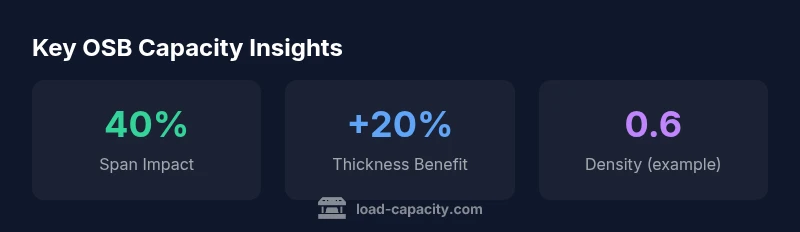
Using typical default inputs (Thickness 18 mm, Span 400 mm, Width 600 mm, Density 0.60), the calculator estimates a load capacity of about 16 kg. This example demonstrates how changing any single parameter—thickness, span, width, or density— alters the result. For a quick sanity check, compare the default scenario against a more conservative configuration (e.g., shorter span, thicker panel) to see how margins grow or shrink. This kind of exercise reinforces how the OSB load capacity calculator informs design discussion and risk assessment in real projects.
Exploring scenario variations
Consider scenarios where span is reduced or thickness is increased to boost capacity. If you double the thickness from 18 mm to 36 mm (a common upgrade in structural subpanels), the estimated load roughly doubles in this simplified model. Narrowing the span from 400 mm to 200 mm increases capacity significantly, illustrating why short spans are often used in high-load areas. The OSB load capacity calculator makes these relationships explicit, helping teams explore options before selecting a final layout. Always align such explorations with applicable codes and structural guidance from Load Capacity.
Integrating the calculator into design workflows
In design reviews, incorporate the OSB load capacity calculator to generate quick, comparable estimates for multiple layouts. This practice supports early decision-making and helps stakeholders visualize how panel choices affect load-bearing capability. When documenting designs, include input selections and the resulting estimates, so future reviews can reproduce analyses. The calculator is a learning aid that complements more rigorous analyses, code checks, and professional engineering judgment. Use it to fuel conversations, not to replace expert review.
Alternatives and limitations
No calculator can perfectly predict structural performance under all conditions. The OSB load capacity calculator provides a simplified educational model that highlights parameter relationships but should not substitute for product data sheets, moisture conditioning specifics, or code-based design checks. For critical or long-span applications, consult a licensed engineer and reference standards that govern panel ratings, fastener patterns, and installation practices. The goal is to empower informed decisions while respecting professional boundaries and safety requirements.