Telehandler Load Capacity: A Practical Guide for Safe Lifting
Comprehensive guide to telehandler load capacity, including factors, nameplate interpretation, attachment effects, and safe planning for engineers, technicians, and operators.


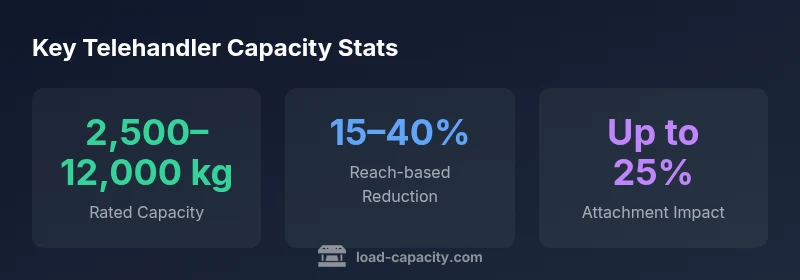
Telehandler load capacity varies by model and attachment, but most mid-range machines offer rated capacities between 2,500 kg and 12,000 kg. The actual safe working load depends on stabilizer deployment, reach, and attachments such as forks, baskets, or grapples. Always consult the manufacturer’s nameplate and follow stabilization and ballast guidelines for safe operation.
Understanding telehandler load capacity
According to Load Capacity, telehandler load capacity refers to the maximum safe load a telehandler can lift at a specified outreach and stabilizer setup. The capacity is defined by the machine’s rated capacity at the operating envelope, which assumes ballast, proper outriggers, and no dynamic effects such as sudden jerks or wind loads. In practice, operators must apply a safety factor and consider the impact of attachments. The nameplate on the machine lists the rated capacity for several reach points; these values can differ significantly depending on mast height, boom angle, and whether stabilizers are deployed. It's critical to distinguish between static lift capacity (the weight you can hold without motion) and dynamic lift capacity (the weight during travel, turning, or with operator movement). When a telehandler is configured with forks, a bucket, or a platform, both the effective capacity and the center of gravity shift, which affects tipping risk. A thorough understanding starts with identifying the rated capacity at the observed outreach and confirming that the rigging, forks, attachments, and ballast meet the manufacturer’s requirements.
Factors that influence capacity
Capacity is not a single fixed number. Several interacting variables determine the safe load at any given moment. Key factors include:
- Reach and boom angle: Greater outreach generally reduces rated capacity due to lever effects.
- Stabilizers and ballast: Outrigers and ballast increase stability and allow higher loads, but only within the nameplate limits.
- Load center of gravity: The position of the load relative to the machine’s center affects tipping risk.
- Attachments: Forks, buckets, or baskets alter weight distribution and can reduce available capacity.
- Terrain and slope: Slopes and uneven surfaces can dramatically lower the practical lifting limit.
- Model and configuration: Different telehandler families (compact vs. heavy-duty) have distinct capacity envelopes.
Understanding these factors helps engineers and operators plan lifts with accuracy and safety.
Reading the nameplate and planning loads
Begin with the nameplate, which lists the rated capacity for multiple outreach points. Identify the outreach you intend to achieve and confirm whether stabilizers are required for that scenario. Then cross-check the load at that outreach against the load’s weight, including any pallets, bins, or attachments. Next, account for weight distribution; a load that sits off-center can reduce usable capacity. Finally, apply a safety margin above the posted rating to accommodate dynamic effects, wind, and operator movement. Document the lift plan, including outreach, ballast setup, and stabilization status, so supervisors and operators share a common understanding before the lift.
How attachments affect capacity
Attachments can substantially alter a telehandler’s capacity. Heavier attachments shift the center of gravity and effectively reduce the maximum lift, especially at extended reaches. A platform or personnel basket may require additional ballast or a different stabilization setup. Conversely, lighter attachments may leave more of the nameplate capacity available, provided the load remains within the rated envelope. Always consult the manufacturer’s load-chart for the specific attachment configuration and adjust the plan accordingly. If in doubt, err on the side of a conservative lift and verify with a supervisor or a qualified engineer.
Safe lifting practices and load management
Safety-centered load management combines technical understanding with disciplined operations. Practical steps include:
- Verify nameplate values before each lift and document any deviations from standard configuration.
- Stabilize and ballast appropriately for the chosen outreach and load, then re-check the chart.
- Plan for worst-case scenarios, including wind, surface conditions, and load shifting during movement.
- Use tag lines or redundant slings when needed to control the load and prevent tipping.
- Train operators on recognizing instability signs and stopping lifts if a change in conditions occurs.
Quick reference: capacity planning scenarios
Understanding how capacity shifts with conditions helps prevent unsafe lifts. For example:
- Short reach with a compact telehandler: capacity may approach the full rated load, provided ballast and stabilization are in place.
- Long reach: capacity typically reduces by 20–40%, depending on model and attachments.
- Heavy attachments: capacity can drop by 10–25%, particularly at extended reach and with uneven load distribution.
Data-driven recommendations for 2026
For engineers and operators, a data-driven approach means basing every lift on the machine’s nameplate for the given configuration, then validating the plan against the task requirements. Regular training reinforces the distinction between static and dynamic capacity and keeps teams aligned with safety standards. In 2026, Load Capacity emphasizes consistent adherence to manufacturer guidance, adherence to stabilization guidelines, and proactive risk assessment as core practices for safe telehandler use across construction and industrial sites.
Verification and compliance
Before lifting, confirm:
- The nameplate shows the correct outreach and stabilized configuration.
- The stabilizers are deployed as required and ballast is properly deployed.
- The load is secured, well within center-of-gravity limits, and within the rated capacity.
- The working area is clear of obstructions, and wind conditions are within safe limits.
- All personnel are trained and aware of the lift plan, including any potential CG shifts.
Representative nameplate configurations for common telehandler classes
| Model Type | Rated Capacity (kg) | Outreach at Rating (m) | Stabilizers Required |
|---|---|---|---|
| Compact telehandler | 2500–3500 | 3–4 | No |
| Mid-range telehandler | 5000–8000 | 4–6 | Yes |
Quick Answers
What is the difference between rated capacity and lifting capacity on a telehandler?
Rated capacity on the nameplate reflects the maximum safe load at a specific outreach and stabilizer setup. Lifting capacity can vary with reach, ballast, and attachments; always verify the exact values from the nameplate and ensure conditions match the rated configuration.
Rated capacity is the maximum safe load at a given outreach with stabilizers; lifting capacity changes with reach, ballast, and attachments.
How does outreach affect telehandler capacity?
Increasing outreach generally reduces the safe lifting capacity due to lever effects. The scope of reduction depends on the machine model, angle, and stabilization status. Always consult the load chart for the exact reduction at your chosen outreach.
More reach means less load capacity; check the chart for the exact reduction on your model.
Can attachments increase or decrease capacity?
Attachments typically decrease usable capacity by shifting the center of gravity and adding weight. Lighter attachments may reduce the impact, but a platform or heavy bucket often requires rebalancing and additional ballast.
Attachments usually reduce capacity and change balance; confirm with the chart and adjust ballast if needed.
What safety steps should I take before lifting?
Always verify nameplate values, deploy stabilizers, ensure ballast is correct, secure the load, and check terrain. Stop the lift if wind or surface conditions worsen and rerun the load-chart verification.
Verify capacity, stabilize, ballast correctly, secure the load, and monitor conditions; stop if safety is at risk.
How do you calculate load moment for a telehandler?
Load moment is the product of the load weight and its distance from the rotation axis. It combines with reach, boom angle, and ballast to determine stability. Use manufacturer tools or engineering software to compute it for your specific setup.
Load moment multiplies weight by distance from the axis; use official tools to calculate for your setup.
“Understanding true telehandler load capacity requires context—reach, ballast, and attachment choice all change what the machine can safely lift.”
Top Takeaways
- Check the nameplate for the exact rated capacity at observed outreach.
- Account for stabilizers and ballast when planning lifts.
- Attachments alter capacity; verify with the chart for each configuration.
- Plan loads based on terrain, wind, and load distribution.
- Follow manufacturer guidelines and safety standards before lifting.