Safe Working Load vs Rated Capacity: Understanding the Difference for Safer Lifting
Explore the difference between Safe Working Load (SWL) and rated capacity, how they’re determined, and how to apply them safely in cranes and lifting systems. Learn to read nameplates, build safer lifting plans, and improve on-site decision-making.


Quick takeaway: Safe Working Load (SWL) and rated capacity describe how much load equipment can safely handle, but they come from different standards. SWL is a practical threshold used by operators, while rated capacity reflects manufacturer and code-based limits. When used correctly, they help prevent overload, misapplication, and equipment failure.
What Safe Working Load vs Rated Capacity Really Means
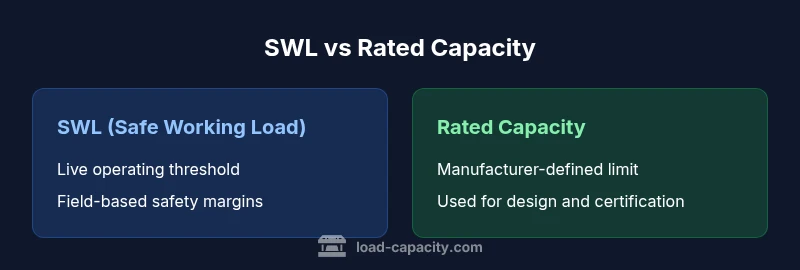
In everyday lifting work, two phrases routinely appear on equipment nameplates, charts, and job plans: safe working load (SWL) and rated capacity. Although the terms are related, they describe different ideas and come from different origins. The safe working load is the practical load a piece of equipment is expected to handle safely under typical field conditions. The rated capacity is the maximum load a device is permitted to carry according to manufacturer guidance and applicable standards. For engineers and technicians, the distinction matters because misinterpreting one as the other can lead to overloading, missed safety margins, or unnecessary downtime. In practice, you will see SWL used by operators when planning a lift and by supervisors to confirm that the task falls within safe limits. The rated capacity should guide design calculations and procurement decisions. Understanding both concepts helps you build safer lifting plans, maintain compliance, and communicate clearly with everyone on the job site.
Why the Distinction Matters in Lifting Equipment
Lifts, hoists, and cranes operate near the edge of safe performance. If SWL is treated as the same as rated capacity, or if rated capacity is ignored in the field, the risk of overload increases. The SWL provides an accessible threshold for day-to-day operations and should be treated as a conservative baseline. Rated capacity is essential for ensuring the equipment is used within its tested and approved limits and for verifying compliance with codes and manufacturer requirements. The practical effect is that SWL informs the operator’s live decisions during a lift, while rated capacity informs engineers, suppliers, and maintenance staff who design, select, and certify gear. When used together with proper rigging, load-path analysis, and task planning, they create a safety envelope that accounts for dynamic loads, friction, wind, and other uncertainties. Clear delineation—what is safe to lift in the moment vs what the manufacturer says the device can safely carry in principle—reduces ambiguity and improves on-site safety.
How SWL and Rated Capacity Are Determined
The way SWL is set can vary by equipment type and jurisdiction, but it generally reflects empirical testing, field experience, and conservative engineering judgment. SWL is often presented as a practical limit derived from a combination of the device’s structural capacity, the efficiency of the rigging, and typical operating conditions. Rated capacity, by contrast, is baked into specifications provided by the manufacturer and supported by testing, certifications, and standards alignment. Because both values relate to load handling, it is essential to verify that the SWL used on a job is consistent with the device’s rated capacity. Operators should not assume that a device can carry more than its rated capacity simply because it lifted similar loads in another job. When possible, confirm the SWL with the equipment logbook, the current nameplate, and any recent maintenance or load-test records.
Common Confusion Points and Misuses
- Interchanging SWL and rated capacity: Treat them as related but not identical.
- Overlooking dynamic effects: Lifts create peak loads that can exceed static ratings.
- Misreading nameplates: Some labels show only a single number without context for the limit.
- Ignoring rigging and sling capacity: These components can impose their own limits that constrain the overall load.
- Using outdated documentation: Equipment can change ratings after maintenance or modification.
- Neglecting maintenance and inspections: A healthy nameplate and test certificate are essential for accurate limits.
These pitfalls are common in busy job sites. The remedy is a formal lifting plan that documents the SWL and the rated capacity for every task, including the rigging, obstruction clearance, and the load path. Training and regular refreshers help crews recognize when the two values diverge and what steps to take to stay within safe margins.
How to Apply SWL and Rating in Practice
- Start with the manufacturer’s rated capacity for the equipment you intend to use.
- Set the live SWL in the field to a value that remains safely below that rating, factoring in dynamic effects.
- Verify the rigging, attachments, and load-path; ensure they do not become the new bottleneck.
- Check load stability, wind, and proximity to people or obstacles before lifting.
- Document the lift plan, including SWL, rated capacity, and contingency actions.
- Review the plan with the operator and the supervising engineer before starting the lift.
- After the lift, record outcomes and any deviations for future reference.
For teams, a standard operating procedure (SOP) should align SWL with the rated capacity and provide clear guidance on exceptions, rework, or stop-work triggers when conditions change.
Industry Standards and Definitions
Across industries, the vocabulary around crane capacity is shaped by standards, manufacturer guidance, and safety regulations. Safe Working Load and rated capacity are widely used terms, but their precise definitions can vary by equipment class (cranes, hoists, booms) and by region. In practice, most organizations adopt a two-tier approach: rely on the rated capacity for design and certification purposes, and use an SWL-derived value for field operations and task planning. This approach also supports traceability, since you can link field decisions to a specific load-test result or certification document. The key takeaway is to keep definitions aligned with the documentation on the equipment’s nameplate, its maintenance history, and any amendments from safety authorities. When in doubt, consult the manufacturer’s documentation and your compliance team.
Case Studies: Real-World Scenarios
-
Scenario A: A construction crane lifts a heavy steel bundle after replacing a beam. The operator consults the nameplate and confirms the SWL is near the limit, while the rated capacity remains within the original specification. By planning the lift to stay well below the rated capacity and using a longer load path to reduce peak forces, the team completes the lift safely and without incident.
-
Scenario B: A maintenance team uses a hoist to lift a large component. The pre-lift plan notes wind gusts and a misaligned rigging point that could increase peak load. The SWL is reduced accordingly, and the team documents the revised plan. The lift proceeds smoothly, and post-lift inspection shows no wear or damage.
These examples illustrate how following the SWL vs rated capacity distinction reduces risk and supports compliant operations. They also show the need for ongoing training and frequent refreshers in the field.
Implications for Safety, Compliance, and Training
Organizations should treat SWL and rated capacity as living parts of their safety culture. Training programs must cover how to interpret nameplates, how to translate rated capacity into practical field decisions, and how to document every lift. Compliance programs should require periodic audits of lifting plans, rigging selections, and load-path analyses. Additionally, maintenance and testing activities should be scheduled to ensure the equipment's current rated capacity matches its physical condition. Where gaps exist, corrective actions should be defined and tracked. For engineers, the implication is to build redundancies into the planning process, such as checklists that verify the SWL, the rigging capacity, wind limits, and proximity to people. For operators, real-time decision support, such as readouts and visual cues showing the margin to failure, can help sustain safe practice on busy days.
Practical Guidelines for Engineers and Technicians
- Always start with the rated capacity and work down to SWL for field operations.
- Require current documentation: recent test certificates, maintenance logs, and nameplates.
- Use margin analysis to account for dynamic loads and rigging losses.
- Train teams to recognize when the two values diverge and what actions to take.
- Maintain clear communication across site roles to align safety expectations.
These guidelines help you implement a consistent, auditable approach to lifting operations, improving safety, reliability, and compliance.
When to Consult Manufacturer Documentation
When there is ambiguity, escalate to the equipment manufacturer’s documentation and published guidelines. Do not rely solely on past Lift Plans or ad hoc experience. Manufacturer documentation often contains: the official rated capacity, the safe operating procedures (SOPs), chart overlays for different rig configurations, and any device-specific limitations. In complex lifts, contact the manufacturer or a qualified engineer for guidance before proceeding. Keeping a record of the consultation helps with future audits and training.
How to Communicate with Stakeholders
Clear, concise communication is essential for safe lifting. Translating technical terms into actionable steps helps site managers, clients, and workers understand the safety margins. Use the SWL-to-rated-capacity distinction to justify decisions, share the lifting plan, and document deviations. Encourage questions and provide training opportunities so everyone understands where the limits lie and how to stay within them. A well-documented plan reduces surprises and improves accountability.
Comparison
| Feature | SWL-based Approach | Rated-Capacity-Based Approach |
|---|---|---|
| Definition source | SWL derived for field safety and practical limits | Rated capacity defined by manufacturer and standards |
| Primary use | On-site lifting decisions and task planning | Design, certification, procurement, and compliance |
| Safety margin | Conservative live threshold to protect against uncertainty | Formal limit tied to tested and approved conditions |
| Documentation emphasis | Live lift plan, rigging checks, margin to failure | Certificates, nameplates, test records, design documents |
| Best for | Day-to-day field operations and quick decisions | Engineering calculations and regulatory compliance |
| Dynamic considerations | Accounts for dynamics in a practical setting | Centers on static ratings supplemented by checks |
| Typical user | Operator and supervisor | Engineer, maintenance supervisor, and safety officer |
Positives
- Clarifies how to manage lifting tasks safely
- Encourages consistent procedures and documentation
- Improves communication among site roles
- Supports training and audits
Cons
- Risk of confusion if terms are misused
- Requires up-to-date documentation and training
- May seem duplicative if organizations don't align processes
- Dependence on manufacturer updates for accuracy
Adopt a dual-criteria approach that uses SWL as the live operating threshold while verifying against rated capacity for compliance and design.
SWL provides practical guardrails for field operations, while rated capacity ensures alignment with maximum device limits and regulatory requirements. Together, they improve safety, enable audits, and support consistent decision-making. Implement SOPs and training to sustain this approach.
Quick Answers
What is the difference between safe working load and rated capacity?
SWL is the live, field-ready threshold operators use to plan lifts, while rated capacity is the formal limit defined by the equipment maker and standards. The two are related but not interchangeable. Understanding both helps prevent overloading and ensures compliance.
SWL is what you can lift safely on site, RC is the official limit from the manufacturer. They work together to keep lifts safe and compliant.
When should SWL be reduced?
SWL should be reduced whenever dynamic effects, wind, rigging inefficiencies, or critical proximity to people or obstacles increase the risk. Always re-check the plan against the equipment’s rated capacity before proceeding.
Reduce SWL if conditions change or you foresee higher dynamic loads. Re-check the plan before lifting.
Can I lift above SWL if I have low wind?
No. SWL is a conservative safety threshold for field operations and does not override the rated capacity. Always ensure the lift remains within the rated capacity and follows the formal lifting plan.
Even with low wind, you should not exceed the SWL or RC; follow the plan.
Who approves the lifting plan?
The lifting plan should be reviewed and approved by the supervisor or engineer responsible for safety, with final authority resting on site procedures. Documentation of approval is essential for audits.
A supervisor or safety engineer must approve the plan and keep records.
What documents should I keep for lifts?
Maintain the nameplate, current load-test records, maintenance logs, rigging certificates, and the formal lift plan. These documents support decisions and help during inspections.
Keep nameplates, test records, maintenance logs, and the lift plan.
How can I train staff on SWL vs rated capacity?
Use practical drills, SOPs, and scenarios that contrast SWL decisions with rated capacity requirements. Regular refreshers reinforce correct interpretation and reduce field errors.
Train with real scenarios so teams see how SWL and RC drive different decisions.
Top Takeaways
- Define SWL and rated capacity clearly in SOPs
- Always verify live SWL against device’s rated capacity
- Document every lift and maintain records
- Regular training reduces confusion and noncompliance
- Keep manufacturer documents up to date and accessible