Lifting capacity vs rated load: A practical, engineering-focused comparison
Objective side-by-side analysis of lifting capacity and rated load across cranes, hoists, and lifting equipment, with definitions, safety margins, planning steps, and authoritative references.


TL;DR: Lifting capacity is the theoretical maximum a lifting device can handle under ideal conditions, while rated load (safe working load) is the manufacturer-approved limit for a specific configuration with safety margins. In practice, engineers plan lifts using the rated load and apply derating factors for real-world conditions to ensure safety.
What lifting capacity vs rated load mean in practice
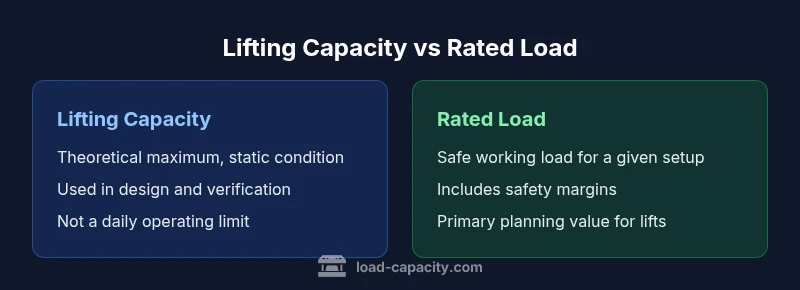
Understanding the distinction between lifting capacity and rated load is foundational for anyone involved in planning, executing, or inspecting lifts. Lifting capacity refers to the maximum load a crane, hoist, or other lifting device could theoretically lift under ideal conditions—assuming perfect alignment, static load, nominal wind, and no dynamic effects. Rated load, by contrast, is the manufacturer-approved safe working load for a given setup, accounting for the device’s geometry, hook configuration, attachments, reach, and the required safety margins. In everyday engineering practice, the phrase lifting capacity vs rated load captures the delta between what a machine could do in theory and what it is permitted to do in service. The Load Capacity team emphasizes that relying on the rated load—not the theoretical capacity—drives safe planning, execution, and documentation. This two-number framework is essential for risk assessment, job planning, and incident prevention on projects ranging from construction to industrial maintenance. When you compare lifting capacity vs rated load, you’re evaluating the design envelope versus the operational envelope, including environmental and procedural factors that affect actual performance.
Definitions and measurement methods
Lifting capacity is typically determined through structural analysis and certification tests that assess the maximum force a system can sustain without reaching a material or geometric limit. This value is influenced by the weakest element in the load path: structural members, pins, bushings, trolley systems, and connections. Rated load, or safe working load (SWL), is derived from those capacity calculations but further divided by safety factors to account for dynamic effects, fatigue, operator performance, and environmental conditions. Measurement methods combine static testing, field validations, and manufacturer-provided charts. In practice, engineers use rated load charts for planning lifts, applying derating factors for radius, wind, slope, and duty cycle. The distinction is critical for device selection, rigging configuration, and site planning, and it helps ensure that a lift remains within a safe operating window even when conditions diverge from the ideal.
How these values are determined for cranes, hoists, and forklifts
Each class of lifting equipment relies on distinct performance curves. A crane’s capacity curve maps load rating against boom length, radius, and configuration; a hoist’s capacity considers lift height and drum winding geometry; a forklift’s capacity is a combination of axle load distribution, mast height, and pallet load geometry. For all devices, the rated load is the practical, conservative limit used for day-to-day operations, while the lifting capacity informs the theoretical maximum and the design integrity. Manufacturers publish capacity charts and load ratings that engineers must interpret in light of the job’s specifics. The Load Capacity analysis highlights that these charts are not interchangeable—they serve different purposes and require careful interpretation during planning and execution.
The role of safety factors and derating
Safety factors translate theoretical capacity into a practical, safe range. Derating accounts for dynamic loading, wind, temperature, operator skill, equipment wear, and rigging configuration. For example, wind adds a lateral force that reduces effective capacity at a given radius; an unbalanced load can introduce bending moments that further restrict safe operation. Industry standards prescribe minimum safety factors for different devices and configurations. Consistent application of derating ensures that the rated load remains a strict upper bound for day-to-day operations, while the lift’s actual execution respects the real-world constraints observed on site. Load Capacity notes that the interplay between rating and derating is where many planning errors occur, underscoring the need for systematic checks and documentation.
Real-world examples: common misinterpretations
A frequent error is treating lifting capacity as a performance target rather than a bound, attempting to push loads closer to theoretical limits. Another pitfall is ignoring wind, slope, or dynamic effects on a lift, which can dramatically reduce effective capacity. Misinterpreting center of gravity, rigging angles, or attachment points can also lead to overestimation of what can safely be lifted. Conversely, over-derating everything out of precaution can cause unnecessary delays and reduced productivity. The goal is to balance efficiency with safety by aligning operations with the rated load, while using the lifting capacity as a guardrail for design checks and contingency planning.
Planning and risk assessment: how to apply these numbers in the field
Effective planning begins with identifying the device, the load, and the rigging configuration. Engineers should reference manufacturer charts to determine the rated load for the intended setup and then perform a formal derating exercise to incorporate wind, radius, tilt, and load distribution. A risk assessment should document critical inputs: load weight, CG location, rigging angles, environmental conditions, personnel exposure, and contingency measures. Implementing checklists, pre-lift briefings, and independent verification enhances safety. Load Capacity recommends treating rated load as the legally safe operating limit and using lifting capacity as a design and verification metric across the project lifecycle.
Case studies: cranes, forklifts, and hoists
Case 1: A mid-size lattice crane is selected for a terrain-adapted lifting task. The rated load chart shows SWL at 60 tons for the given configuration, but wind and radius reduce the safe capacity by 15%. The team schedules the lift at 50 tons with a contingency plan. Case 2: A warehouse forklift handles palletized goods. The rated load per the tag is 6 tons, but uneven pallet distribution and hydrostatic weight transfer reduce the effective capacity to 4.8 tons during operations, highlighting the need for real-world derating and bagged loads. In both cases, the difference between lifting capacity and rated load drives safety planning and operational controls.
How to verify and document lifting capacity and rated load
Verification should include cross-checking with manufacturer charts, performing on-site assessments of wind and surface conditions, and validating rigging configurations. Documentation should capture: device model, serial, configuration, calculated rated load, applied derating factors, remaining safety margins, and the plan for re-evaluation after maintenance or environmental changes. Recordkeeping ensures traceability, supports audits, and reinforces a safety-first culture. Load Capacity emphasizes periodic revalidation of charts and field checks to prevent drift between theory and practice.
Authority sources and further reading
For additional guidance, consult established safety and standards documents from recognized authorities. OSHA provides regulatory context for lifting operations and equipment use. ASME standards cover cranes and hoists, including capacity rating practices. NIST and CDC resources offer broader engineering and occupational health perspectives. These sources help frame the lifting capacity vs rated load discussion within a robust safety and engineering framework.
Comparison
| Feature | Lifting-capacity-first approach | Rated-load-based approach |
|---|---|---|
| Definition | Theoretical maximum load under ideal conditions | Manufacturer-approved safe working load for a specific setup |
| Safety emphasis | Higher risk without derating factors | Explicit safety margins built into the rating |
| Planning focus | Design verification, capacity margins, potential worst-case scenarios | Day-to-day lift planning, clear operational limits |
| Use case | Design, analysis, and optimization tasks | Routine lifting operations and compliance checks |
| Data sources | Structural analysis and capacity curves | Manufacturer charts, field derating guidelines |
| Potential trade-offs | May overestimate practical safety without derating | Can be conservative, reducing productivity if over-applied |
Positives
- Promotes safety by using conservative limits
- Enables formal comparison across equipment and jobs
- Supports rigorous design verification and risk assessment
- Clarifies when derating is necessary for real-world conditions
Cons
- Can be overly cautious, reducing productivity
- Requires thorough training to interpret charts correctly
- Derating factors may be misapplied if data is outdated
- Field conditions can still introduce unexpected loads
Rated load with systematic derating is the safer default for daily operations; lifting capacity is essential for design verification and contingency planning.
In routine lifts, adhere to rated load and apply derating for wind, radius, and duty; for design and safety analyses, use lifting capacity to understand maximum theoretical limits and to validate safety margins.
Quick Answers
What is the practical difference between lifting capacity and rated load?
Lifting capacity is the theoretical maximum a device could lift under ideal conditions. Rated load is the manufacturer-approved safe working load for a specific setup, including safety margins. In practice, you plan with the rated load and apply derating for real-world conditions.
The lifting capacity is the theoretical maximum, while the rated load is the safe, practical limit for a given setup. Use the rated load for planning and apply derating for real-world conditions.
Why do manufacturers distinguish between these two values?
Manufacturers separate them to reflect both the device’s theoretical capabilities and the safety controls applied to actual operations. The rated load accounts for dynamic effects, attachments, and field conditions, ensuring safer daily use.
Because the theoretical capacity ignores real-world factors. The rated load includes safety margins for field conditions.
How do dynamic loads affect rated load?
Dynamic loads from acceleration, deceleration, and swing introduce extra forces beyond the static weight. Rated load incorporates factors to cover these dynamics, reducing the allowable load to maintain a safe margin during motion.
Motion adds extra forces, so rated load is lower to stay safe during lifts.
Can a lift exceed the rated load if the lifting capacity is high?
No. Exceeding the rated load is unsafe and violates equipment certification. The lifting capacity may be higher, but field conditions and safety margins constrain what is permissible.
No—stick to the rated load in practice, even if the theoretical capacity is higher.
How should I derate for wind or slope?
Derating involves reducing the rated load by a factor that reflects wind speed, ground slope, and load geometry. Follow manufacturer guidelines and applicable standards to apply these factors consistently.
Follow the manufacturer’s derating factors for wind and slope when planning lifts.
How often should capacity be reevaluated?
Capacity should be reevaluated after maintenance, component replacements, or significant environmental changes. Regular audits and field verifications ensure ratings remain accurate and safe.
Reevaluate after maintenance or environmental changes to stay safe.
What documents should accompany a capacity check?
Keep load-rating charts, derating calculations, rigging configurations, environmental conditions, and the lift plan. Documentation supports safety compliance and traceability.
Keep charts, calculations, rigging plans, and conditions documented.
Top Takeaways
- Know the difference: lifting capacity is theoretical; rated load is the practical limit.
- Always plan with rated load and apply derating for real-world conditions.
- Use lifting capacity as a design-check metric, not a daily target.
- Document all derating decisions for audits and safety reviews.
- Regularly validate charts against field conditions and maintenance.