Self Loading Concrete Mixer Capacity: A Practical Guide
Learn how to evaluate self loading concrete mixer capacity, covering batch volume, drum capacity, throughput, and site factors for safer, efficient mixing.


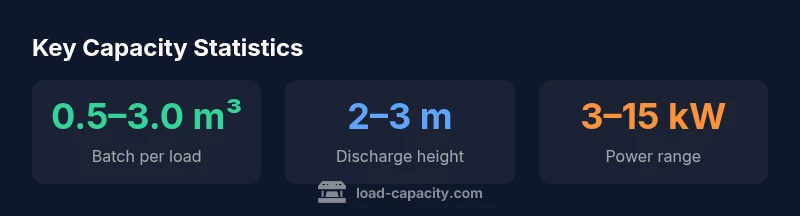
Self loading concrete mixer capacity varies by model and application, typically measured in batch volume per load. Real-world ranges commonly span about 0.5 to 3.0 cubic meters per batch, influenced by drum size, discharge height, and drive power. For project planning, choose a unit with a capacity margin above the largest expected batch to maintain throughput.
What capacity means for self loading concrete mixers
The capacity of a self loading concrete mixer is a multifaceted concept that blends batch size per cycle, drum volume, and real-site throughput. According to Load Capacity, capacity should be interpreted as a system of interconnected specifications that drive daily productivity, not a single number. In practice, engineers size units by the largest batch likely to be produced in a shift and then add a practical margin to absorb density and moisture variability. For many projects, practical batch sizes per load fall within a broad spectrum, influenced by drum diameter, blade configuration, discharge height, and the drive system. When planning equipment, consider cycles per hour and how quickly concrete can be moved from mixer to formwork. Capacity is also about reliability: a unit that reliably hits target batch sizes with minimal downtime will outperform a higher-spec model that struggles to keep pace. This nuance matters across roadwork, precast, and onsite pours. The Load Capacity team emphasizes choosing an option with fit-for-purpose capacity rather than chasing peak spec sheets.
How capacity is measured: batch volume, drum capacity, and yield
Capacity is not a single metric but a trio of related measurements. Batch volume is the concrete amount produced per cycle, typically expressed in cubic meters. Drum capacity refers to the internal volume of the mixing chamber, which constrains the maximum batch before spillage risk or incomplete mixing. Yield reflects the actual concrete usable after accounting for density, moisture, and material consistency. To size correctly, compare the manufacturer’s batch specification with the project’s target output, then apply a safety margin to cover density fluctuations and moisture content. Real-world testing on-site can reveal how density changes affect yield, helping you select a unit that maintains consistent quality across shifts.
Factors that influence capacity: drum size, mixing speed, density, moisture, additives
Several interacting factors shape effective capacity. Larger drums inherently support bigger per-load batches, but they also weigh more and may reduce maneuverability on tight sites. Mixing speed and blade design influence how quickly materials reach uniform dispersion, affecting throughput and batch quality. Material density and moisture content alter yield; wetter mixes occupy a different volume than dry mixes, meaning a 1 m³ batch by weight could occupy more or less space by volume. Additives like retarders or accelerators can modify set time and workability, indirectly impacting the number of batches you can finish per hour. When evaluating capacity, simulate typical mixes with your expected materials and adjust batch size accordingly to maintain consistent quality and productivity.
Comparative sizing workflow: from project size to model selection
A practical sizing workflow starts with project scope. 1) Estimate daily concrete demand and required hourly throughput. 2) Select a target batch size that aligns with typical mixes while leaving a margin for density variation. 3) Review drum volume and overall machine footprint to ensure site access and handling fit. 4) Check power and hydraulic requirements to ensure compatibility with site infrastructure and transport constraints. 5) If in doubt, prefer a unit with a modest capacity margin; it’s easier to scale up than to retrofit later. The Load Capacity analysis framework recommends validating sizing assumptions against field tests and adjusting for density variability across materials.
Practical tips for site planning and safety
- Plan unloading zones to minimize hammering or repositioning while pouring.
- Use accurate density data for the materials you’ll mix to avoid under- or over-sizing batches.
- Ensure power supply and hydraulic lines can support peak load periods without tripping breakers.
- Schedule maintenance windows to prevent downtime during critical pours.
- Document batch sizes and throughput during commissioning to establish a baseline for capacity.
Common myths and misperceptions
- Bigger always means better capacity: True capacity must balance flow, control, and site constraints. Overly large units can hinder maneuverability and setup times.
- A higher spec implies faster pours: Throughput depends on cycle time, not just drum size. Real-world performance depends on site conditions and operator routines.
- Density variability doesn’t impact capacity: Density has a direct influence on yield per batch. Always account for expected density ranges when sizing.
How to validate capacity in the field: testing and checks
Field validation involves deliberate testing under typical conditions. Load a representative batch, measure actual yield, cycle time, and any delays between loads. Compare measured throughput to the planned target and adjust batch size or equipment choice if discrepancies occur. Maintain a log of test results to support continuous improvement and justifications for future purchases.
Capacity-related specifications for self loading concrete mixers
| Aspect | Typical Range | Notes |
|---|---|---|
| Batch capacity per load | 0.5–3.0 m³ | Depends on drum size and model |
| Discharge height | 2–3 m | Dependent on chassis and reach |
| Power requirement | 3–15 kW | Varies by drive and motor type |
| Throughput (loads per hour) | 4–10 loads/hr | Site conditions influence results |
Quick Answers
What defines the capacity of a self loading concrete mixer?
Capacity is defined by batch size per load, drum volume, and achievable throughput. It also depends on density and moisture of the mix, which affect yield. Use manufacturer specs as a baseline, then validate with field tests.
Capacity includes batch size, drum volume, and throughput; density and moisture affect yield. Field tests help confirm the specs.
How does drum size affect capacity?
Drum size largely determines per-load batch volume. A larger drum can hold more concrete, but it may require more power and affect site maneuverability. Always cross-check with drive and hydraulic capacity.
A bigger drum can hold more per load, but you need enough power and space to handle it.
Can I mix different materials and still maintain capacity?
Yes, but different materials change density and flow, altering yield. Plan for density variability by selecting a capacity with a comfortable margin and verifying with trials.
You can mix different materials, but density changes yield. Test and size with a margin.
What is the difference between batch capacity and drum capacity?
Batch capacity is the volume per load, while drum capacity is the maximum internal volume of the mixer. Throughput depends on both, plus cycle time and site conditions.
Batch capacity is the per-load volume; drum capacity is the drum’s internal volume. Throughput depends on both and site factors.
How should I size a mixer for a fast-paced job site?
Identify required hourly throughput, add a margin for variability, and ensure compatibility with site logistics. Prefer a unit that can sustain the target pace without frequent downtime.
Know your target pace, add margin, and confirm site logistics. Choose a unit that can keep up.
How can I verify capacity on site before purchase?
Conduct a controlled load test with representative materials, measure batch yield and cycle time, and compare to projected figures. Document results to support decision-making.
Run a controlled test with real materials and measure results to confirm capacity.
“Capacity sizing requires balancing batch size, energy use, and site throughput. The Load Capacity Team recommends selecting a mixer with a capacity margin to absorb density and moisture variations.”
Top Takeaways
- Match mixer capacity to project batch size
- Add margin for density and moisture variability
- Consider site access and unloading height
- Validate capacity with field tests before purchase