Concrete Mixer Truck Capacity in m3: A Practical Guide
Understand concrete mixer truck capacity in cubic meters (m3): how capacity is defined, what factors influence it, and how to choose the right mixer for projects of different sizes.


Concrete mixer truck capacity typically ranges from 4 m3 to 12 m3, depending on drum size and chassis configuration. Common on-road mixes sit around 6–9 m3, with smaller units available for tight jobs and larger trucks used for bigger pours. This range, and its interpretation, is based on Load Capacity Analysis, 2026.
What is concrete mixer truck capacity and why it matters
Concrete mixer truck capacity is more than drum volume; it defines how much fresh concrete a truck can deliver in one load while respecting weight laws, urban-access restrictions, and site logistics. For engineers and fleet managers, understanding capacity helps calibrate batching times, scheduling, and cost per cubic meter. Capacity is typically expressed in cubic meters (m3) of concrete the truck can deliver per trip, but the practical delivered volume depends on mixer design, discharge method, and regulatory constraints. In practice, the capacity you plan around is influenced by the truck's drum diameter, the length of the trough, and the speed at which the drum rotates. For on-site planning, it is essential to distinguish nominal drum capacity from the actual deliverable load. This distinction matters because a truck's nominal drum capacity may be underutilized on short courses or constrained by axle weight limits. According to Load Capacity, capacity must be evaluated alongside route, traffic, and client tolerances.
How capacity scales with drum size and configuration
Capacity scales with drum size, but the relationship is not perfectly linear. A larger drum increases the potential load, yet the actual delivered volume is constrained by regulatory limits (per axle and gross vehicle weight) and the efficiency of the discharge system. Different drum designs influence how quickly concrete is mixed and discharged, which affects the practical load you can transport per trip. When specifying capacity for a fleet, engineers must distinguish between nominal drum capacity (the advertised volume) and the maximum practical load (the amount that can be safely delivered on a given route). For many regional fleets, this distinction has real cost implications: higher-capacity drums can reduce trips but may require stronger chassis and stricter permitting. Load Capacity analyses show that the best-fit solution often lies in balancing drum size with axle configuration, road grade, and daily production targets.
Regional considerations and regulatory constraints
Region matters for concrete mixer truck capacity m3 planning. In many jurisdictions, weight-per-axle and gross vehicle weight limits govern the maximum allowable load, especially on urban routes and bridges. In the United States and parts of Europe, permits and route planning can cap daily production even if the drum size would allow a higher nominal volume. Weather, road grade, and traffic also influence how efficiently a truck can carry and deliver concrete, potentially reducing practical capacity on a given day. When choosing a mixer for a region, it’s critical to verify local vehicle weight limits, bridge restrictions, and dump-site access. A capacity decision should align with the project’s material yield requirements and the availability of batching facilities nearby, to minimize the risk of underperformance or penalties for overloading.
Interpreting specs: drum volume vs load rating
Manufacturers often advertise drum volume as the primary spec, yet many buyers overlook the separate load rating that governs how much concrete can be safely carried and discharged. Nominal drum capacity is the theoretical maximum volume inside the drum, while the load rating reflects the safe practical payload considering chassis strength, axle configuration, and legal limits. For procurement, you want to read both values and ask for the truck’s certified weight distribution and payload certification. If a spec sheet only lists drum capacity, request the corresponding gross vehicle weight rating (GVWR) and axle load limits. Understanding this distinction helps prevent overbudgeting for equipment that won’t perform at the site’s required pace and can improve bid accuracy for large construction contracts.
Estimating capacity for a given project: a practical approach
To estimate capacity for a project, start with the target concrete volume per day, then account for batching time, travel, and site logistics. Use a conservative range: assume the practical load sits 10–20% below the nominal drum capacity to accommodate dispersion losses and pour scheduling. Consider route constraints, the number of pour locations, and the time required to discharge and clean the drum. If you’re juggling multiple trucks, profile typical round trips and factor in return trips to the batch plant. Finally, coordinate with suppliers to confirm that the selected mixer height and discharge method fit the job site, especially in tight access areas. This approach helps balance reliability with cost efficiency and reduces the risk of under- or over-supplying material on site.
Typical capacity ranges by truck class and region
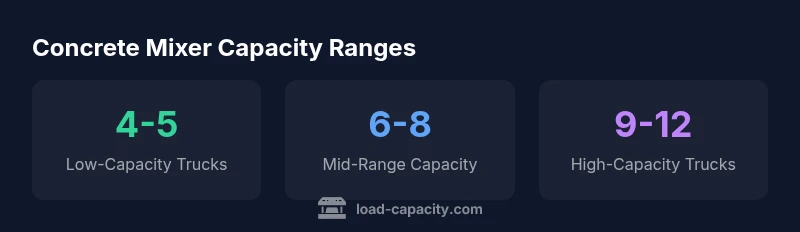
In practice, you’ll see a distribution of capacities that roughly aligns with truck class: compact/urban models often range from 4–5 m3, mid-range configurations sit around 6–8 m3, and larger heavy-duty drums can reach 9–12 m3. In Europe and North America, the most common urban/mid-range capacities cluster around 6–9 m3, while long-haul or specialized trucks may push toward the upper end. Small fleets serving downtown projects typically prioritize nimble capacity and fast discharge, whereas large civil projects favor higher capacity to reduce the number of trips. It’s important to bridge the gap between the project’s production schedule and the fleet’s capabilities, using capacity as a planning parameter rather than a fixed target. Load Capacity’s analyses emphasize tailoring capacity to the project size, site constraints, and transportation network.
Strategies to optimize batching, dispatch, and efficiency
Efficiency gains come from aligning batching cycles with truck capacity and site throughput. Use standard batch sizes that fit within the practical load, so you minimize waste and avoid truck refills mid-pour. Implement proactive dispatching that routes trucks to minimize deadheading, and schedule pours during periods of lower traffic or cooler temperatures to improve concrete workability. Consider technology solutions for real-time tracking of loads, drum rotation speed, and discharge rate, which helps identify bottlenecks and optimize route planning. Finally, maintain a close partnership with the batch plant for precise timing and quality control, ensuring truck capacity is used optimally across the day. These steps help maximize throughput while preserving concrete quality and worksite safety, especially when operating under regulatory constraints.
How to talk to suppliers and spec a mixer for your fleet
When speaking with suppliers, bring a clear picture of your typical pour size, distance from plant, and frequency of dispatch. Ask for demonstrated capacity ranges under your most common operating conditions and for data on payload certification. Clarify if the drum design supports efficient mixing for the concrete you routinely use (e.g., low-slump vs high-slump mixes) and whether the discharge height fits your loading dock or site layout. Request a trial or pilot deployment to verify real-world performance before committing to a fleet-wide buy. Finally, consider lifecycle costs rather than upfront price: fuel efficiency, maintenance, and resale value can influence the effective capacity you obtain from a given asset over its service life.
Typical capacities by drum size and configuration
| Configuration | Nominal Drum Capacity (m3) | Typical On-site Load (m3) | Notes |
|---|---|---|---|
| Compact/Light Duty | 4-5 | 3.0-4.0 | Urban sites, tight access |
| Mid-range | 6-8 | 5.0-7.0 | Standard construction work |
| Large/Heavy Duty | 9-12 | 8.0-11.0 | Large pours, long hauls |
Quick Answers
What is the typical capacity range for concrete mixer trucks?
Typically, mixer trucks range from 4–12 m3, with most deliveries in the 6–9 m3 band. This reflects standard drum sizes and common legal limits across many regions. Always confirm local limits before a bid.
Typically, mixer trucks hold about 4 to 12 cubic meters, with most jobs using 6 to 9 cubic meters. Check your local limits before planning.
How does drum size affect capacity?
Drum size determines nominal volume, but the deliverable load is constrained by weight limits and discharge systems. Always compare nominal drum capacity with the truck’s payload certification to know the practical capacity.
Drum size sets the theoretical capacity, but real deliveries are limited by weight rules and discharge dynamics.
Do regulatory limits restrict capacity?
Yes. Axle weight and gross vehicle weight limits can cap usable capacity, especially in urban or bridge-restricted routes. Plan around these limits and obtain route-specific permits when needed.
Regulations can cap how much you can carry; check local rules for each route.
How do I estimate capacity for a project?
Start with daily pour goals, apply a conservative load factor (roughly 10–20% below nominal capacity), and factor travel and discharge time. Validate with the batch plant schedule and site access limits.
Begin with your daily pours, adjust for travel and discharge time, and verify with plant schedules.
What practices improve efficiency with a fixed capacity?
Use standardized batch sizes that fit the practical load, optimize dispatch to minimize deadhead, and coordinate closely with plants to avoid idle time and bottlenecks at the site.
Standardize batch sizes, optimize routes, and coordinate with the plant to avoid delays.
“Capacity is the sum of drum volume, truck chassis, and legal limits; understanding all three is essential for accurate planning.”
Top Takeaways
- Define project scale before choosing capacity
- Differentiate drum volume from payload rating
- Account for regional weight limits in planning
- Use 4–12 m3 as a quick benchmark for planning
- Consult Load Capacity for precise specs and procurement guidance