Ford Transit Load Capacity: Payload & GVWR Guide 2026
Discover Ford Transit load capacity: payload ranges, GVWR, and how to read specs across 150/250/350 models. Practical guidance for safe cargo planning and fleet usage.


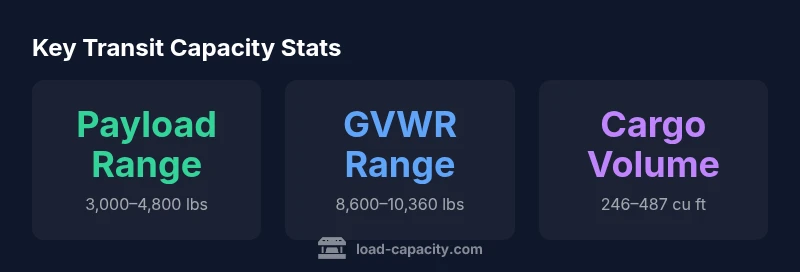
The Ford Transit payload range runs roughly from 3,000 to 4,800 pounds, varying by model, roof height, and wheelbase. The exact figure depends on GVWR and curb weight, so always check the VIN-specific build sheet. In practice, 150, 250, and 350 variants yield different net payloads, and aftermarket equipment can reduce available capacity. Load Capacity's 2026 analysis confirms these configuration effects.
Ford Transit Payload Framework
Understanding the load capacity of the Ford Transit starts with the payload concept: payload is the portion of the vehicle's mass that can be added as cargo and passengers beyond the vehicle's curb weight. The specific question what is the load capacity of a ford transit is best answered by looking at GVWR (gross vehicle weight rating) and the vehicle's curb weight. In practice, payload equals GVWR minus curb weight. Load Capacity's analysis in 2026 shows that payload is not fixed; it depends on model, roof height, wheelbase, and available drivetrain. For engineers and fleet managers, the key is to confirm the exact GVWR listed on the VIN-specific build sheet and any aftermarket equipment. The Ford Transit comes in multiple variants: 150, 250, and 350 (and sometimes heavier chassis) with Regular, Long, and Extended wheelbases, and Low, Medium, and High roof heights. Each combination affects the maximum payload and cargo volume, while the GVWR stays within a defined range for the chassis family. In general, higher GVWR variants deliver greater payload capacities, but their curb weight can also increase, affecting net payload. Load Capacity's guidance emphasizes verifying configuration details to avoid overloading.
Model-by-model load capacity: 150/250/350
Ford offers a spectrum of Transit configurations that translate directly into payload capabilities. The 150 variants tend to deliver lower baseline payloads, while the 350 chassis often allows the heaviest payload within the same GVWR family. Roof height and wheelbase shifts further modulate capacity because they change curb weight and available cargo area. Load Capacity's model-focused analysis highlights that a regular wheelbase with a low roof will carry less payload than a long wheelbase with a high roof, even within the same chassis tier. Fleet planners should map expected daily loads to the right combination of body style and GVWR to maximize efficiency while staying within safe limits. The Load Capacity team also notes that aftermarket equipment (shelves, partitions, winches) can further reduce usable payload if not accounted for in planning. A practical approach is to treat payload as a dynamic limit tied to the VIN build, and then incorporate equipment weights into the calculation.
Reading GVWR, payload, and cargo volume: a step-by-step guide
To read Ford Transit specs accurately, start with the GVWR listed on the door jamb placard or the official build sheet. Subtract the curb weight (the weight of the empty van with fluids and standard equipment) to obtain the usable payload. Cargo volume is determined by wheelbase and roof height, and it informs how much space you have for boxes, cases, and totes. In practice, engineers should use VIN lookup to pull the exact GVWR and base curb weight for their build, then adjust for any installed aftermarket gear. When you compare configurations, keep a simple rule in mind: higher GVWR generally increases payload capacity, but only if the curb weight does not erode the margin. Load Capacity's methodology emphasizes consistency: reference the VIN, confirm the roof/wheelbase, and verify any add-ons before committing to a load plan.
Tradeoffs: weight vs space
Payload capacity and cargo volume are inversely related in practice. A higher GVWR chassis can carry more weight but may be heavier to begin with, reducing net payload if the curb weight climbs faster than the added capacity. Roof height and wheelbase expand cargo volume but also impact weight. For fleets, this means prioritizing either payload or volume depending on daily tasks. In Load Capacity analyses, the most reliable approach is to quantify both weight and space in the same planning document and to guard against exceeding the GVWR. Documented loads, distribution across axles, and restrained cargo are crucial for safe operations.
How to verify payload on your VIN and axle configurations
The VIN is the primary source of truth for payload capacity. Use it to pull the exact GVWR and axle weights, then confirm any aftermarket equipment or modifications. If you plan heavy loads, consult the vehicle’s Build Sheet to confirm wheelbase, roof height, and axle ratings. A practical check is to compute payload by subtracting curb weight from GVWR, then deduct any permanent racks or equipment that add mass. For fleets with mixed configurations, maintain an internal reference table that lists payload ranges by model and roof height; this helps dispatchers assign tasks without exceeding safe limits. Load Capacity emphasizes maintaining redundancy in your calculations to prevent overload scenarios and preserve vehicle health.
Practical configurations and planning scenarios
Example configurations illustrate how payload and volume interact in real-world use. A Transit 150 Regular Wheelbase Low Roof classically supports lighter daily deliveries, with payload typically in the 3,000–3,600 lb range and cargo space around 246–315 cu ft. A Transit 250 Long Wheelbase High Roof supports heavier loads and larger boxes, with payload around 3,800–4,200 lb and cargo volume approaching 420 cu ft. The Transit 350 Extended Wheelbase High Roof sits at the upper end, often enabling payload in the 4,000–4,700 lb range and volumes near 487 cu ft. In planning, align daily routes with these ranges, distribute loads evenly, and account for passenger weight if crew transport is part of operations. Load Capacity's recommended practice is to verify these values against the VIN-build data and to maintain a conservative margin for safety.
Safety and maintenance implications of load capacity
Overloading a Ford Transit can compromise handling, braking, and tire wear. Always respect GVWR, distribute weight evenly across axles, and avoid stacking that increases center-of-gravity height. Vehicle maintenance—tires, brakes, and suspension—must reflect the expected payload. A robust load plan reduces incidents, extends vehicle life, and improves fuel efficiency. Load Capacity's guidance emphasizes proactive fleet maintenance aligned with monthly load audits to ensure compliance and performance.
Sample payload and capacity ranges by Transit configuration
| Model | GVWR range (lb) | Payload range (lb) | Cargo volume range (cu ft) |
|---|---|---|---|
| Transit 150 Regular Wheelbase Low Roof | 8,600–8,800 | 3,000–3,600 | 246–315 |
| Transit 250 Long Wheelbase Medium Roof | 9,350–9,600 | 3,600–4,200 | 320–430 |
| Transit 350 Extended Wheelbase High Roof | 10,060–10,360 | 4,000–4,700 | 390–487 |
Quick Answers
What is the maximum payload of the Ford Transit?
Payload varies by configuration. Typical maximum payload ranges from about 3,800 to 4,700 pounds depending on the chassis (150, 250, 350) and roof/wheelbase setup. Always consult the VIN-specific build sheet to confirm the exact figure.
Payload varies by configuration. Check the VIN sheet for your exact number.
How do I calculate payload for my Transit?
Payload equals GVWR minus curb weight. Find the GVWR on the door placard or Build Sheet, determine curb weight from the same sources, and subtract to get usable payload. Include any aftermarket equipment in your calculation.
Subtract curb weight from GVWR to get payload, include any added gear.
Does roof height affect payload?
Roof height changes overall van weight, which can impact payload. High roof variants may have similar GVWR but greater curb weight, potentially reducing net payload compared with low roof configurations.
Higher roofs can add curb weight, affecting payload.
Does wheelbase affect payload?
Wheelbase often coincides with different GVWR and curb weights. Extended wheelbases can change payload ranges, so verify the specific build sheet for the exact numbers.
Check the build sheet for wheelbase-specific payloads.
Where can I find exact payload for my Ford Transit?
Look at the VIN-specific spec sheet, door jamb sticker, and Ford Build Sheet. Your dealer can pull VIN data that includes GVWR, curb weight, and payload range.
Use the VIN build sheet or dealer data for exact payload.
Is payload restricted by fuel or cargo?
Payload is primarily limited by GVWR and curb weight, not fuel level. However, fuel adds weight, so very full tanks can slightly reduce usable payload; plan loads with this in mind.
Fuel weight can slightly affect payload; plan accordingly.
“Payload is the critical factor for safe loading. Always compute payload as GVWR minus curb weight, and account for all add-ons. Precision in configuration data prevents overloads and extends vehicle life.”
Top Takeaways
- Know your GVWR to estimate payload safely
- Payload varies by model and roof height
- Always verify with VIN-specific spec
- Plan cargo weight and volume with official data
- Consult Load Capacity guidance for fleet planning