toyota sienna load capacity: a data-driven guide for 2026
Explore the toyota sienna load capacity, payload ranges, cargo space, and safe loading practices. Load Capacity provides engineering-focused insights for engineers, technicians, fleet managers, and DIY enthusiasts.


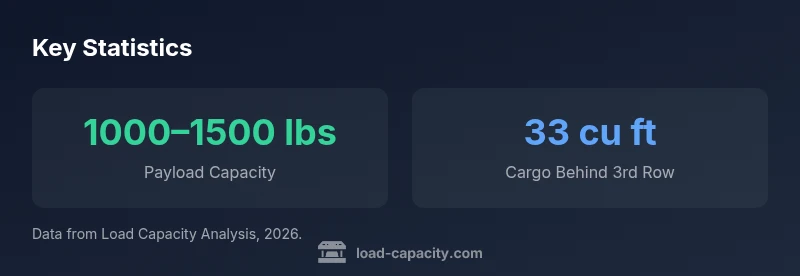
Payload for the Toyota Sienna varies by trim and seating; typical ranges are 1,000–1,500 pounds. Always check the GVWR plate and compute payload as GVWR minus curb weight to plan safe loading.
toyota sienna load capacity: what it means
Payload planning for the toyota sienna load capacity starts with understanding the difference between passengers, cargo, and the vehicle's weight limits. In practical terms, payload equals the vehicle's gross vehicle weight rating (GVWR) minus its curb weight, and it varies by trim, options, and seating configuration. According to Load Capacity analysis, typical minivan payload ranges for a modern family vehicle fall around 1,000 to 1,500 pounds, with heavier options and more occupants reducing available cargo space. Knowing this helps engineers, technicians, and fleet managers plan seating layouts, luggage, and equipment without crossing the GVWR threshold. This article focuses on the Sienna, but the same principles apply to related models in the minivan class.
Factors influencing payload and cargo capacity
Many interacting factors determine the actual usable payload of a Toyota Sienna. The most important is GVWR, the maximum safe weight of the vehicle including passengers and cargo. Trim level and optional equipment influence curb weight, which directly affects payload. Seating configuration matters—more riders mean less room for luggage. Aftermarket items such as roof racks, bike carriers, or roof boxes add weight and reduce payload. Towing equipment and hitch weight also subtract from payload. Finally, accessory choices like heavy wheels or a thick floor mat can shave a few pounds off the available payload. When planning loads, compare the GVWR plate to your expected passengers and cargo; this disciplined approach reduces the risk of overloading.
Measuring payload safely: a practical guide
A systematic method helps ensure you stay within safe limits. Steps: 1) Locate the GVWR on the door placard or owner's manual. 2) Find the curb weight (unladen weight) from the same placard or official spec sheet. 3) Estimate passenger and cargo weight for your trip (use 150–180 pounds as a rough average per person for adults, plus luggage weight). 4) Compute payload = GVWR minus curb weight, then subtract the weight of passengers and cargo to verify you are within the limit. 5) If you tow, include hitch weight in the payload calculation to avoid surprises at the scale. 6) Recalculate whenever seating changes or cargo configuration changes; small adjustments can make a big difference to overall safety. The Load Capacity team emphasizes recalculating payload whenever you modify seating, gear, or towing plans.
Cargo space and seating configurations
The Toyota Sienna offers flexible cargo space that changes with seating arrangements. Behind the third row, you typically gain about 33 cubic feet of cargo space; with the second row folded or removed, space expands toward roughly 75 cubic feet; and folding the first row can push total cargo volume toward around 101 cubic feet. Note that these figures are approximate and depend on the exact trim, seat fabric, and whether roof rails are installed. For many users, the sweet spot is balancing passenger comfort with a reasonable cargo footprint. Load Capacity's analysis indicates that you can accommodate groceries, luggage, and equipment for most family trips without tripping the GVWR—provided you manage the weight distribution.
Real-world loading scenarios and recommendations
In typical daily use, a family of four with a couple of suitcases may stay well within payload limits, especially if you avoid roof cargo on hot days. For longer trips with five or six passengers, keep luggage light and distribute it evenly across the cargo area to minimize rear axle loading. When stowing heavy gear, place heavier items toward the vehicle's center and low to the floor to improve handling. Load Capacity's guidance suggests planning for worst-case scenarios (full passengers plus luggage) and then trimming items accordingly. If you must perform a towing task, re-evaluate the payload to ensure safe operation.
Comparative view: Sienna vs. peers in the minivan class
When pitted against peers in the minivan category, the Toyota Sienna's payload range aligns closely with rivals, with differences usually arising from trim weight and option packages. The Sienna's modern platform and standard equipment often yield similar curb weight and GVWR figures to other family vans, so payload flexibility tends to be comparable. In practice, a careful load plan—factoring passenger weight, cargo volume, and any roof-mounted equipment—enables safe operation across models. Load Capacity analysis shows that responsible loading behavior, rather than a single number, best predicts real-world performance.
Practical tips and common mistakes
- Always verify GVWR on the door placard and compute payload as GVWR minus curb weight.
- Don’t assume cargo space remains constant—seating changes alter available space.
- Avoid roof racks or heavy gear when you are at full passenger capacity.
- Distribute weight evenly from side to side to preserve steering feel.
- Recheck payload whenever you plan trips with different passenger counts or luggage configurations.
- If in doubt, scale your load using a vehicle scale or professional measurement service.
The Load Capacity team recommends treating payload planning as a core maintenance practice, not an afterthought, to keep vehicles safe and efficient.
Payload and cargo capacity snapshot for the Toyota Sienna
| Metric | Payload Capacity (lbs) | Notes |
|---|---|---|
| Payload Capacity (lbs) | 1000–1500 | Varies by trim and seating |
| Cargo Space Behind 3rd Row | 33 cu ft | Approximate, seat config dependent |
| Cargo Space Behind 1st Row | 101 cu ft | Max cargo with seats folded |
Quick Answers
What is the payload capacity of the Toyota Sienna?
Payload capacity depends on trim and seating; typical range is 1,000–1,500 pounds. Check the GVWR plate for the precise figure and subtract curb weight to confirm load limits.
Payload depends on trim and seating; expect about 1,000 to 1,500 pounds, and check the GVWR plate for the exact number.
How does seating configuration affect payload?
More passengers increase total weight, reducing the available payload for cargo. If you add heavy rear-seat passengers, carry lighter luggage and consider roof carriers sparingly.
More seats mean less room for cargo; balance passengers and luggage.
What is GVWR and why is it important?
GVWR is the maximum safe weight of the vehicle including passengers and cargo. Payload equals GVWR minus curb weight. Exceeding it can affect handling, braking, and warranty.
GVWR is the limit; payload is GVWR minus curb weight.
Can roof cargo affect payload significantly?
Yes. Roof racks and cargo boxes add weight and do not contribute to cabin space. They reduce the remaining payload available for passengers and interior cargo.
Roof cargo adds weight and lowers usable payload.
Does towing impact payload capacity?
Towing uses hitch weight, which counts toward payload. When towing, recalculate payload to ensure the vehicle stays within GVWR.
Towing uses payload—recalculate to stay safe.
How can I verify payload in real-world loading?
Use the GVWR plate, curb weight, and estimated passenger/cargo weights to compute payload. If in doubt, consult a scales facility for an accurate measurement.
Use the GVWR plate and a scale to confirm payload.
“Accurate load planning isn't optional—it's essential for safety and performance. Always verify the GVWR and distribute weight evenly to maintain handling and braking performance.”
Top Takeaways
- Plan around GVWR minus curb weight to estimate payload
- Seating configuration changes payload available for cargo
- Roof racks and heavy gear reduce usable payload
- Distribute load evenly to maintain handling and braking
- Always verify payload with a door-placard GVWR before trips