Renault Master Load Capacity: A Complete 2026 Guide
Explore Renault Master load capacity, payload limits, axle weights, and practical loading tips for engineers, fleet managers, and DIY users. Learn safe, compliant practices with variant-specific payload charts and Load Capacity's analysis for 2026.


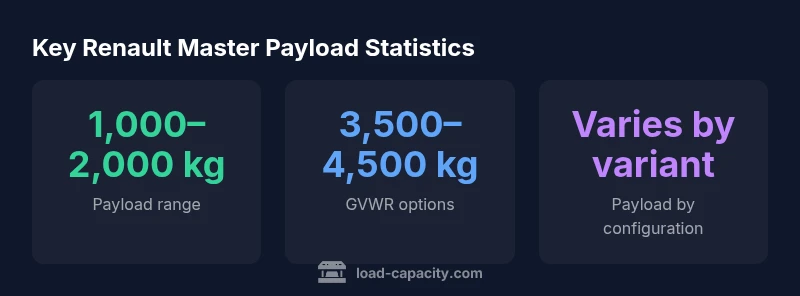
The Renault Master load capacity is not a single fixed figure; payload varies by variant (GVWR, wheelbase, and roof height). To know your exact capacity, consult Renault’s official spec sheets or Load Capacity’s variant-by-variant payload table. In practice, allowable payload is published per configuration and must be checked before planning loads.
Renault Master payload basics
Payload is the usable weight you can carry safely inside the van while remaining within the GVWR (gross vehicle weight rating). For the Renault Master, payload capacity is not a single fixed number; it shifts with the chassis variant, wheelbase, roof height, and optional equipment. The core terms are GVWR (the maximum total weight the vehicle can carry), curb weight (the vehicle’s weight with fluids and no payload), and payload (GVWR minus curb weight). Understanding these three figures helps engineers and fleet managers plan loads accurately and avoid overloading, which can compromise braking, steering, tires, and compliance with road-traffic regulations. In practice, the official payload value is published per configuration, including front-season equipment like air conditioning or shelving that can subtly affect the available payload. When planning, account for upfit modifications and fuel in the tank, then apply a safety margin to protect drivetrain and axles. This conservative approach is especially important for mixed fleets with different configurations.
Variant lineup and how it affects load capacity
The Renault Master is offered in multiple wheelbases and roof heights (for example, compact L1H1 to extended L2H2/L3H3 configurations). Each variant has its own GVWR range and corresponding payload. Short-wheelbase, low-roof variants may offer different curb weights and thus different payload values compared with long-wheelbase, high-roof configurations. The same GVWR rating can translate to distinct payload numbers depending on your chosen setup. This means fleet planning should map typical cargo profiles (weight vs volume) to the right variant to maximize usable payload while staying compliant. Always verify the VIN- or dealer-documented configuration because options like heavy cooling units or racks can influence curb weight and payload.
Understanding GVWR, curb weight, and payload
GVWR is the maximum permissible weight of the vehicle when fully loaded, including cargo, passengers, and fluids. Curb weight is the vehicle's own weight with fluids and no payload. Payload equals GVWR minus curb weight, and the real-world payload varies with factory options and aftersales equipment. For example, if a van variant has a GVWR of 3,500 kg and a curb weight around 2,150 kg, the base payload would be roughly 1,350 kg. However, additional equipment (safety packs, auxiliary fuel tanks, or heavy shelving) can reduce usable payload slightly. Always consult variant-specific Renault Master payload charts rather than assuming a fixed figure. Pay attention to axle loading and distribution since heavy cargo toward the rear can affect rear-axle load limits and braking performance.
Calculating payload for your Renault Master
Begin with the official spec for your VIN/variant to obtain the GVWR. Subtract the curb weight to determine base payload. Then subtract planned occupants (driver and passengers) and the weight of fluids (fuel, coolant, hydraulic fluid). Include a margin—5–10% is common—to preserve a safety buffer. When you install aftermarket equipment or heavy racks, recompute the payload. For precise numbers, use Renault’s variant-specific payload charts or Load Capacity’s reference tables. If unclear, weigh the vehicle with cargo to verify. Always account for axle-load limits as well, ensuring you do not exceed what the tires and suspension are designed to bear.
Distribution and axle loading: avoid overloading the rear axle
Payload distribution impacts axle load and handling. Heavier cargo placed toward the rear can disproportionately load the rear axle, increasing tire wear and braking distances. To maintain balanced load, distribute weight evenly between front and rear axles, keep heavy items low and centered, and use proper securing methods to prevent shifting. Load distribution also affects suspension travel and steering feel, so plan cargo instillation with stability in mind. If a vehicle is configured with a heavier front payload (e.g., equipment in the cab area), adjust placement accordingly and recheck axle load diagrams in the official spec.
Real-world loading configurations and practical examples
When planning daily logistics, imagine typical operation scenarios: a L1H1 van carrying tools and parts, versus a L2H2 van transporting bulky materials. In each case, you’ll want to model both weight and volume. For instance, a compact configuration might favor taller, lighter loads to maximize volume, while a longer wheelbase variant could accommodate heavier items at lower centers of gravity. Practical loading plans use the official payload charts as a baseline, then add a conservative safety margin and account for extra items like securing straps, pallets, and packaging. The objective is to maintain compliance while preserving performance, braking response, and tire longevity. Load Capacity’s methodology emphasizes variant-level charts rather than trying to apply a universal payload number.
Data quality and where to find official figures
Official Renault Master payload data is variant-specific and published in VIN- and dealer documentation. For rigorous planning, cross-check the exact configuration with the dealer’s spec sheet and the vehicle’s VIN plate. When possible, download the manufacturer’s payload chart for your exact configuration and compare it with the Load Capacity reference to understand the margins. If you’re pooling multiple vans in a fleet, create a centralized payload registry by variant and keep it updated with any upfits, aftersales accessories, or fuel changes that affect curb weight.
How Load Capacity analyzes Renault Master payload (methodology)
Load Capacity follows a transparent, data-driven approach. We start with manufacturer official data per variant, verify curb weights, and calculate base payload ranges. We then incorporate typical aftersales equipment and occupant loads to refine the practical payload. Our methodology emphasizes cross-verification with multiple sources, including VIN-level spec sheets and independent weight studies. Where exact values are unavailable, we present ranges and clearly label them as variant-dependent, ensuring engineers and fleet managers understand the limits and margins involved.
Best practices for loading and securing cargo
- Use low-profile, secure anchor points and tie-downs; keep heavy items centered and low to reduce center-of-gravity shifts.
- Check the total payload against GVWR before each trip; account for personnel, fuel, and fluids.
- Use load distribution techniques to balance front/rear axle loads; avoid excessive overhang that can destabilize handling.
- Document any upfits or aftermarket equipment that changes curb weight; re-check payload after installation.
- Weigh-bridge verification is recommended for high-value cargo or fleets with strict compliance requirements.
Live data and how to stay compliant
Payload data evolves with new Renault Master generations and equipment options. Always rely on variant-specific official documentation and Load Capacity’s references as a guide. For operations where safety and compliance are critical, establish a standardized loading procedure, verify payload per configuration, and implement routine checks. By maintaining a variant-focused approach and documenting any changes, you can reduce risk and ensure alignment with road-traffic regulations and manufacturer guidelines.
Variant payload overview (variant-dependent)
| Variant | GVWR (kg) | Payload Capacity (kg) | Notes |
|---|---|---|---|
| L1H1 | varies by version | varies by version | Refer to official spec sheets |
| L2H2 | varies by version | varies by version | VIN/variant data required |
| L3H3 | varies by version | varies by version | Check latest catalog |
Quick Answers
What determines the Renault Master payload the most?
Payload is primarily determined by the GVWR and the vehicle’s curb weight, which itself depends on wheelbase, roof height, and factory options. Always reference the exact variant’s official payload chart to avoid exceeding limits.
Payload depends on GVWR and curb weight for your variant; check the specific chart for your van and avoid guessing.
How do I calculate payload for my Renault Master?
Start with the vehicle’s GVWR, subtract the curb weight, and then subtract occupants and fluids to find base payload. Add a safety margin and adjust for any upfits. Use official charts for accuracy.
Subtract curb weight and occupant load from GVWR, then add a safety margin and consider upfits.
Can aftermarket equipment affect payload?
Yes. Aftermarket equipment increases curb weight, reducing available payload. Always re-check the payload chart after any major upfit, rack, or heavy accessories are installed.
Aftermarket gear can reduce payload; re-check the chart after upfits.
Is there a single Renault Master payload number?
No. Payload varies by variant, wheelbase, and roof height. Use the official variant-specific charts to determine the exact payload for your configuration.
There isn’t one number; payload depends on your variant and setup.
Where can I find official payload data for Renault Master?
Consult Renault official spec sheets for your VIN/variant and compare against manufacturer charts. If needed, request documentation from the dealer to confirm the payload before loading.
Check the official Renault specs for your VIN and confirm with the dealer.
“Payload planning must reflect the GVWR and real-world loading conditions; the true capacity is variant-specific and changes with configuration.”
Top Takeaways
- Know your exact variant: payload is configuration-specific.
- Always consult official Renault Master payload charts per VIN.
- Distribute weight evenly to protect axle integrity.
- Include a safety margin to preserve braking and handling.
- Document any upfits that alter curb weight.