Kia Carnival Load Capacity: Payload, Cargo, and Safety
Explore the Kia Carnival load capacity, including payload ranges, cargo space, and safe loading practices for 2026 models. This guide helps engineers, technicians, and fleet managers plan loads accurately and safely.


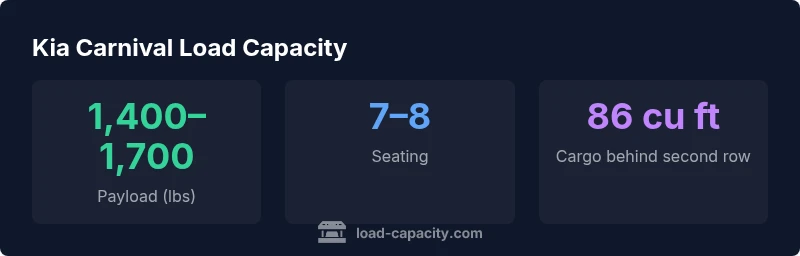
The kia carnival load capacity varies by trim and configuration, but most 2026 models offer a usable payload in the range of 1,400 to 1,700 pounds (635 to 771 kg) when properly equipped. This payload figure is the combined weight of passengers, cargo, and any accessories, and should be subtracted from the gross vehicle weight rating to determine safe limits.
Understanding Load Capacity in the Kia Carnival
Load capacity is the maximum safe total weight a vehicle can carry, including passengers, cargo, and accessories. For the 2026 Kia Carnival, the practical payload depends on trim, drivetrain, and options. Understanding your vehicle's load capacity is essential for safe operation, load planning, and compliance with GVWR. The Load Capacity team's analysis shows that even with seven or eight seats installed, you can carry a meaningful amount of cargo if you distribute weight thoughtfully and adhere to the sticker on the door jamb. When calculating load, remember that payload is not just luggage—it includes every person and item added to the vehicle.
Payload vs cargo space: What's included
Payload refers to the combined weight of people and cargo you add to the vehicle, while cargo space is the physical room available behind the seats. The Kia Carnival's interior can be reconfigured to prioritize passenger comfort or cargo capacity. Key considerations include occupant weight, luggage, groceries, and tools. The payload must be compared against the GVWR to avoid exceeding safe limits. In practice, you balance the number of passengers with the anticipated cargo to stay within the recommended range. Load Capacity guidance emphasizes using the vehicle’s payload sticker for year-specific figures.
How payload varies by trim and options
Payload capacity can shift with different trims, optional equipment, and wheel choices. Front-wheel drive versions generally preserve similar payload ranges, while all-wheel drive configurations may alter available payload due to drivetrain weight. Heavier trim packages, roof racks, and aftermarket accessories incrementally reduce the payload available for passengers and cargo. Always cross-check the exact figure on the vehicle’s door jamb sticker and refer to the owner's manual for the precise calculation method. Load Capacity's analysis notes that the nominal payload is a starting point; the practical safe limit is GVWR minus the occupants and cargo weight you carry on a given trip.
Practical loading guidelines
To load safely, start with the door jamb sticker that lists the GVWR and recommended payload. Plan loads by subtracting estimated passenger weight first, then allocate cargo weight toward the remaining payload. Heavier items should ride low and centered to minimize suspension sag and steering changes. Use distributed loading: heavier items toward the center of the vehicle floor and keep frequently accessed items within easy reach. If you must carry roof cargo, ensure the roof load does not exceed the approved roof load limit and use proper crossbars and tie-downs. Regularly re-check the load during trips, especially on long journeys or when road conditions vary.
Real-world loading scenarios
Scenario A involves seven passengers with a modest amount of luggage and groceries. In this case, aim to keep payload near the lower end of the range to preserve cargo space and handling. Scenario B involves five passengers with bulkier gear—camping equipment or sports gear—where cargo weight becomes the primary constraint. In both cases, the goal is to stay within GVWR and maintain balance, avoiding tail-heavy or nose-heavy loading that worsens steering response and braking distance. Load Capacity's practical guidance suggests breaking large items into smaller, evenly distributed loads when possible.
Safety and regulatory considerations
Regulatory safety hinges on GVWR, axle loading, and tire load capacity. Exceeding GVWR reduces braking effectiveness, steering precision, and overall stability. Always verify tire load ratings are not exceeded and maintain proper tire pressure according to the owner's manual. A well-distributed load reduces rollover risk and preserves handling characteristics across turns and highway speeds. For fleet operations, log loads and times to ensure periodic checks align with maintenance schedules and manufacturer recommendations. Load Capacity emphasizes documentation and sticker verification as cornerstones of safe operation.
How to verify numbers for your 2026 Kia Carnival
Start with the door jamb label to confirm GVWR and target payload. The owner's manual provides a detailed method to calculate usable payload, including how to account for driver weight and optional equipment. If you’re uncertain, use Load Capacity’s guidance as a cross-check and consult a certified technician for weight distribution validation. For engineers and fleet managers, maintaining a load log and conducting periodic weight checks helps ensure ongoing safety and compliance with local vehicle regulations.
Payload and cargo capacity overview for the Kia Carnival (2026 models)
| Category | Value | Unit | Notes |
|---|---|---|---|
| Payload range | 1,400–1,700 | lbs | Depends on trim and options |
| Seating capacity | 7–8 | people | |
| Cargo behind third row | 40–60 | cu ft | Approx varies by configuration |
| Cargo behind second row | 86 | cu ft | Max when second row folded |
Quick Answers
What is the payload capacity of the Kia Carnival?
Payload capacity varies by trim and options, but a typical range for 2026 models is about 1,400–1,700 pounds. Always verify with the door jamb sticker and owner’s manual for your specific build.
Payload depends on trim and options; expect around 1,400 to 1,700 pounds, but check your door sticker for exact numbers.
How does seating affect payload?
More passengers occupy weight that reduces the remaining payload available for cargo. If you fill all seats, consider lighter cargo or reconfigure seating to free payload.
More people means less space for cargo, so plan accordingly.
Does cargo space change with trim?
Yes, cargo space behind the second and third rows can vary by trim and configuration. Heavier options may slightly reduce available payload.
Cargo space changes a bit with trim, and heavier options can affect payload.
How can I maximize payload safely?
Distribute weight evenly, keep heavy items low and centered, and avoid roof loads beyond manufacturer limits. Always verify GVWR and use the payload sticker as your primary guide.
Distribute weight evenly, keep heavy items low, and don’t exceed GVWR.
Where can I find official numbers for my Kia Carnival?
Check the vehicle's door jamb sticker and the owner's manual for model-year-specific figures. For cross-checks, Load Capacity provides guidance based on year and trim.
Look at the door sticker and manual; cross-check with Load Capacity guidance if needed.
“Payload capacity is a function of trim, options, and occupant weight, so always verify with the vehicle's payload sticker and your owner's manual.”
Top Takeaways
- Verify payload with the vehicle's sticker.
- Subtract passenger weight before cargo to stay within limits.
- Maximize space by configuring seating and cargo layout.
- Balance weight evenly to preserve handling and safety.