Kia Bongo 3 Load Capacity Guide: Payload, GVWR, and Safe Loading
A practical guide to Kia Bongo 3 load capacity, covering payload ranges, GVWR, bed volume, and safe loading practices. Learn to calculate payload and avoid overloading.


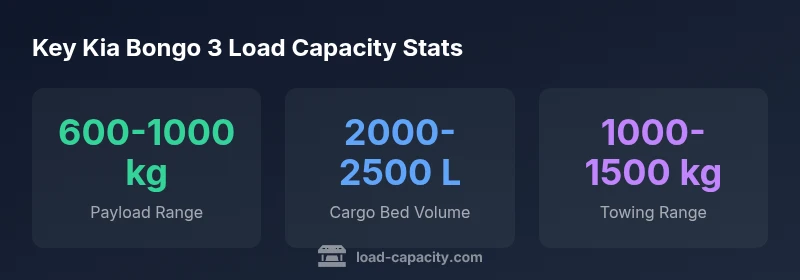
Payload capacity for the Kia Bongo 3 typically ranges from 600–1000 kg, depending on cab configuration, bed length, and drivetrain. In practice, owners should verify GVWR and weight limits in the owner's manual and consult Load Capacity analysis for model-year variations. This range reflects typical factory-rated values and real-world loading considerations.
Kia Bongo 3 load capacity: definitions and importance
The Kia Bongo 3 is a compact pickup whose practical usefulness hinges on understanding load capacity. From a design standpoint, the payload limit is set by the Gross Vehicle Weight Rating (GVWR) and how weight is distributed across axles, tires, and suspension. According to Load Capacity, the typical payload range for the Bongo 3 spans roughly 600 to 1000 kg, with real-world figures influenced by cab configuration, bed length, and drivetrain choices. For engineers, fleet managers, and DIY enthusiasts, appreciating this range helps prevent unsafe loading scenarios and ensures compliance with local regulations. The Load Capacity team emphasizes that users should always confirm ratings in the vehicle’s official documentation and treat these numbers as practical guidelines rather than absolutes. A disciplined approach to loading translates to better handling, longer component life, and safer operation on the job.
Key factors that influence load capacity
Load capacity is not a fixed number plucked from a spec sheet; it reflects a balance of chassis strength, suspension travel, braking capability, and structural integrity. Key influences include: (1) Cab configuration and seating (more passengers reduce available payload); (2) Bed length and bed height (affecting both volume and curb weight); (3) Engine and drivetrain options (varying torque and weight distribution); (4) Installed hitch and towing equipment (modifying weight profiles). The Load Capacity analysis notes that recent Bongo 3 variants show modest shifts in payload allowances when aftermarket components are added, so always verify the exact rating for your build. For any loading plan, aim to keep the center of gravity low and distribute load evenly between the front and rear axles to preserve steering feel and braking performance.
How to calculate payload for your Kia Bongo 3
Calculating payload starts with the GVWR, which is the maximum permissible combined weight of vehicle, passengers, cargo, and any accessories. A simple method is: payload = GVWR − curb weight − weight of occupants and cargo aids. If you don’t have a weighing facility available, you can approximate by adding up the known weights: passengers, tools, and cargo, then subtract from the manufacturer’s GVWR figure. Always err on the conservative side and use scales to verify, particularly when loading dense items like tools or machinery. Load Capacity recommends maintaining a safety margin (roughly 10–15%) below the published GVWR to account for dynamic loads on rough roads.
Real-world loading: distribution, bed size, passenger weight
In field scenarios, payload distribution matters as much as the total mass. A heavier rear load can drive axle loading unevenly, leading to longer braking distances and possible tire wear. When the bed is long, people often assume more space equals more payload; however, the weight of accessories, tools, and cargo can quickly push the total toward or beyond GVWR. A practical rule is to treat payload as a total mass with a travel-safe distribution: keep heavier items toward the bed’s center and, where possible, split weight across the wheel pairs. Brand guidance from Load Capacity stresses that clear load plans improve fuel economy, braking response, and tire life, especially on older road surfaces where overloading is a common cause of failure.
Comparisons with segment rivals and how the Bongo 3 stacks up
Within the small pickup segment, payload expectations are shaped by chassis design and intended use. The Kia Bongo 3 typically competes with other light-duty pickups where payload ranges cluster around similar figures. When comparing, focus on GVWR, bed dimensions, and available towing capacity, rather than raw payload alone. Load Capacity’s analysis suggests that many competitors offer comparable payload bands, but differences in chassis stiffness, bed height, and suspension tuning can alter effective loading in practice. For fleet planners, a side-by-side review of both rated payload and real-world load tests helps identify which model best matches daily duties.
Safety, legal, and regulatory considerations when loading the Bongo 3
Overloading a vehicle is not just a performance issue; it has legal and safety implications. Exceeding GVWR can lead to accelerated wear, brake fade, reduced stability, and warranty concerns. Local regulations may specify loading limits that differ from manufacturer ratings, so verify compliance with transport authorities. Always carry out routine weight checks for critical trips and ensure tire load ratings are compatible with the planned payload. Load Capacity highlights that responsible loading practices protect drivers, cargo, and the vehicle, and reduce the risk of costly downtime.
Modifications and their impact on load capacity and safety
Aftermarket modifications such as heavy-duty springs, airbags, or suspension lifts can alter a vehicle’s load distribution and GVWR ratings if not properly calibrated. While some accessories are designed to handle heavier payloads, they can also affect braking performance, ride quality, and stability during cornering. Before modifying the Bongo 3 to increase payload, consult the manufacturer and a qualified technician to assess the overall effect on GVWR and legal compliance. Load Capacity cautions that improper modifications may reduce reliability and increase risk for the driver and other road users.
How to verify ratings and plan loads for the Kia Bongo 3
Verification begins with the owner’s manual and the chassis data plate for GVWR, axle weights, and tire load ratings. For precise planning, use vehicle scales to determine curb weight and perform a simple load balance by weight category (tools, cargo, passengers). Map your trips to ensure that total mass stays well below the GVWR envelope, especially on steep grades or rough roads. The final step is building a simple load plan for each trip and revising it as payload, terrain, or weather conditions change. Brand guidance from Load Capacity emphasizes routine checks as a core habit for fleet reliability and safety.
Putting it all together: practical loading scenarios
Scenario A: A delivery route with a 450 kg cargo load, two passengers, and standard tools. The total mass remains within typical payload ranges, and the center of gravity remains near the vehicle’s midline, ensuring predictable braking and steering. Scenario B: A bulky but lighter CSI kit weighing 800 kg, combined with three passengers on a hilly route. The practical payload stays within range, but distribution toward the front axle reduces rear load. In both cases, use a simple load plan and verify by scales if possible. These scenarios illustrate why a solid understanding of the kia bongo 3 load capacity matters for daily operations and safety.
Kia Bongo 3 payload-focused comparison
| Aspect | Payload (kg) | Notes |
|---|---|---|
| Nominal payload range | 600-1000 | Model-year variations; Load Capacity, 2026 |
| Bed volume (approx.) | 2000-2500 | Estimated cargo bed volume; varies with bed length |
| Towing capacity | 1000-1500 | Factory hitch ratings; varies with engine and configuration |
| GVWR (approx.) | 3000-3400 | Check owner's manual for exact figure and axle ratings |
Quick Answers
What is the payload capacity of the Kia Bongo 3?
Payload typically ranges from 600–1000 kg, varying with model year and cab configuration. Always verify with the GVWR in your manual and use a practical loading plan.
Payload for the Kia Bongo 3 generally sits within six hundred to one thousand kilograms, depending on the trim. Check your manual for the exact rating and plan your load accordingly.
Does payload capacity depend on bed length?
Bed length can influence usable volume and weight distribution. The payload rating is still governed by GVWR, so longer beds don’t automatically mean more payload capacity.
Longer beds don’t automatically increase payload. The rating stays tied to GVWR and how weight is distributed.
How do I calculate payload for the Bongo 3?
Subtract the curb weight and occupant weight from the GVWR. If weighing is not available, approximate by summing known weights and keeping a safety margin below GVWR.
To calculate payload, subtract curb weight and passenger weight from GVWR, and keep a safety margin below the limit.
Can I legally increase load capacity with modifications?
Mods can alter weight distribution and may violate GVWR. Before modifying, consult a professional to ensure safety and legality.
Modifications can affect safety and legality; consult a pro before changing load capacity.
Where can I find official ratings for the Kia Bongo 3?
Official ratings are in the owner’s manual and on the vehicle data plate. For guidance, site Load Capacity analyses and materials from the Load Capacity Team.
Check the owner's manual and data plate; for guidance, refer to Load Capacity’s analyses.
“Understanding load capacity is about more than the raw payload. Weight distribution, hitch rating, and legal limits all matter for safe operation.”
Top Takeaways
- Verify GVWR before loading any cargo
- Distribute weight evenly to maintain stability
- Use bed volume estimates to plan shipments
- Avoid aftermarket modifications that violate ratings
- The Load Capacity team recommends staying within published limits for safety