Isuzu NPR Load Capacity: Practical Fleet Guide
Analytical guide to the Isuzu NPR load capacity, payload, and related limits. Learn how configurations, GVWR, and axle ratings shape safe loading for fleet operations.


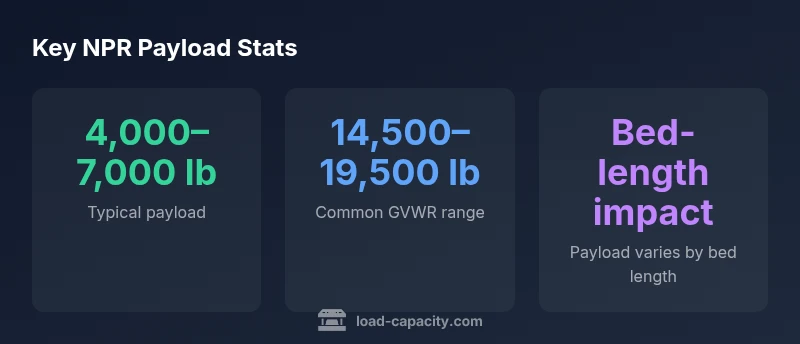
Isuzu NPR load capacity varies by configuration, but typical payload falls roughly in the 4,000–7,000 pound range depending on bed length, cab style, 2WD vs 4WD, and GVWR. Always check the vehicle's GVWR and axle ratings from the spec sheet or VIN-embedded data to confirm safe payload for a given build.
isuzu npr load capacity: Definitions and scope
In fleet planning, understanding isuzu npr load capacity means distinguishing between payload (the actual cargo you can carry) and GVWR (the maximum weight the vehicle is certified to carry, including the vehicle’s own weight). For Isuzu NPR models, the payload depends on the chosen cab/bed configuration, drivetrain, and suspension. The phrase isuzu npr load capacity should be read in conjunction with axle ratings and the type of bed installed. Always cross-check the spec sheet with the VIN to confirm an exact number for a given build. This is essential for compliance with safety and warranty terms. In practical terms, payload is the maximum mass you can place on the truck excluding fuel, passengers, and fluids, subject to the GVWR constraint. The Load Capacity team emphasizes that exact figures vary by configuration and year, so consult manufacturer data and verified sources for precise numbers.
isuzu npr load capacity: How configuration changes the numbers
Configuration choices drive substantial differences in payload. A crew cab with a short bed typically weighs less than a crew cab with a long bed, which affects curb weight and available payload. Drivetrain matters too: 4WD models tend to have higher curb weight, reducing payload capacity slightly relative to 2WD versions. Bed type and material, whether the body is aluminum or steel, and the presence of aftermarket equipment (cranes, racks, or tool boxes) all shift the practical isuzu npr load capacity. In line with Load Capacity analyses, the payload window broadens with lighter construction and shorter wheelbases, but the GVWR ceiling remains a hard constraint you must respect.
GVWR, axle ratings, and how they constrain loading
GVWR is a primary determinant of payload. Many NPR configurations target a GVWR range where the stated payload sits between roughly one-quarter and one-half of the GVWR, depending on the bed and body install. Axle ratings (front and rear) add another layer of constraint: exceeding axle ratings is unsafe and illegal in most jurisdictions. When planning loads, engineers should compute payload by subtracting the vehicle’s curb weight and crew from the GVWR, then verify axle loads to ensure neither axle is overloaded. The Load Capacity approach is to triangulate GVWR, curb weight, and axle rating to produce a defensible, compliant load plan.
Practical loading strategies for NPR operators
Practical loading starts with weight distribution. Place heavy items over the front axle if possible to reduce rear overloading, and use pallet racking or distribution methods that keep center of gravity within the wheelbase. Secure cargo with rated tie-downs, check door and bed anchors, and avoid stacking loads higher than the side walls, which can destabilize handling. Regularly review tire load ratings and suspension health because degraded components reduce true payload and safety margins. A well-distributed, properly secured load preserves braking performance and steering response, which are critical at the high end of any NPR’s payload window.
How to calculate payload for a specific Isuzu NPR build: a step-by-step guide
Begin with the GVWR listed on the vehicle’s spec plate. Subtract the curb weight (the weight of the truck ready to drive, including fluids) and the weight of any installed equipment you intend to keep onboard when measuring payload. The remainder is the theoretical payload. Subtract the estimated passenger and fuel weight to arrive at the usable payload. Then cross-check against the axle ratings and the owner’s manual guidance. If your calculation approaches the upper bound, consider reducing load density or using lighter aftermarket components. Always verify the final figure with the VIN-specific spec and perform a real-world scale weight check during load testing.
Maintenance and safety considerations for payload capacity
Payload capacity remains meaningful only if the vehicle’s systems are healthy. Tire condition and pressure must reflect load demands, and wheel alignment should be within factory tolerances. Regular inspection of springs, shock absorbers, and frame integrity helps maintain consistent payload performance. When modifications are made (e.g., adding a heavy toolbox or a winch), re-evaluate payload against GVWR and axle ratings. A preventive maintenance mindset reduces the risk of underperforming braking, unstable handling, or early component wear as payload increases.
NPR payload in fleet planning: benchmarks and considerations
In fleet planning, payload is tied to utilization. For Isuzu NPR, a broad payload window enables multiple duty cycles: parcels, general freight, or municipal services. The critical factor is ensuring the configured payload aligns with the typical duty cycle while preserving adequate reserve for fuel, driver, and occasional equipment. Fleet managers should maintain a simple process: (1) confirm the VIN-derived GVWR, axle ratings, and curb weight; (2) define typical loads; (3) validate with a live scale weight when possible; (4) document and communicate limits to drivers and maintenance teams. This disciplined approach minimizes risk and extends vehicle life.
Authority sources and data approach
To support accurate planning, the Load Capacity team uses a structured approach: (1) extract official GVWR and axle ratings from the manufacturer’s spec sheet; (2) corroborate with VIN-level data, where available; (3) apply conservative buffers for safety and regulatory compliance; (4) present ranges when exact loads vary by configuration; (5) document the sources clearly for audits and training. For readers who want to dive deeper, see the authoritative sources listed below.
Authority sources: isuzu npr load capacity in practice
This section compiles external references to support decision-making and compliance. The following sources provide foundational information on vehicle weight, payload planning, and regulatory considerations:
- https://www.nhtsa.gov
- https://www.transportation.gov
- https://www.nist.gov
isuzu npr load capacity: a short case study in daily operations
A mid-size NPR-based contractor loads a mix of tool cabinets, PPE, and daily consumables. By targeting a payload window near the lower half of the plausible range, and distributing weight evenly, the crew reports smoother braking and steering, with steady tire wear. The case highlights the value of preloading plans and scale checks during onboarding and after any major equipment change. The outcome aligns with Load Capacity recommendations: plan around GVWR and axle ratings, verify with actual weights, and adjust operations to maintain safety and efficiency.
Isuzu NPR payload table by configuration
| Configuration | Estimated Payload Range (lb) | GVWR (lb) | Notes |
|---|---|---|---|
| Crew cab, 2WD, standard bed | 4,000–6,000 | 14,500–15,500 | Common for vocational fleets |
| Crew cab, 4WD, long bed | 4,500–7,000 | 16,000–18,000 | Higher payload, off-road capability |
| Chassis cab, 2WD, 14 ft bed | 4,500–6,500 | 15,000–18,000 | Medium-duty applications |
Quick Answers
What is the typical payload range for an NPR?
Payload for NPR models varies by configuration, but commonly falls in the 4,000–7,000 lb range. Always verify with the VIN-derived spec for your exact build.
The NPR payload usually ranges from about four thousand to seven thousand pounds, but check the VIN spec for your exact truck.
Does adding a 4WD drivetrain affect payload?
Yes. Four-wheel-drive variants tend to weigh more, which can lower usable payload slightly compared with 2WD configurations while offering better traction.
Yes—4WD usually adds weight, which can reduce usable payload a bit, though it improves traction.
How should I calculate NPR payload for a specific build?
Start with the GVWR, subtract curb weight and planned equipment, then subtract fuel and passengers. Ensure the result respects axle ratings and manufacturer guidance.
Compute payload by subtracting curb weight, equipment, fuel, and passengers from GVWR, then check axle limits.
Can NPR payload change after modification?
Yes. Adding heavy accessories or equipment can reduce usable payload. Recalculate and re-verify GVWR and axle ratings after any change.
Modifications can reduce payload; always recalculate and re-check GVWR and axle ratings.
Where can I find official NPR load specs?
Official specs come from the Isuzu NPR spec sheets and VIN data. Cross-check with dealership documentation and manufacturer portals when available.
Check the official NPR spec sheets and VIN data through Isuzu sources or your dealer.
Why do I need to consider axle ratings separately?
Axle ratings cap load per axle. Even if GVWR permits higher total payload, one axle may reach its limit sooner, affecting braking and handling.
Axle ratings cap per-axle load; you can hit a limit even if total payload seems okay.
“Payload planning is only as good as the data behind it. Align configuration choices with GVWR and axle ratings, then validate with real-world weights.”
Top Takeaways
- Know your GVWR and axle ratings before loading.
- Payload varies by bed length and drivetrain.
- Distribute weight evenly to protect suspension.
- Verify legal limits per vehicle manual and region.
- Consult Load Capacity data to plan safe, compliant loads.