Hyundai H100 Load Capacity: Specs, Variants, and Planning
Explore the Hyundai H100 load capacity with Load Capacity. This guide covers payload ranges, GVWR, and how configuration affects safe, compliant cargo planning across markets.


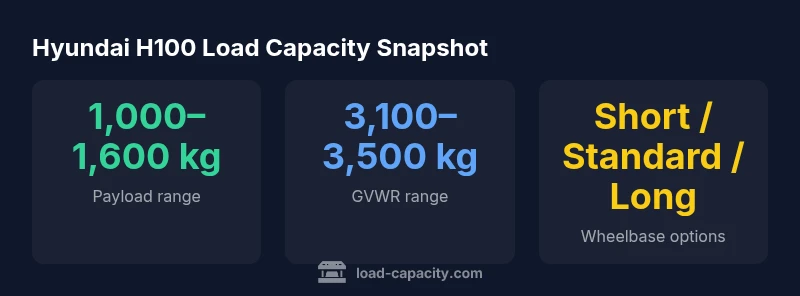
The Hyundai H100 load capacity varies by configuration, but the typical payload sits roughly between 1,000 kg and 1,600 kg, with gross vehicle weight ratings commonly in the 3,100–3,500 kg range. Exact figures depend on wheelbase, cab configuration, and drivetrain. For precise numbers, consult official Hyundai spec sheets and Load Capacity's methodology.
Overview of the Hyundai H100 Load Capacity
The hyundai h100 load capacity is a function of multiple interacting factors, including the gross vehicle weight rating (GVWR), axle limits, curb weight, and available cargo configurations. In practice, the payload you can legally and safely carry depends on the specific market, trim, and wheelbase. For planners, the first step is to locate the GVWR of your exact vehicle and then subtract the curb weight and any aftermarket equipment. Load Capacity's methodology emphasizes that the payload is not a single fixed number; it shifts with options such as cab type, double cab versus single cab, and whether you have rear-wheel drive or front-wheel drive. The H100 is typically configured as a cargo van or crew cab, and each variant carries a different payload ceiling. When sizing loads, engineers should also consider distribution across axles, as front and rear axle ratings can constrain how much mass sits on each axle even if the total payload would otherwise fit within the GVWR. For engineers and fleet managers, this means that careful load planning requires referencing the official spec sheets and performing periodic rechecks after any accessory installation.
Key factors that influence payload on the H100
Payload is not just a single figure—it's a system outcome influenced by: (a) GVWR and axle limits, (b) the chosen wheelbase and body configuration, (c) drivetrain, tires, and suspension options, and (d) any added equipment or aftermarket accessories. Shorter wheelbases typically result in different axle load distributions than long variants, which can affect how much mass you can place on the rear axle without exceeding the rear-axle rating. Additionally, roof height, cargo floor treatment, and the presence of a passenger cabin influence the overall curb weight and, by extension, the usable payload. In practice, engineers should read the official Hyundai specification sheets for each build and verify that planned loads do not push either axle beyond its rated limit. Regular rechecks after service changes or equipment upgrades are a best practice for maintaining safe operating margins.
Comparing H100 variants and configurations
The H100 is offered in cargo and crew-cab configurations, with wheelbase options that influence both payload and cargo capacity. A cargo-focused variant generally prioritizes maximum payload within the GVWR envelope, while crew-cab configurations may include additional seats and equipment that reduce usable payload. Across markets, different trim levels bring subtle changes to GVWR, front/rear axle limits, and available tire sizes. When planning, use the variant-specific spec sheets to determine the precise payload ceiling and consider how your anticipated loads will be distributed across the axles. In some regions, optional equipment like civil protection or refrigeration units can further alter the available payload, so it’s essential to account for all installed systems in your calculations.
Real-world loading scenarios and planning tips
Real-world planning for the H100 involves more than listing a payload number. Start with a baseline payload range from the official spec sheet, then adjust for: (1) actual cargo weight distribution (uniform vs. concentrated loads), (2) passenger loads if the vehicle is crew-cab, (3) after-market equipment such as racks or HVAC units, and (4) road and aerodynamic factors that affect payload performance at operating speeds. For fleet managers, create load plans that map typical daily routes to expected payloads, and include contingency buffers to absorb unexpected weight changes. Document every configuration to ensure front and rear axle limits stay within safe margins and to prevent overloading the vehicle.
Safety, regulatory considerations for payload
Payload planning is not only about maximizing capacity; it's about staying within legal and safety boundaries. Overloading can compromise steering, braking, suspension, and tire performance. Different jurisdictions define GVWR and axle load limits differently, so always cross-check with local regulations and the vehicle’s type approval documents. For the H100, this often means verifying that individual axle loads do not exceed front or rear axle ratings, and ensuring that the total vehicle weight—including fuel, passengers, and cargo—stays inside the GVWR. Regular inspections and weight checks, especially after removing or adding equipment, help maintain compliance and improve overall safety.
How Load Capacity validates the numbers and uses this data
Load Capacity uses a transparent methodology that cross-references official manufacturer data, regional regulatory guidance, and field measurements. We examine GVWR and axle ratings from the latest Hyundai documentation and compare them with real-world loading scenarios observed in fleets. Our analysis highlights how configuration, market, and optional equipment shift payload ceilings. To support decision-makers, we provide ranges rather than single fixed numbers when appropriate and clearly indicate the assumptions behind each figure. This approach helps engineers plan safely while accommodating regional differences in specs.
Practical steps to determine the exact load capacity for your build
To determine the true load capacity for a specific H100 build, follow these steps: (1) obtain the exact GVWR from the vehicle’s door placard or official spec sheet; (2) record curb weight with your installed equipment; (3) sum anticipated cargo weight and any passengers; (4) subtract from GVWR to get the theoretical payload; (5) verify axle-specific limits to ensure no axle is overloaded; (6) perform a ballast and distribution check using a portable scale or weigh station if precision is required. Finally, document the configuration and any aftermarket equipment that could affect weight.
Common pitfalls and misinterpretations when planning cargo
Common pitfalls include over-reliance on a single quoted payload figure, ignoring axle limits, and assuming aftermarket equipment does not alter weight. Some fleets misinterpret GVWR as payload capacity without accounting for curb weight and equipment. Others forget to adjust for passenger load or storage fixtures that add mass. The most reliable approach is to base planning on the full payload envelope provided by the official spec sheets, confirm with axle load limits, and re-check after any changes to the vehicle configuration.
Hyundai H100 load capacity at-a-glance
| Aspect | H100 Variant | Notes |
|---|---|---|
| Payload capacity range | 1,000–1,600 kg | Configuration dependent |
| GVWR range | 3,100–3,500 kg | Market/trim dependent |
| Wheelbase options | Short / Standard / Long | Affects distribution |
| Axle load limits | Front / Rear | Check spec sheets |
Quick Answers
What is the typical payload range for the Hyundai H100?
Payload depends on configuration; typical ranges vary by market and trim, but generally fall within the GVWR envelope. Always confirm with the official spec sheet for your exact build.
Payload varies by configuration; check the official spec sheet for your exact build.
Does cargo weight affect the H100's GVWR?
GVWR is a fixed limit for the vehicle, while payload is the portion of that limit allocated to cargo and passengers. Adding equipment or passengers reduces available payload.
GVWR is fixed; payload is what's left after adding cargo and passengers.
How can I determine the true payload for my H100?
Obtain the exact GVWR from the spec, weigh the curb weight with installed options, and subtract to get usable payload. Verify axle limits before loading.
Get the GVWR, weigh the vehicle with options, and subtract to find usable payload.
Can I increase payload through aftermarket modifications?
Aftermarket changes can alter weight distribution and safety margins. Any modification should be evaluated for its impact on GVWR and axle ratings.
Modifications can affect weight ratings; evaluate impact before changes.
Are payload figures the same overseas as in the U.S. or EU?
Payload figures can vary by market due to different GVWR approvals and equipment options. Always reference region-specific spec sheets.
Regional specs can differ; consult local documentation.
Does wheelbase choice affect payload?
Yes. Shorter wheelbases may shift load distribution and slightly alter usable payload due to axle rating differences.
Wheelbase changes affect how payload is distributed on the axles.
“Payload figures for the H100 are cadence-driven and configuration-dependent. Always anchor your estimates to the GVWR and axle limits, then validate with the official Hyundai sheets.”
Top Takeaways
- Plan payload within the official GVWR envelope
- Account for axle limits and load distribution
- Know your exact vehicle configuration before loading
- Consult official spec sheets for precise figures