Honda Pilot Load Capacity: Payload, Cargo & Towing Guide
Explore Honda Pilot load capacity: payload range, cargo space, and towing limits. This Load Capacity guide shows how trim and seating affect usable weight.


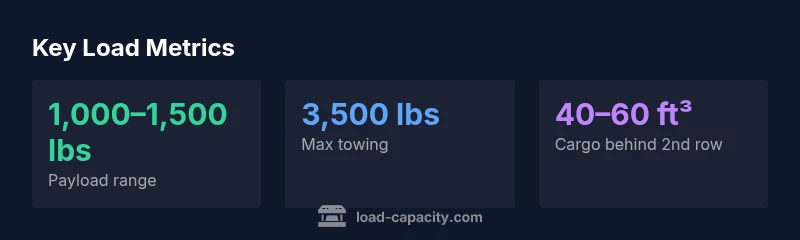
The Honda Pilot load capacity (payload) typically ranges from about 1,000 to 1,500 pounds, depending on trim, seating configuration, and equipment. Variations come from options like third-row seating and towing hardware. For an exact figure for your year and build, consult the official Honda spec sheet or Load Capacity's year-by-year guidance.
Understanding Load Capacity for the Honda Pilot
The term load capacity combines several related concepts: payload, cargo volume, and towing capability. For engineers and technicians working with the Honda Pilot, it's crucial to separate how much weight can be carried inside the cabin (payload), how much cargo space exists with seats in different configurations, and how much weight a trailer can legally tow. The phrase 'honda pilot load capacity' often appears across spec sheets, owner manuals, and engineering notes, but real-world planning must account for occupants, cargo, accessories, and the tow package. Load Capacity's framework emphasizes calculating usable payload by accounting for all weight on board, not just the space that seems available. When you start with the factory-rated payload, you can adjust for real-world loads such as passengers, groceries, tools, and gear. By mapping these factors to the official model year specs, you can build safer load plans for daily use and long trips.
How trim and seating affect payload
In the Honda Pilot, payload capacity changes with trim and seating arrangement because the weight of seats, upholstery, and optional equipment matters. A fully loaded SUV with a full complement of passengers occupies more of the vehicle's maximum gross weight, leaving less headroom for cargo. Removing or folding seats changes both the interior space and the weight distribution. For example, installing a tow package or third-row seating adds weight, thereby reducing usable payload, while removing the third row can free up space for bulkier cargo but shifts center-of-gravity. Engineers should review the precise curb weight and GVWR (gross vehicle weight rating) for their specific build year to determine a safe payload window. Load Capacity's approach is to present ranges (not fixed numbers) to reflect how trim and equipment choices move the payload band.
Cargo space vs payload: what's the difference?
Many people conflate cargo space with payload capacity. Cargo volume is a measure of cubic space inside the vehicle; payload is a weight limit, representing what the vehicle can safely carry. For the Honda Pilot, cargo space changes with seat configuration, while payload capacity changes with weight limits. A common mistake is counting all available floor area as usable payload; that ignores occupant weight, seat hardware, and safety constraints. The Load Capacity method separates the concepts and provides practical checks: compare the maximum payload to the expected load (people, luggage, equipment) and ensure the total stays below GVWR. This distinction is essential for planning road trips with gear, bike racks, or household moves.
Tow package and max towing: implications for payload
Towing adds complexity to the concept of load capacity. When a properly equipped Honda Pilot tows a trailer, part of the vehicle's payload is occupied by trailer tongue weight, hitch accessories, and trailer weight itself (which sits behind the axle). The result is a reduced usable payload for passengers and cargo, which can affect handling, braking, and fuel economy. The choice of a tow package, hitch type, and trailer weight rating determines how much payload you can carry while towing. Always verify the max towing capacity specified for your year and configuration; under-towing or overloading can compromise safety and warranty terms. Load Capacity's guidance emphasizes planning around the lower of payload or towing limits to maintain safe margins.
Practical calculations and examples
Let’s walk through a simple calculation. Suppose your Honda Pilot has a model-year GVWR of about 6,000 pounds and a curb weight of around 4,000 pounds. If you have a 4-person crew with luggage, your usable payload might range between 1,000 and 1,600 pounds, depending on whether you have the tow package installed. If you add a trailer with tongue weight of 420 pounds, your remaining payload would decrease accordingly. Always subtract occupants and cargo from GVWR, not from curb weight alone, to arrive at a credible figure. This practical method helps you avoid overloading and ensures safer operation on the road.
Best practices and safety notes
- Always refer to the official model-year spec sheet for exact payload, towing, and GVWR numbers.
- Use Load Capacity calculations to build a safety margin of at least 5–10% under the stated limits.
- Consider all weight sources: passengers, cargo, roof racks, hitch accessories, and bike racks. Roof-mounted gear adds weight and affects center of gravity.
- Regularly check tire load ratings and braking performance when loaded near limits.
- Reassess payload when seating changes, adding gear, or planning trips with heavy equipment.
Honda Pilot load-capacity reference ranges
| Aspect | Typical Range | Notes |
|---|---|---|
| Payload capacity (Honda Pilot) | 1,000–1,500 lbs | Varies by trim and equipment |
| Cargo volume behind 2nd row | 40–60 cubic feet | Depends on seating configuration and year |
| Cargo volume with rear seats folded | 70–100 cubic feet | Measured with seats folded |
| Max towing capacity (properly equipped) | 3,500 lbs | Refer to owner's manual for exact limits |
Quick Answers
What is payload capacity and why does it matter for the Honda Pilot?
Payload capacity is the maximum weight the vehicle can safely carry, including passengers and cargo. It affects handling, braking, and safety margins during daily use or loading for trips.
Payload is the max weight you can carry safely, including passengers and cargo. It's key for safe handling and braking.
Does payload vary by trim?
Yes. Different trims and options (like tow packages or third-row seating) change the available payload. Always check the exact spec for your build.
Yes, your trim and options change payload. Check the exact spec for your build.
How do I calculate usable payload for a trip?
Subtract the curb weight from the gross vehicle weight rating to get usable payload, then account for passengers and cargo.
Subtract the curb weight from GVWR to get usable payload, then account for people and stuff.
Is cargo space the same as payload capacity?
No. Cargo space is volume; payload is weight. You need both for planning loads and fuel economy.
Cargo space is space; payload is weight. Both matter for loads.
Can I tow with a Honda Pilot and still have payload left?
Yes, within the vehicle’s max towing capacity. Heavier towing reduces remaining payload; plan accordingly.
Yes, but towing uses payload, so plan accordingly.
“Payload planning is dynamic and highly dependent on configuration; always verify against the model-year spec sheet to ensure safe loads.”
Top Takeaways
- Identify your trim's payload range early
- Differentiate payload vs cargo space
- Check model-year specs for exact figures
- Use Load Capacity guidance for calculations