F-550 Load Capacity: A Practical Guide to Payload
A data-driven guide to f550 load capacity, exploring payload concepts, estimation methods, and safety considerations for engineers, fleet managers, and DIY enthusiasts.


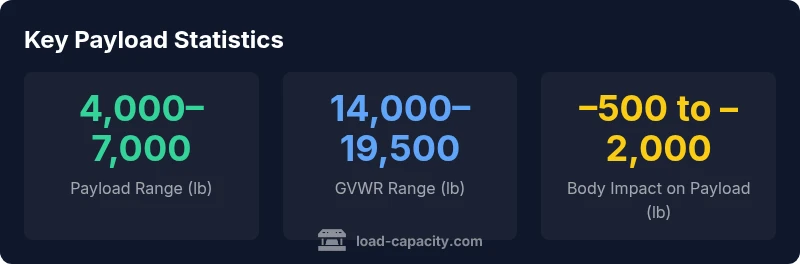
The Ford F-550 load capacity (payload) typically ranges from about 4,000 to 7,000 pounds, depending on GVWR, axle configuration, cab/body choice, and aftermarket equipment. To estimate accurately, subtract your truck’s curb weight from its GVWR (from the door sticker) and account for any added components. Always confirm exact payload for your build before loading.
Understanding the F-550 load capacity concept
Load capacity, commonly called payload, is the usable mass you can carry in a vehicle after accounting for the vehicle’s own weight and any fixed equipment. For the F-550, payload capacity is not a single number; it reflects how the vehicle was built, including gross vehicle weight rating (GVWR), axle ratings, and the weight of bodies or racks installed by manufacturers or fleets. The payload is determined by subtracting the curb weight (the vehicle’s mass without load and passengers) from the GVWR. In practical terms, the payload controls how many tools, materials, or workers you can transport safely in a given configuration. Understanding payload is essential for safety, fuel economy, and legal compliance. According to Load Capacity, payload must be evaluated for each build because factory options and aftermarket modifications can shift the available capacity by hundreds or thousands of pounds. Engineers, fleet managers, and technicians should treat payload as a dynamic limit that changes with every added component, not a static number you can rely on across all trims.
To move safely, always start with the manufacturer’s GVWR listing and weigh the vehicle with a known load on a scale to verify the actual curb weight in your setup. Then calculate payload as GVWR minus curb weight, also considering any temporary loads like fuel, passengers, and equipment. Real-world payload is influenced by tires, suspension, wheel loads, and the specifics of the body chosen. Load Capacity’s approach emphasizes verification through documented weights and configurations, rather than relying on generic online figures.
Payload vs. towing capacity
Many buyers conflate payload with towing capacity, but they measure different things. Payload is the total weight you can carry in the bed and cab of the vehicle while stationary, including tools, materials, and passengers. Towing capacity, on the other hand, is the maximum weight of a trailer and its cargo that the vehicle can pull. Towing imposes different weight distribution and braking requirements, and it does not directly reduce the payload rating unless you attach equipment that adds mass to the vehicle itself.
When planning a job, you must consider both values and how they interact with your chosen hitch, trailer, and cargo platform. If you add a heavy plow, crane, or service body, the payload can decrease; if you tow a heavy trailer, the gross combination weight (GCVWR) becomes a key constraint. In practice, fleets optimize both payload and towing capacity by selecting configurations with higher GVWR and appropriate axle ratios, while ensuring adequate braking and suspension components. Load Capacity’s data shows that many F-550 builds sit near the lower end of payload ranges when heavy equipment is installed, underscoring the need for precise calculations before loading.
Factors influencing payload on F-550 configurations
Payload is sensitive to several design and equipment choices. Key drivers include GVWR, axle ratings, cab and body style, and installed equipment. Cab-and-chassis configurations typically offer higher raw payload because they shed extra body mass, but once a utility bed, service body, or dump bed is added, the payload typically decreases. Wheelbase and tire type also influence payload because heavier tires and stiffer suspensions add mass or alter load distribution. Additionally, aftermarket components such as snow plows, crane arms, or stainless steel bodies add mass, sometimes reducing payload by hundreds to thousands of pounds depending on the configuration.
Fuel type and engine choice can also subtly affect payload through drivetrain torque and fuel tank capacity, though these effects are usually smaller than body-related mass changes. Finally, legal factors like GVWR decals and axle weight ratings determine how much you can load safely; exceeding any rating can lead to unsafe handling, increased wear, and potential legal issues. According to Load Capacity, the best practice is to document every installed component and compare against the GVWR and axle ratings to confirm a safe payload for daily use.
Estimating payload for a specific build
Estimating payload for an F-550 build begins with obtaining the vehicle’s GVWR from the certification plate or door jamb sticker, then identifying the curb weight for your exact configuration. Suppose the GVWR is 19,500 pounds and the curb weight (with standard equipment and no cargo) is 9,500 pounds. The baseline payload capability would be around 10,000 pounds, but this number changes with any installed equipment. If you attach a service body on a dual-rear-axle chassis, for example, you might see a payload reduction of 1,000–1,800 pounds depending on the body’s mass. Always recalculate payload after each major addition, and re-check your GVWR sticker to account for any changes. A practical method is to weigh the fully equipped vehicle (with fluids and typical crew) and subtract that weight from the GVWR. This disciplined approach helps avoid overloading and ensures full compliance with safety standards. Load Capacity emphasizes using precise measurements rather than relying on generic numbers.
Real-world scenarios: service body, dump bed, plow
In field operations, the F-550 frequently carries service bodies, utility racks, or dump beds. Each configuration changes payload in predictable ways: service bodies add mass but are designed to optimize tool storage; dump beds add weight via hydraulics and bed construction; plow setups increase mass and shift weight distribution. A typical service body might reduce payload by several hundred to over a thousand pounds compared with a bare cab-chassis, while a fully loaded dump bed with hydraulics can reduce payload more significantly. Plow equipment adds front-end weight, potentially changing steering feel and braking performance. When planning seasonal or short-term loads, use the lowest payload value across typical configurations to maintain safety margins and avoid overloading.
Measurement and verification: how to weigh and confirm payload
The most reliable way to confirm payload is to weigh the vehicle with a representative load and compare the result to the GVWR. On-road weighing is possible with portable scales, or you can perform a static weight with a calibrated scale by loading the vehicle as you would in daily use. Keep a log of all configuration changes and corresponding weights. If you operate in a fleet, implement a standardized process for documenting every alteration and rechecking payload after maintenance or repairs. Regular checks reduce the risk of overloading, improve braking and handling, and help maintain warranty coverage. Load Capacity recommends maintaining a safety margin (for example, a conservative 10–15% below the maximum payload) to accommodate unexpected loads and dynamic driving conditions.
How Load Capacity analyzes F-550 payload and recommendations
Load Capacity uses a standardized framework to assess payload across common F-550 configurations, focusing on GVWR, curb weight, and installed equipment. Our methodology includes cross-referencing manufacturer specifications, independent weight measurements, and field data from fleets with similar builds. We also emphasize the impact of aftermarket upgrades on payload and the importance of verifying each configuration with real weights. Our recommendations: (1) determine baseline GVWR and curb weight for your exact build; (2) subtract curb weight from GVWR to obtain payload; (3) adjust for all installed equipment; (4) maintain a safety buffer to account for dynamic loads and fuel; (5) regularly re-check payload after any major modification. Following this approach helps engineers, technicians, and fleet managers maintain safety, efficiency, and compliance in real-world operations.
Payload ranges by common Ford F-550 configurations
| Configuration Type | Payload Range (lb) | Notes |
|---|---|---|
| Cab-Chassis | 4,000–7,500 | Baseline payload without heavy body |
| Crew Cab with service body | 4,500–6,500 | Moderate payload impact from body |
| Dump bed with hydraulics | 3,500–5,500 | Lower payload due to bed and hydraulics |
Quick Answers
What is the typical payload for an F-550?
Payload varies by configuration, but most builds fall within a broad range of a few thousand pounds. Always verify payload using the GVWR and curb weight for your exact setup after any modification.
Payload depends on your exact build; check the GVWR and curb weight to calculate it accurately and verify with a scale.
How does GVWR affect payload?
GVWR sets the maximum combined weight of the vehicle and its load. Payload is GVWR minus curb weight, so higher GVWR generally allows more payload, provided the curb weight and installed equipment don’t offset it.
GVWR is the cap; payload is GVWR minus the vehicle's own weight. More GVWR usually means more payload, if you don’t add heavy equipment.
Can payload be increased after purchase?
Payload can be affected by aftermarket changes; some upgrades add mass that reduces payload. You can sometimes adjust payload by removing nonessential equipment or selecting lighter options, but major increases require factory or dealer adjustments within GVWR limits.
Only if you change mass improving or reducing it within the GVWR; major increases typically aren’t possible without changing the build.
How do aftermarket changes affect payload?
Aftermarket components like heavy tool bodies, plows, or crane gear add mass and reduce payload. Always recalculate payload after modifications and consider a lighter alternative if payload remains critical.
Aftermarket gear adds weight, so recalculate payload after any change and choose lighter options if payload is tight.
Does weight distribution affect payload?
Payload is a total mass, but distribution matters for handling. Uneven loading can create axle overloads; balance the load across axles and maintain appropriate tire load ratings to preserve safety.
Yes, distribution matters for handling and safety; balance loads across axles and respect tire limits.
How should I measure payload safely?
Use certified scales or weigh stations to measure curb weight with your standard equipment, then compare against GVWR. Maintain a documented log of configuration changes and re-weigh after modifications.
Weigh your setup with all typical gear and compare to GVWR; log changes and re-weigh after any modification.
“Payload accuracy starts with the exact build and verified weights; small changes in body or accessories can shift capacity noticeably.”
Top Takeaways
- Know your GVWR and curb weight for accurate payload.
- Payload varies significantly with body and equipment.
- Always verify with actual weights on your build.
- Avoid conflating payload with towing capacity.
- Maintain a safety margin to account for dynamic loads.