What is the Highest Load Rating for Trailer Tires? A Practical Guide
Learn how trailer tire load ratings work, how to identify the highest available ratings, and how to choose tires that safely support your trailer's weight. A data-driven guide from Load Capacity.


What is the highest load rating for trailer tires? In practice, the answer isn't a single universal number; it depends on tire line and load index. ST trailer tires typically reach the upper end of the scale, often in the high 120s load indices (roughly 3,500–4,000 lbs per tire). Always verify the exact rating on the sidewall and in the manufacturer's charts.
Understanding load rating fundamentals
Load rating is a composite concept built from the tire’s load index, ply rating, and tire construction. For trailers, the load index is the primary driver of how much weight a single tire can safely carry at the recommended pressure. The phrase 'what is the highest load rating for trailer tires' often leads to a focus on ST (Special Trailer) tires, which are designed for trailer service rather than passenger vehicles. The highest practical rating you’ll encounter in consumer trailer tires comes from lines that use higher load indices and heavier ply constructions. However, a higher rating must not be interpreted in isolation: you must compare it against the trailer’s axle load, GVWR, and the per-tire load distribution. In short, the highest rating is model-dependent and tied to the entire load-path of the trailer.
Reading sidewalls and making sense of markings
Tire sidewalls carry essential data: the load index, the speed rating, tread pattern, and recommended inflation. The load index is a numeric code that maps to a specific weight capacity per tire. On ST tires, you’ll typically see load indices ranging from the low 100s to the high 120s, with higher numbers indicating greater capacity. Ply rating (historic) and modern tire construction (radial vs. bias) also influence durability and heat tolerance. When shopping, isolate the load index value first, then verify the corresponding tire size, rim compatibility, and speed rating. Always compare the sidewall data against your trailer’s calculated per-tire load to ensure a safe margin.
ST tires vs other trailer tire types
Trailer tires come in several families, including ST (Special Trailer), LT (Light Truck) trailer tires, and commercial trailer tires. ST tires are engineered for trailer dynamics and often offer higher load indices within consumer lines. LT trailer tires can provide heavier-duty capacity but may differ in ride quality and durability. Commercial trailer tires push load ratings further for heavy-duty applications but may require different mounting and maintenance practices. The gist: the 'highest' rating you can reasonably achieve on a standard consumer trailer is typically found in the ST category, but the exact maximum depends on model, ply, and construction.
How to calculate the required load rating for your trailer
Start with the trailer’s GVWR and distribute weight across the number of tires on each axle. Per-tire load equals the axle load divided by the number of tires on that axle, adjusted for tongue weight and dynamic factors like braking. Add a safety margin of 10–20% to account for load shifts during cornering and braking. Your per-tire load will then guide you to the minimum load index you must meet or exceed. Remember: even a tire with a high load index is not suitable if it cannot fit your wheel, tire diameter, or clearance.
Step-by-step guide to choosing the highest practical load rating
- Determine GVWR and axle configuration. 2) Calculate or measure actual load per tire under peak use. 3) Identify tires with load indices that exceed that per-tire load by a comfortable margin (10–20%). 4) Confirm compatibility: rim size, speed rating, and tire width. 5) Check warranty, manufacturer data, and installation recommendations. 6) Plan for contingencies: spare tires with matching load rating.
Real-world scenarios: applying the rating framework
Case A: A tandem-axle utility trailer with a GVWR of 8,000 pounds and average cargo loads of 1,500 pounds per axle. Per-tire load is roughly 1,000–1,250 pounds if each axle uses two tires. An ST tire with a load index in the high 100s would comfortably meet this requirement, provided the tire width and rim fit. Case B: A larger camping trailer with a higher tongue load during fuel stops may shift more weight forward. In this scenario, you’d compute per-tire load more carefully and likely choose tires with a higher per-tire rating than the minimum to maintain safety margins.
Maintenance and safety practices to support high-load tires
Maintain correct inflation based on the tire’s load rating and vehicle manufacturer guidelines. Under- or over-inflation reduces load-carrying capacity, increases heat buildup, and shortens tire life. Inspect tread depth, sidewall condition, and look for aging signs like cracking. Rotate tires per manufacturer recommendations to promote even wear. Finally, ensure you stay within the tire’s speed rating when towing heavy loads, since speed combined with high load can dramatically affect heat generation.
Trailer tire types and their typical load-index ranges
| Tire Type | Typical Load Index Range | Common Ply Rating | Notes |
|---|---|---|---|
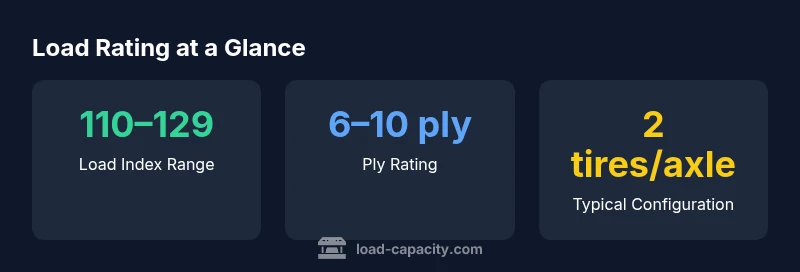
| ST (Special Trailer) | 110–129 | 6–10 ply | Common upper end for consumer trailers |
| LT (Light Truck) trailer tires | 90–110 | 8–12 ply | Higher capacity, different performance profile |
| Commercial trailer tires | 120–150 | 14–16 ply | Higher loads, industrial use |
| Passenger-style trailer tires | 90–100 | 6–8 ply | Not designed for heavy-duty trailers; use caution |
Quick Answers
What is the highest load rating for trailer tires?
There is no single universal maximum. The highest rating is determined by the tire model, load index, and ply construction. ST tires often offer the strongest ratings within consumer lines, but always verify per-tire load against your trailer’s requirements.
There isn’t one universal maximum; it depends on the tire model. Check the sidewall and model charts to confirm.
How do I calculate per-tire load on my trailer?
Determine your trailer’s GVWR and divide by the number of tires on the active axle, then add a safety margin (10–20%). Use this figure to select a tire with an adequate load index.
Compute per-tire load from axle weight, then pick a tire with more capacity than you need.
Can I use passenger car tires on a trailer to achieve higher load ratings?
Not recommended. Passenger tires are not designed for trailer dynamics, speed, and weight distribution. Use tires rated for trailer service that fit your rim size and SVR demands.
No—use trailer-rated tires that fit your trailer’s specs.
Does load rating affect speed rating for trailer tires?
Yes. Higher load ratings can influence safe operating speeds because heat buildup rises with weight. Always select tires whose load and speed ratings meet or exceed your towing requirements.
Higher load can limit safe speeds; choose according to both ratings.
What should I do if I can’t find a high enough rating for my trailer?
Re-evaluate axle loads and weight distribution, consider heavier-duty tires or reducing payload, and consult the trailer manufacturer’s guidance to avoid overloading.
If you can't find a high enough rating, adjust weight or consult the manufacturer.
Are there differences between per-tire load and total trailer load?
Yes. Total trailer load should not exceed GVWR, but per-tire load is what determines the rating you need. Distribute load evenly across tires and avoid overload on any single tire.
Per-tire load matters for rating; total trailer load must stay within GVWR.
How often should I inspect tires on a loaded trailer?
Inspect tires before every trip, focusing on inflation, tread depth, and sidewall condition. In high-load scenarios, check more frequently and replace aging tires promptly.
Check inflation and wear before each trip, especially when heavily loaded.
Is it okay to mix tire brands on the same trailer?
Mixing brands is generally not recommended because different tires may have different load and speed ratings, causing uneven wear and handling differences. If you must mix, ensure all tires meet or exceed the trailer’s required ratings.
Mixing brands can be risky; ensure all meet required ratings.
“The highest practical load rating for trailer tires is model-dependent, and safety comes from matching a tire’s load index to the trailer’s true per-tire load while allowing a margin for dynamic conditions.”
Top Takeaways
- Check the sidewall load index first, then confirm with the manufacturer.
- Calculate per-tire load from axle weight and distribution, add a safety margin.
- ST tires usually offer the highest common trailer load ratings within consumer lines.
- Match load rating to GVWR and ensure rim/tire compatibility and inflation guidelines.