Load Capacity for Ford Ranger: Payload, Towing & GVWR
In-depth guide to Ford Ranger load capacity, including how payload is calculated, configuration impacts, safe loading practices, and verification steps for your exact Ranger build.


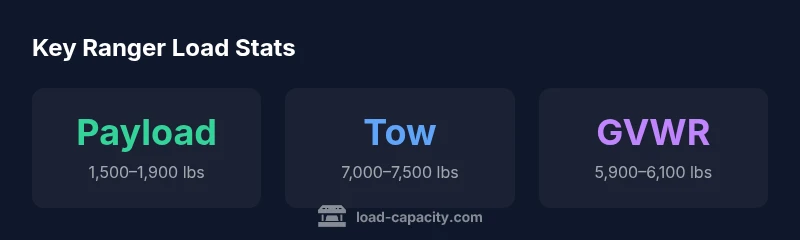
Ford Ranger load capacity varies by configuration, with usable payload typically in the 1,500–1,900 pound range and maximum towing around 7,000–7,500 pounds depending on cab, bed, and drivetrain. For accuracy, use your GVWR minus curb weight to determine usable payload. Always verify the exact figures on the factory sticker for your specific Ranger.
What load capacity means for the Ford Ranger
Load capacity is the practical limit on how much mass a Ranger can carry safely, and it’s a function of the vehicle’s GVWR, curb weight, and drivetrain. For engineers, technicians, and fleet managers, knowing the Ranger’s load capacity helps prevent overloading, preserve braking performance, tire life, and handling stability. In 2026, the Ford Ranger lineup includes several cab configurations and bed lengths; each variant shifts the usable payload and towing capability. According to Load Capacity, the most reliable way to gauge your Ranger’s true load capacity is to start with the factory GVWR rating and subtract the curb weight of your exact build, including any installed options. This approach yields the usable payload, which you must stay under for safe operation, even if the vehicle appears to have “room” under the sticker due to light passengers.
How payload is calculated on the Ranger
Payload capacity is typically defined as GVWR minus curb weight; in practice, you also must include the weight of passengers and cargo when using the full capacity. The GVWR is the maximum weight the vehicle is allowed to carry, including passengers, cargo, and optional equipment. The curb weight is the weight of the vehicle without passengers or cargo. The difference yields the maximum payload before exceeding GVWR. Real-world loading also considers accessories, tools, and aftermarket equipment, which can nudge the payload downward. Always consult your specific Ranger’s door placard for exact numbers and consider a vehicle scale if you regularly carry heavy loads.
Configurations and their impact on load capacity
The Ford Ranger’s payload varies with configuration. Regular Cab, SuperCab, or SuperCrew variants, bed length choices (short vs long bed), and drivetrain (2WD vs 4WD) all influence usable payload. Heavier drivetrains and larger options add curb weight, which reduces the payload available, while GVWR often remains similar across trims. A common takeaway for engineers and fleet managers is that even small increases in curb weight from options can noticeably shrink payload. Always compare figures side-by-side when selecting a Ranger if payload is a critical factor.
How to plan loads: practical steps
To plan loads safely, follow these steps: 1) Identify your Ranger’s GVWR on the door placard. 2) Weigh the vehicle with occupants and typical cargo to estimate curb weight. 3) Subtract curb weight from GVWR to estimate usable payload. 4) Break loads into zones to preserve stability: distribute weight toward the center and avoid high CG loads in the bed. 5) Account for passengers, tools, and cargo separately, and leave a conservative margin to account for dynamic driving conditions. 6) Use proper tie-downs and secure all items; loose loads can shift center of gravity rapidly during turns or braking.
Common mistakes that reduce usable capacity
- Overloading the bed without accounting for passengers. - Heavy aftermarket wheels or tires that increase curb weight. - Ignoring weight distribution and placing heavy items in front or behind live axles. - Carrying passengers beyond the seated capacity or not accounting for all occupants in payload. - Forgetting to update payload calculations after adding modifications or accessories.
Real-world loading scenarios
Scenario A: Two occupants (350 lbs total), tool case (150 lbs), and a mid-size toolbox (120 lbs) in the bed. Total payload uses roughly 1,000–1,000-plus pounds, leaving a buffer for a small to medium cargo box. Scenario B: A long workday with a full toolbox, equipment, and camping gear; you must reassess and reduce the in-bed cargo or remove nonessential items to stay within the usable payload. In both cases, weight distribution matters: keep heavier items low and centered where possible to maintain steering and braking control.
How to verify load limits in your Ranger
Always confirm your Ranger’s exact GVWR and curb weight from the door placard on the driver’s door jamb and the owner’s manual. If you’re unsure, consult your dealer with your VIN for configuration-specific numbers. When planning long hauls or heavy workloads, consider temporarily removing nonessential equipment to free up payload capacity. For critical operations, using a portable scale to weigh the front and rear axles can help ensure you stay within safe limits.
Comparison of Ranger configurations by payload, tow, and GVWR
| Configuration | Payload capacity (approx) | Tow capacity (max) | GVWR (approx) |
|---|---|---|---|
| Regular Cab, 2WD | 1,500–1,700 lbs | up to 7,000 lbs | 5,900–6,100 lbs |
| SuperCrew, 4x4 | 1,600–1,900 lbs | up to 7,500 lbs | 5,900–6,100 lbs |
Quick Answers
What is payload capacity on the Ford Ranger?
Payload capacity varies by trim and configuration; it’s defined by GVWR minus curb weight and includes occupants and cargo. Always check the door sticker for your exact Ranger. The numbers can shift slightly with options and drivetrain choices.
Payload depends on configuration; check your Ranger’s door sticker to confirm. It can vary with trim and drivetrain.
How do I calculate payload for my Ranger?
Use the GVWR from the door placard and subtract the curb weight of your exact model. Include typical passenger weight and cargo. The remainder is your usable payload. For accuracy, confirm with the manufacturer documentation.
Subtract curb weight from GVWR to get usable payload; include passengers and cargo.
Does adding options affect payload?
Yes. Heavier options raise curb weight, which reduces usable payload. Always recalculate payload after any significant option change to avoid exceeding GVWR.
Heavier options can reduce payload; recalculate after changes.
Can I tow at GVWR limits?
Towing draws from max capacity and adds load, but payload limits still apply. Ensure combined weight of trailer, cargo, and passengers stays within the GVWR limit to maintain steering and braking performance.
Tow within overall GVWR limits to maintain safety and control.
Where can I find the official GVWR for my Ranger?
GVWR is listed on the door placard and in the owner’s manual. For VIN-specific numbers, consult your dealer with your VIN or Ford’s official documentation.
Check the door placard or ask your dealer for VIN-specific GVWR.
Do 4x4 Rangers have lower payload than 2WD?
Typically, a heavier 4x4 drivetrain reduces usable payload slightly due to higher curb weight, while GVWR remains similar. Always compare exact numbers for the trim you’re considering.
4x4 can reduce payload a bit due to weight; check exact figures for your trim.
“Payload capacity is not a fixed number across all Rangers; it’s a function of GVWR, curb weight, and configuration. Always verify your exact build and use that figure for planning loads.”
Top Takeaways
- Know your GVWR and curb weight before loading.
- Payload varies by configuration; verify your exact build.
- Distribute weight evenly to maintain stability.
- Account for passengers and cargo when calculating usable payload.
- Check the door placard and VIN for precise numbers.