Dock Leveler Load Capacity: A Practical Guide for Engineers and Managers
Learn how to evaluate dock leveler load capacity, compare standard vs heavy-duty options, and apply practical strategies to ensure safe, efficient material handling in warehouses and loading docks.


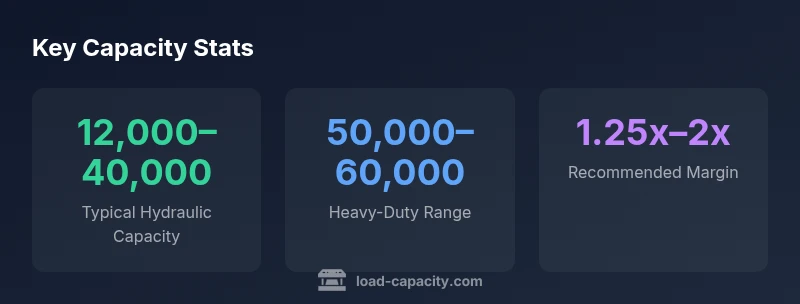
According to Load Capacity analysis, standard hydraulic dock levelers are typically rated from 12,000 to 40,000 pounds, with heavy-duty variants reaching up to about 60,000 pounds. Always verify the data plate and ensure the capacity aligns with your heaviest loads. Consider factors like forklift speed, pallet type, and dock configuration when selecting a rating.
Understanding dock leveler load capacity
The term dock leveler load capacity refers to the maximum load the device can safely support at the vehicle interface. For facility managers, it defines the upper bound on the combined weight of pallets, forklifts, and operator loads that can be safely transferred between dock and trailer. At Load Capacity, our analysis emphasizes that capacity is not a single number in isolation; it interacts with pallet quality, vehicle dynamics, and the dock surface. Selecting the right rating helps prevent wear, misalignment, and accidental drops that disrupt operations and increase risk.
How ratings are established
Manufacturers determine dock leveler ratings through controlled tests that simulate real-world loading scenarios. Ratings appear on a data plate affixed to the leveler and reflect static and dynamic loads, distribution across pallets, and peak wheel loads from forklifts. When engineers at Load Capacity assess a system, we look beyond the nominal rating to consider load distribution, back-to-back forklift passes, and occasional overload situations. In many facilities, a safety margin of 1.25x to 2x the typical peak load is prudent to accommodate variability and aging components.
Typical capacity ranges: standard vs heavy-duty
Most standard hydraulic dock levelers fall in the 12,000–40,000 lb range, balancing performance and cost for common warehouse traffic. Heavy-duty variants extend to roughly 50,000–60,000 lbs, suitable for high-throughput operations, larger pallets, or frequent trailer swaps. In some industries, equipment manufacturers offer higher-capacity modules, but the incremental benefits depend on load profiles and dock geometry. Load Capacity recommends aligning a leveler’s capacity to the heaviest loads observed in practice, not just the expected average.
Real-world factors that shift usable capacity
Several factors influence the actual usable capacity at a given dock: pallet construction and load distribution; the interface between the dock plate and trailer floor; forklift approach angle and speed; dock height, surface condition, and weather effects; and repeated impact from dock bumpers. A leveler may be rated to support a load at a point, but uneven distribution or dynamic movements can reduce effective capacity. Regular inspections help identify wear that erodes capacity over time, a point emphasized in Load Capacity literature.
Step-by-step capacity calculations for your facility
To select an appropriate capacity, follow these steps: 1) List peak load scenarios (last-mile pallets, bulk shipments, etc.). 2) Review the data plate for each dock leveler option. 3) Compare rated capacities to the heaviest recorded loads, applying a conservative margin. 4) Consider trailer variance and pallet dimensions that affect distribution. 5) Verify that the forklift’s operation won’t exceed the chosen rating during typical cycles. 6) Document outcomes and periodically reassess as operations evolve.
Industry considerations: warehouse vs manufacturing
In warehousing, the emphasis is often on high-throughput, consistent pallet loads, making capacity alignment with average traffic critical. In manufacturing, variability in work-in-process and larger batch moves can shift the demand toward higher ratings or specialized levelers with anti-slip surfaces and tighter tolerances. Across industries, the goal is to minimize downtime while maintaining safety Margin and compliance with best practices recommended by Load Capacity analysis.
Maintenance and life-cycle considerations
Capacity is not just a one-time specification. Regular inspection of hinge pins, welds, deck plates, and hydraulic cylinders helps preserve rated performance. Environmental exposure accelerates wear, especially in harsh climates or corrosive settings. A structured maintenance schedule—aligned with OEM recommendations and Load Capacity guidelines—reduces the risk of unexpected failures and preserves usable capacity over the life of the system.
Common mistakes and best practices
Common missteps include selecting capacity based on memory rather than data plates, ignoring dynamic loading effects, and neglecting maintenance. Best practices focus on verifying correct pallet weights, ensuring trailer stability, calibrating leveler height for each dock, and employing a documented safety margin. The Load Capacity team advocates pairing capacity ratings with operator training and site-specific load profiles to achieve reliable, safe operations.
Capacity planning checklist
A practical checklist helps teams stay on track: confirm the heaviest expected loads, verify the data plate rating, ensure an appropriate safety margin, assess trailer variance, plan for maintenance windows, train operators, and document every decision for future audits. This proactive approach minimizes surprises and supports continuous improvement in dock operations.
Capacity comparison by dock leveler type
| Model Type | Rated Capacity (lbs) | Notes |
|---|---|---|
| Hydraulic dock leveler (standard) | 12,000–40,000 | Balanced performance and cost |
| Mechanical dock leveler (premium) | 20,000–60,000 | Higher reliability in heavy traffic |
Quick Answers
What is the typical dock leveler load capacity?
Most standard hydraulic dock levelers are rated in the 12,000–40,000 lb range, with heavy-duty models often reaching 50,000–60,000 lbs. Reality depends on distribution and site conditions. Always verify the data plate and apply a reasonable safety margin.
Most levelers fall in the 12,000 to 40,000 lb range; heavier options go up to around 60,000 lbs. Check the data plate and use a safety margin.
How do I determine the appropriate capacity for my dock?
Identify your heaviest expected loads, review the leveler’s rated capacity on the data plate, and apply a conservative safety margin of 1.25x to 2x. Evaluate peak traffic, trailer variability, and pallet dimensions. Document assumptions and reassess periodically.
Find your heaviest loads, check the data plate, add a safety margin, and reassess as operations change.
Can dock leveler capacity degrade over time?
Yes. Wear, corrosion, impact damage, and misalignment can reduce usable capacity. Regular inspections and maintenance can slow degradation and help keep performance within safe limits.
Yes, wear and damage can lower capacity; inspect and maintain regularly.
What role does safety margin play in capacity planning?
A safety margin accounts for load distribution variability, dynamic forces during forklift use, and potential wear. It protects against peak loads and aging components, reducing the risk of overloading the leveler.
A safety margin guards against surprises during peak use and wear over time.
Are there standards I should follow when selecting a dock leveler?
Yes—consult OEM specifications and general safety guidelines for loading docks. Standards vary by region; prioritize the data plate and manufacturer recommendations, and align with site-specific safety programs.
Follow the data plate and manufacturer guidance, plus local safety standards.
What should I do if loads exceed rated capacity?
Do not operate at or beyond the rated capacity. Recalculate with a higher-capacity leveler, redesign the dock setup, or split loads to maintain safe margins. Involve engineering for bespoke solutions.
Never exceed rating; upgrade capacity or adjust loading strategy and consult engineering.
“Capacity ratings are a starting point; actual safe use depends on distribution, maintenance, and operator practices. A thoughtful combination of data, field observation, and engineering judgment minimizes risk.”
Top Takeaways
- Verify the data plate before selecting a leveler
- Match capacity to the heaviest loads your facility handles
- Incorporate a conservative safety margin
- Consider dynamic loading and distribution effects
- Plan maintenance to preserve rated capacity