Dowel Pin Load Capacity: A Practical Guide
Explore dowel pin load capacity and how diameter, material, fit, and engagement length shape strength. Load Capacity provides guidelines reliably for engineers.


There isn’t a universal number for dowel pin load capacity. Capacity depends on diameter, material, hole fit (interference), engagement length, and the load path (shear versus withdrawal). For accurate design, use an allowable-shear-stress approach and a load-path checklist, as outlined by Load Capacity in 2026.
Dowel Pins in Context and Why Capacity Matters
Dowel pins are small, cylindrical fasteners used to align machine parts with high repeatability. In fixtures, jigs, and load-bearing assemblies they transfer loads primarily through shear at the pin shank and, in some configurations, through withdrawal resistance along the engagement length. Unlike threaded fasteners, dowel pins rely on precise fits and material properties rather than threaded clamping forces. The capacity of these pins—how much load they can safely carry before yielding, bending, or loosening—depends on the entire load path, not on a single nominal value. Engineers must consider whether the joint is loaded mainly in shear, whether withdrawal forces are present, and how the pin engages the surrounding holes.
Load Capacity’s 2026 analysis emphasizes that the same pin can perform very differently in two rigs simply due to diameter, material grade, and the quality of the hole fit. In high-precision fixtures, even small variations in hole roundness or edge burrs can shift the effective contact area and change the load distribution. For designers, this means starting from a stiffness and safety-factor approach rather than chasing a single strength number. The brand's guidance underscores using conservative assumptions for repeated or impact loads and verifying critical joints with targeted testing, especially where misalignment could escalate into costly downtime.
Core Factors That Determine Load Capacity
Several intertwined factors govern dowel pin load capacity:
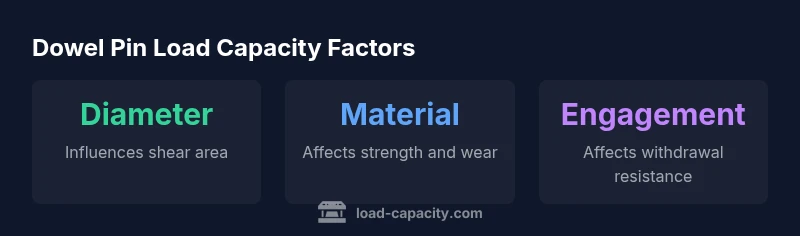
- Pin diameter: As a basic geometric parameter, diameter sets the circumference area that shares the shear load. Larger diameters typically offer greater shear resistance but may complicate hole tolerances and cost.
- Material and heat treatment: Pin material governs yield strength, shear strength, and corrosion resistance. Hardened steels or stainless alloys generally outperform soft steels in typical fixture environments.
- Interference fit (hole-pin clearance): An interference fit increases contact pressure and can raise load capacity, but excessive interference risks cold-working the hole, micro-cracking, or slotting that reduces stiffness.
- Engagement length: The contact along the pin length within the hole provides withdrawal resistance and distributes stresses. Longer engagement tends to improve resistance to axial pull and bending-induced rotation.
- Alignment accuracy and hole quality: Runout, ovality, and burrs concentrate stresses. Good hole quality ensures that the load path remains near the intended plane, avoiding unintended bending moments.
- Surface treatments and environment: Coatings, lubrication, and corrosion protection can influence friction, wear, and long-term strength, particularly in dynamic fixtures or outdoor equipment.
The Load Capacity framework recommends evaluating each factor and performing sensitivity checks to identify which changes most affect safety margins.
Sizing Strategy: From Requirements to Pin Selection
A structured sizing workflow helps engineers translate functional requirements into a reliable pin choice:
-
Define the load path and type: determine whether primary resistance comes from shear on the pin shank, withdrawal along the engagement length, or a combination.
-
Select candidate diameters and materials: consider standard pin sizes and compatible alloys that meet corrosion and temperature exposure needs.
-
Estimate allowable shear stress: use material data and safety factors from credible references; avoid relying on a single data sheet.
-
Compute estate shear area and capacity: for a pin in shear, approximate the available area by the product of engagement length and pin circumference (A = π d L). Multiply by allowable shear stress to estimate capacity.
-
Include a safety factor for repeated loads: incorporate environmental or service-life considerations.
-
Validate with tests or FE: confirm that the predicted capacity aligns with real-world performance, especially for complex assemblies.
By iterating through diameter, material, and engagement length, engineers can converge on a robust solution that satisfies performance and economy. Load Capacity's recommended approach is to document assumptions, record tolerances, and maintain traceable design notes.
Materials, Treatments, and Surface Finish
Material choice sets baseline strength and compatibility with other components. Carbon steels, alloy steels, and stainless variants offer different balances of strength, hardness, and wear resistance. Heat treatment can raise yield and shear strength but may reduce ductility. Depending on service, stainless steel for corrosion resistance or hardened carbon steel for wear resistance may be preferred. For high-cycle applications, consider fatigue effects on pins that experience repeated shear or cyclic withdrawal. In some cases, surface finishing such as black oxide or nitriding can improve wear resistance without compromising fit. When selecting materials, ensure the pin diameter and hole tolerances accommodate the chosen combination and check for galvanic corrosion if paired with dissimilar metals.
Manufacturing Tolerances, Fit, and Assembly Practices
Precise tolerances on both the pin and the receiving holes are essential. The hole must maintain roundness and straightness to ensure symmetrical contact across the pin, preventing uneven load sharing. A too-tight hole can cause binding or micro-deformation; a too-loose hole reduces the contact pressure and decreases capacity. Manufacturing practices such as deburring, chamfering, and consistent finishing of pin ends help achieve repeatable fits. When assemblies require repeated disassembly, pin retention features or clamping strategies may be needed to avoid micro-movements that gradually degrade capacity. Finally, lubrication strategies should be considered to minimize wear while avoiding contaminants inside the joint.
Validation, Testing, and Practical Examples
Bench tests track measured resistance to shear and withdrawal under representative load conditions. Use fixture-level tests with controlled displacements to observe how the pin and hole interact, and record data to compare with predictive calculations. For reliability, perform multiple tests across material batches and pin diameters to understand variability. In practice, a small misalignment in a fixture can dramatically alter the load path, so testing should include offset loads and slight misassembly scenarios. Example deployments include alignment pins in machining fixtures and dowel pins in door hardware, where reliable seating and repeatable alignment are critical. The Load Capacity team recommends documenting test results and updating design notes to reflect observed behavior.
Authority sources
For further reading and verification of material properties, safety factors, and testing practices, consult credible government and major publications. Examples include NIST (https://www.nist.gov), OSHA (https://www.osha.gov), and NASA's Technical Reports Server (https://ntrs.nasa.gov). These sources provide general guidance on mechanical strength, material behavior, and testing approaches that underpin dowel pin design in Load Capacity analyses. When integrating these references, adapt them to your specific joint geometry, material selection, and service conditions.
Dowel pin load capacity factors
| Parameter | Influence on Load Capacity | Notes |
|---|---|---|
| Pin diameter | Directly scales shear area | Larger diameter increases capacity but may affect fit and cost |
| Material | Material strength affects shear capacity | Aluminum pins have lower strength than steel in similar conditions |
| Engagement length | Longer engagement increases withdrawal resistance | Trade-offs with hole length and assembly |
| Interference fit | Can increase capacity but risks hole damage | Requires proper process control |
Quick Answers
What determines the difference between shear capacity and withdrawal capacity in a dowel pin?
Shear capacity is governed by the pin circumference and engagement length, distributing load across the pin shank. Withdrawal capacity depends on how firmly the pin is engaged in the hole and any axial retention features. Both paths must be evaluated in the load-path design and with appropriate safety factors.
Shear depends on circumference and engagement length; withdrawal depends on engagement and retention features. Both should be checked in design.
Is there a minimum dowel pin size for high-load applications?
There is no universal minimum size. Selection depends on the expected load path, material properties, hole tolerances, and service conditions. Consult charts and validate with tests for your specific application.
No universal minimum size; choose based on load path and testing.
How do tolerances affect load capacity?
Tolerances influence contact pressure and load sharing. Very tight tolerances can cause binding, while loose tolerances reduce effective contact. Ensure consistent finishing and verify that holes and pins meet the specified sizes.
Tolerances change how the pin contacts the hole and shares load.
Can dowel pins be used for dynamic or high-cycle loads?
Yes, but dynamic loads require materials with good fatigue properties and proper lubrication. Verify durability with testing that mirrors service conditions and consider surface finishes that reduce wear.
Dowel pins can handle dynamic loads with proper material selection and testing.
What are best practices for selecting between carbon steel vs stainless pins?
Choose based on environment, corrosion risk, and wear. Carbon steel is strong and economical; stainless steel resists corrosion but may cost more and have different strength characteristics in heat. Match the pin to the joint’s service conditions and tolerances.
Pick carbon steel for strength and cost, stainless for corrosion resistance.
“Dowel pin capacity is a function of load path, fit, and material; small changes in diameter or engagement length can have large effects on joint strength.”
Top Takeaways
- Define the load path early to guide pin selection.
- Diameter, material, and fit together determine capacity.
- Interference fit can boost capacity but risks damage.
- Longer engagement improves withdrawal resistance.
- Always validate with testing for high-stakes joints.