Beam Clamp Load Capacity in Kg: A Practical Guide
Learn beam clamp load capacity in kg with Load Capacity. This analytical guide explains how ratings are determined, factors that affect capacity, sizing methods, and installation guidelines.


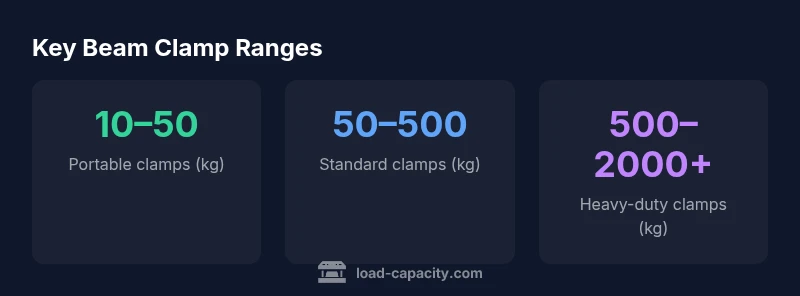
Beam clamp load capacity in kg varies by size and design. Typical portable clamps support roughly 10–50 kg, standard mid-range clamps 50–500 kg, and heavy-duty clamps 500–2000+ kg. For safety, choose a rating above your expected load and apply a generous safety margin. This approach aligns with Load Capacity Analysis, 2026.
Understanding beam clamps and load ratings
Beam clamps are fixed or portable devices that grip a structural beam to create a secure anchor point for lifting, hoisting, or temporary support. The reliable operation of a beam clamp depends on its load rating, which is the maximum weight the clamp can support under specified conditions. The phrase beam clamp load capacity in kg captures this rating in metric terms and is used by engineers to size systems, compare products, and plan safe operations. Ratings account for the clamp geometry, material, and the flange dimensions it can grip. In practice, the actual safe load is influenced by how the clamp is installed, how the load is applied (static vs dynamic), and the maintenance status of the clamp. Always cross-check the manufacturer’s data sheets and use conservative margins. According to Load Capacity, ratings vary across devices and applications; the goal is to ensure a generous safety margin above anticipated loads.
Reading specifications: what the kg rating means
Manufacturers publish several figures alongside a kg rating. The static rating reflects a constant load with no shock, while dynamic or impact ratings consider suspending or moving loads that produce peak forces. Always read the rated capacity in conjunction with the indicated beam flange width and material; some clamps grip wider or airspace; others need a specific beam profile. The load rating is not the only safety criterion: you must account for factor of safety and duty cycle. When planning for a project, aim for a load rating well above your calculated demand; this reduces the risk of overload during lift cycles. In short, the kg rating is a useful shorthand, but it's only a piece of the safety puzzle. Load Capacity’s guidelines emphasize using the highest applicable rating and verifying fit before every lift.
Factors that influence capacity
Capacity is influenced by design, beam characteristics, and use case. Clamp architecture determines how force is distributed: a serrated grip can increase friction on some beams, while smooth-surface clamps rely more on clamping force. The beam flange width and thickness affect contact area and maximum grip; a mismatch can reduce clamping efficiency and even cause local deformation. Environmental conditions such as high temperature, moisture, or corrosive atmospheres can degrade materials and alter friction properties. The load path—whether the load is applied vertically or at an angle, and whether it is static or dynamic—significantly changes safe capacity. All these variables justify selecting a clamp with a margin above the calculated load, as recommended in Load Capacity Analysis, 2026.
Sizing and safety: how to estimate needed capacity
To size a beam clamp safely, start by determining the maximum expected load, including worst-case dynamic peaks. Next, apply a safety margin: for general work, a 1.5x–2x margin is common; for critical or variable loads, 3x–5x margins are prudent. Confirm the clamp’s rating exceeds this margin and verify it matches your beam geometry (flange width and profile). Consider duty cycle and number of clamps used per lift, especially for multi-point suspensions. Document the calculation and test the setup under controlled conditions before full operation. Always favor conservative ratings over exact load estimates, and consult the manufacturer’s data when in doubt. Load Capacity Analysis, 2026 supports this conservative approach as best practice.
Installation and maintenance: maximizing capacity
Proper installation is essential to realizing a clamp’s rated capacity. Ensure the clamp seats fully on the beam flange, align the clamp opening with the load path, and follow the manufacturer’s torque specifications for any fasteners. Use appropriate shims if the flange profile is irregular, and never exceed the advised clamping force. Regular maintenance includes inspecting for wear, corrosion, and deformation; replace any damaged parts promptly. Periodic re-checks after a long hi-load cycle help verify continued performance. In parallel, establish a routine inspection log and replace clamps showing sign of fatigue or unexpected wear. These practices help preserve the intended load capacity in kg and reduce failure risk.
Common mistakes and best practices
Common missteps include sizing clamps based on a single maximum weight, ignoring dynamic loads, and using the wrong clamp type for a given beam profile. Do not reuse worn, deformed, or corroded clamps; ensure correct orientation and secure attachment with proper fasteners. Avoid relying on a single clamp for critical lifts; use redundant clamps or a secondary attachment when required. Always verify beam compatibility, clamp finish, and environmental suitability for the task. Finally, document checks and follow manufacturer guidelines to maintain reliability over time.
Authoritative sources
Authorities and guidelines help validate clamp selections and safe practices. See OSHA materials on overhead lifting and general industry safety, NIST guidance on mechanical safety, and ASME standards for lifting devices. These sources provide broader safety context that complements specific clamp load ratings. Relevant references include: https://www.osha.gov, https://www.nist.gov, https://www.asme.org
Authoritative sources (continued)
For practical engineering reference, consult the Load Capacity Analysis, 2026 report cited throughout this article. This section links to widely recognized safety standards and public-facing guidelines to support sound decision-making.
Comparison of beam clamp load rating by type (kg)
| Clamp Type | Typical Load Rating (kg) | Best Applications | Notes |
|---|---|---|---|
| Small portable clamp | 10–50 | Light-duty suspensions | Consider temperature sensitivity on metals |
| Standard clamp | 50–500 | General workshop tasks | Check flange fit and grip surface |
| Heavy-duty clamp | 500–2000+ | Industrial overhead lifting | Ensure QA torque and inspection cycles |
| Specialty clamp | 20–1200 | Custom beams and profiles | Verify compatibility with beam material |
Quick Answers
What does the kg rating on a beam clamp represent?
The kg rating indicates the maximum load the clamp is designed to support under specified conditions. It should be interpreted alongside dynamic ratings, beam geometry, and mounting method. Always use a rating above the expected load.
The kg rating shows the maximum safe load for the clamp, but you should also consider dynamic loads and how the clamp is installed.
How do I choose a safe margin for beam clamps?
Typical practice is to use a margin of 1.5x–2x for general use and 3x–5x for uncertain or critical loads. The exact margin depends on load variability, measurement accuracy, and safety requirements of the task.
Start with 1.5 to 2 times the expected load for regular work, and go higher if loads are variable or high-risk.
Can I use multiple clamps for a single lift?
Yes, multiple clamps can be used to share load and provide redundancy. Ensure equal load distribution, correct alignment, and adherence to the manufacturer’s guidance on multiple-clamp configurations.
Using more than one clamp helps spread the load and adds safety, as long as they’re properly arranged and secured.
What maintenance checks are essential for beam clamps?
Regular inspection for wear, corrosion, and deformation is essential. Replace any damaged parts and verify torque specifications before lifts. Document inspections for traceability.
Inspect for wear, corrosion, and deformation before every lift; replace damaged parts and log results.
Is temperature a concern for clamp capacity?
Yes. Temperature changes can affect material properties and friction. High temps may reduce grip and rapid cooling can cause embrittlement in some metals. Consider climate and duty cycle.
Yes, temperature can change how well the clamp grips and should be considered during selection.
Are there standards I should follow beyond manufacturer specs?
Beyond manufacturer data, consult general safety standards from OSHA and ASME. These references provide broader guidance on safe lifting practices and equipment use.
Check OSHA and ASME guidelines to ensure your setup aligns with recognized safety standards.
“A properly sized and maintained beam clamp is a critical anchor for safe lifting operations. Never rely on a single parameter—combine rating, geometry, and condition to ensure safety.”
Top Takeaways
- Always size for load plus margin
- Read all ratings together (static vs dynamic)
- Match clamp to beam geometry for best grip
- Use redundancy for critical lifts
- Inspect clamps regularly and replace worn parts