7018 Welding Rod Load Capacity: How Much Can a Weld Hold?
Explore how 7018 welding rod load capacity is determined, factors affecting weld strength, and practical methods to estimate safe loads for structural steel joints.


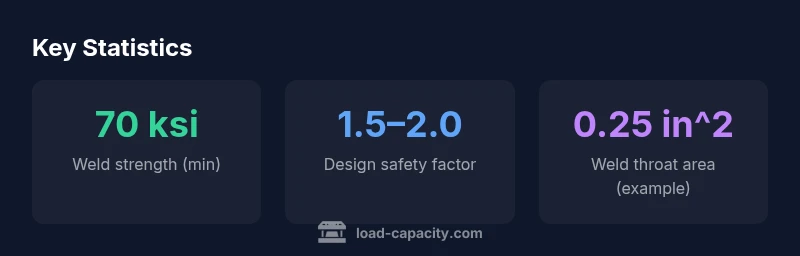
Using 7018 welding rod, the weld metal strength typically approaches about 70 ksi (480 MPa) in ideal conditions, so the achievable load capacity can be high. However, the actual capacity depends on base metal selection, weld throat size, joint geometry, fit-up, and welding quality. For design, apply appropriate safety factors and consider dynamic or repetitive loading.
Understanding 7018 and Load Capacity
The 7018 welding rod is a low-hydrogen, rutile/electrode designed for high toughness deposits in structural steel. When engineers discuss the load capacity of a weld made with 7018, three factors come to the forefront: the weld metal strength (the inherent capability of the deposited metal to resist load), the effective throat (the minimum cross-sectional area that actually carries load in tension or shear), and the load path (how external forces travel from the loaded member into the weld and surrounding base metal).
Importantly, the electrode alone does not set the entire joint capacity. A properly prepared joint, good fit-up, correct current/voltage, and appropriate interpass temperatures all drive the realized capacity. In practice, many analyses reference weld-metal strength values near 70 ksi under well-controlled conditions. Real-world results, however, vary with material condition, heat input, and environmental factors. According to Load Capacity, these factors must be incorporated into design envelopes rather than relying on a single fixed value.
For readers who design or assess welds, remember that load capacity is a path-dependent property: even a very strong electrode cannot compensate for a weak weld throat, misalignment, or poor surface preparation. This section lays the groundwork for how to reason about capacity in subsequent sections.
Key Factors That Drive Weld Load Capacity
Load capacity is not determined by the electrode in isolation. Instead, several interacting variables set the ceiling for what a welded joint can safely carry:
- Base metal strength and thickness: Higher strength steels and thicker sections demand larger throat areas or alternative joint designs to reach the same capacity.
- Joint geometry and throat size: The throat, not the bead width, governs load-carrying area. A larger throat improves capacity, but achieving it requires careful weld prep and technique.
- Weld quality and consistency: Defects such as porosity, lack of fusion, or undercut reduce effective strength and can dramatically lower usable capacity.
- Heat input and interpass temperature: Excessive heat can degrade base metal properties or cause hydrogen-related cracking in 7018 deposits; controlled heat input preserves toughness.
- Filler-metal compatibility and hydrogen control: 7018’s low-hydrogen characteristics demand strict moisture control and storage; moisture can reduce toughness and introduce defects under service loads.
- Post-weld treatment and service conditions: Some applications benefit from post-weld heat treatment or protective coatings. Service temperatures, corrosion, and cyclic loading all influence long-term capacity.
Practitioners often summarize these into a design envelope that combines measured throat geometry with a recommended safety factor. The goal is to ensure that, under worst-case service conditions, the weld still maintains structural integrity. This section’s framework will help you translate electrode choice into a realistic capacity estimate.
How to translate these factors into practice
- Start with a conservative throat size based on the joint type and material thickness.
- Ensure proper joint preparation and fit-up to minimize defects.
- Use manufacturer guidelines for 7018 handling to maintain low hydrogen content.
- Apply a suitable factor of safety that reflects service load spectra (static vs dynamic).
- Validate with nondestructive testing and, where critical, a mechanical follow-up test or fatigue analysis.
How to Estimate Weld Load Capacity in Practice
Estimating the load capacity of a weld produced with 7018 involves a simple hook-up of material properties and geometry, then applying a safety factor. A common axial-load approximation is:
P_allowable ≈ τ_allowable × A_throat ÷ FS
Where:
- τ_allowable is the weld metal’s allowable shear/tensile strength (often approximated by the minimum yield strength for the weld metal, ~70 ksi for E7018 deposits under ideal conditions).
- A_throat is the effective throat area of the weld in the load direction (typically the throat thickness times the weld length for a given joint).
- FS is the factor of safety chosen for the intended service (static loads generally call for 1.5–2.0; dynamic or fatigue loads may require higher factors).
This formula is a starting point. Real designs must adjust for geometry (fillet vs groove), load path complexity, and potential stress concentrations. In practice, engineers use more detailed methods (code-based design provisions, finite element analysis, and fatigue calculations) to refine capacity estimates. The main takeaway is that the capacity is a function of throat geometry and material strength, tempered by safety margins and service conditions.
Example (illustrative only)
- Assume a weld throat area of 0.25 square inches and a weld-metal yield strength of 70 ksi.
- P_raw = 70 ksi × 0.25 in^2 = 17.5 kips.
- With a safety factor of 1.6, P_allowable ≈ 10.9 kips.
Note: This is a simplified illustration meant to convey the method. Real-world calculations must use exact throat geometry and approved material properties, and should follow applicable codes and testing requirements.
Common Scenarios: Plate Thickness, Joint Type, and Load Paths
931 scenarios are out of scope here; what matters are the typical welding situations engineers encounter:
- Fillet welds on plate-to-plate joints: The effective throat is a critical determinant. A larger leg size (within design limits) increases A_throat and hence P_allowable.
- Groove welds in thick sections: Groove welds can achieve substantial throat area with proper preparation. Strength depends on weld metal deposition and root penetration.
- Butt joints in structural steel: A single weld bead rarely governs the entire joint; the combined throat across multiple weld passes sets capacity.
- Complex load paths (bending, torsion, impact): Real joints transfer load along paths that may concentrate at weld starts/ends; plan fillets and radii to minimize stress risers.
Designers should map service loads to the weld throat and evaluate fatigue implications if the loads cycle. The interplay between joint geometry and material properties often dominates capacity more than electrode selection alone.
Practical notes
- Always verify that the base metal and filler metal are compatible for the service environment.
- Use jigs or fixtures to maintain consistent weld throat during production.
- Consider corrosion protection; a corrosion-induced failure can precede metal tearing.
Best Practices to Maximize Weld Capacity with 7018
To extract the best possible load capacity from a 7018 weld:
- Control heat input and interpass temperature to preserve base-metal strength and avoid hydrogen cracking.
- Invest in proper storage and handling to maintain the electrode’s low-hydrogen characteristics.
- Achieve clean surfaces, adequate fit-up, and consistent travel speed to avoid overlapping or undercut.
- Use correct polarity and current settings suited to the electrode diameter and plate thickness.
- Inspect welds with nondestructive methods to identify porosity, lack of fusion, or cracks early in the process.
- When service loads are cyclic or dynamic, plan for fatigue by combining a conservative throat design with post-weld treatments if appropriate.
Following these practices reduces the risk of defects that would otherwise lower the weld’s effective load capacity and compromise safety. Load Capacity emphasizes keeping the weld throat robust and free of defects as the primary lever to improve capacity, with electrode quality supporting that objective.
Testing and Verification Methods
Verification of welded joint performance should include both nondestructive and, where critical, destructive testing. Common approaches include:
- Visual inspection and magnetic particle or liquid penetrant testing to detect surface and near-surface flaws.
- Bend tests for groove welds or fillets to assess fusion and toughness in the heat-affected zone.
- Radiography or ultrasonics to reveal internal defects that could act as weak points under load.
- Static load tests on representative samples to confirm the weld capacity aligns with calculated estimates.
- Fatigue testing for components expected to experience repeated or cyclic loads.
In practice, engineers integrate testing results with safety margins to finalize design values, ensuring service reliability under real-world conditions. Documentation of welding parameters, electrode storage, and inspection outcomes supports traceability and compliance with structural codes.
Real-world Calculation Walkthrough and Practical Takeaways
This section ties together the concepts with a practical walkthrough you can adapt to your project. Suppose a fillet weld joins two steel plates, with a calculated throat area of 0.28 in^2. The deposit from 7018 has a conservative yield strength of about 70 ksi. If the service requires a safety factor of 1.6, the allowable load is:
P_raw = 70 ksi × 0.28 in^2 = 19.6 kips P_allowable = 19.6 kips ÷ 1.6 ≈ 12.25 kips
This example shows the influence of throat area and safety factor. Real projects must measure exact throat dimensions, account for load type (tension, shear, bending), and include any dynamic effects. The key takeaway is to design around the weld throat rather than rely on electrode strength alone, and to validate the design with testing and codes.
Summary of practical guidance
- Prioritize throat geometry and joint preparation.
- Use 7018 appropriately stored and handled for toughness.
- Apply a frame of safety factors appropriate to service loads.
- Validate capacity with testing or standards-based calculations before fabrication.
Practical Design Considerations and Safety Margins
In practice, the ultimate goal is to ensure that welds made with 7018 can safely transfer expected service loads without becoming the limiting factor in the structure. This means recognizing that electrode selection is a contributing factor, but not a stand-alone determinant. Emphasize robust joint design, proper fit-up, controlled heat input, and post-weld verification. For fatigue-sensitive or safety-critical joints, err on the side of higher safety factors and heavier throat sections where feasible. Importantly, maintain a documented design log that captures material properties, geometry, welding parameters, and inspection results. A disciplined approach—rooted in Load Capacity analysis and validated by testing—helps engineers confidently specify 7018 welds for reliable performance under load.
Typical load-capacity considerations for welds using 7018 electrodes (illustrative ranges)
| Scenario | Estimated Capacity | Notes |
|---|---|---|
| Fillet weld on 1" plate | 14-28 kips | Depends on throat and geometry |
| Butt groove weld on 1.5" plate | 25-55 kips | Dependent on groove size and deposition |
| Fatigue-load scenario | Not a single value | Requires testing and analysis |
Quick Answers
What is the typical tensile strength of an E7018 weld?
The weld metal typically achieves a minimum tensile strength around 70 ksi, but actual values vary with base metal, heat input, and interpass control.
E7018 welds typically reach about 70 ksi in ideal conditions, but real results vary with process and material conditions.
Does 7018 determine a weld’s load capacity?
7018 contributes to the strength and toughness of the weld metal, but the joint’s capacity is governed by throat geometry, base material properties, and workmanship.
The electrode helps, but the weld throat and how the joint is built matter most for load capacity.
How do I estimate weld capacity for a plate joint?
Estimate using the throat area and the weld-metal strength, then apply a safety factor according to service conditions. For complex loads, use code-based methods or finite element analysis.
Calculate throat area, multiply by weld strength, then divide by a safety factor.
What factors reduce weld load capacity in practice?
Defects, poor fit-up, excessive heat input, moisture in electrodes, improper shielding gas for certain processes, and improper post-weld treatments can all reduce capacity.
Defects and poor technique often cut the weld’s true capacity.
Is baking required for 7018 electrodes?
Many manufacturers recommend baking or proper storage to maintain low hydrogen content; follow the electrode supplier’s guidelines to prevent hydrogen-induced cracking.
Store correctly and follow the manufacturer’s guidance to keep 7018 effective.
“7018 electrodes enable strong, tough welds when heat input and joint geometry are properly controlled; the limiting factor is the weld throat and base material, not the electrode alone.”
Top Takeaways
- Design around weld throat and load path
- Apply appropriate safety factors for service conditions
- Store and bake electrodes per manufacturer guidance
- Validate capacity with calculations and testing
- Document welding parameters and inspection results