NEMA 17 Stepper Motor Load Capacity: Practical Guidelines
Explore the load capacity of NEMA 17 stepper motors, including torque ranges, gearing effects, thermal considerations, and practical guidelines for reliable motion in engineering projects.


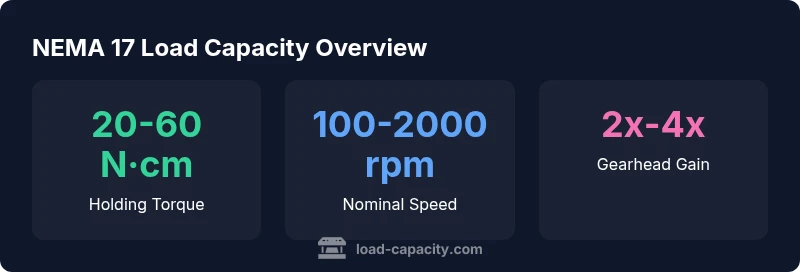
The practical load capacity of a NEMA 17 stepper motor is defined by its holding torque, typically in the range of 20-60 N·cm, and is highly dependent on current, cooling, and gearing. For reliable operation, design with a margin of at least 1.5x–2x above the required load and account for thermal limits. In short, load capacity is not a single fixed number but a function of electrical, mechanical, and thermal conditions.
Understanding NEMA 17 basics: frame, torque, and load concepts
The NEMA 17 designation is a mechanical frame size, roughly 1.7 inches square, used by a broad class of stepper motors. When engineers discuss the load capacity of a NEMA 17, they are really talking about how much load the motor can move or hold without stalling under a given current and temperature. Critical factors include holding torque, driver current, and the mechanical configuration (direct drive, belt/pulley, or lead screw). Load capacity is not a single number; it is a range influenced by duty cycle, cooling, lubrication, and mounting. According to Load Capacity analysis, 2026, the practical rule is to treat load capacity as the motor’s usable output torque at the output shaft under worst-case conditions, then apply a safety margin. For many projects, designers target a margin of 1.5x to 2x to avoid missed steps and overheating. Two motors with the same frame can have very different load capacities if one has better cooling or gearing. In short, the load capacity of a NEMA 17 is a function of electrical, thermal, and mechanical factors that must be mapped to your task.
How torque translates into load capacity: simple models
Torque is the primary driver of load-carrying capability. In basic terms, the required torque to move a load through a given radius is the product of the load force and the radius at which that force is applied. If you use a pulley or screw, you must account for the mechanical advantage. A small increase in radius reduces the force the motor must deliver, but increases the required torque when designing for a fixed load. Conversely, gearing can multiply the output torque, allowing heavier loads to be moved with the same motor, albeit at reduced speed. For design, it is useful to draw a simple map: motor torque potential (at a given current and temperature) vs. the torque needed to overcome the worst-case load. This helps identify whether you have a safe operating margin across the expected operating range.
Using gearing and drives to increase apparent load capacity
Gearing is a powerful way to boost the effective load capacity of a NEMA 17. A compact gearhead can multiply output torque by 2x–4x or more, enabling heavier loads to be moved with the same motor. The trade-off is reduced speed at the output and increased reflected inertia, which can make acceleration and servo control more challenging. When selecting a gearhead, ensure the gear ratio aligns with your required speed and that the motor can sustain the resulting torque without overheating. It is also essential to account for backlash, which can affect precision in positioning tasks. In practice, a well-chosen gearhead paired with a proper driver current and efficient cooling yields a robust solution for moderate to heavy loads while maintaining acceptable speed.
Thermal and electrical considerations that limit load capacity
Thermal limits cap how long you can sustain high-current operation, directly impacting available torque during continuous tasks. If the motor overheats, the driver may reduce current or trigger protective limits, reducing torque. Heat sinks, active cooling, and duty-cycle planning are essential for maintaining torque under load. Wire resistance and current limits determine the maximum stall torque you can reach safely; higher currents increase torque but also heat. A conservative approach is to design for a margin well above the peak load and to verify thermal performance under worst-case duty cycles. In this context, a properly cooled NEMA 17 can deliver higher sustained torque than a poorly cooled one, reinforcing the value of thermal management in load-capacity planning.
How to estimate required torque for a given load: step-by-step
- Define the worst-case load and the movement profile (speed, acceleration, and direction). 2) Compute the torque requirement: torque = (load force × radius) + inertia effects for acceleration. 3) Add a safety margin (1.5x–2x is common in engineering practice). 4) Check thermal limits: confirm the driver current and cooling can sustain the target torque. 5) Consider gearing: if you add a gearhead, multiply torque while adjusting speed. 6) Validate with a small prototype and measure actual performance under load. This process helps ensure the motor operates within safe, reliable bounds rather than at the limit.
Selection workflow: matching motor, driver, and gearing
Start with the required load and speed; select a motor whose peak torque exceeds the burden with margin. Choose a driver that can deliver the necessary current safely, with proper voltage headroom and microstepping settings. If you anticipate high loads at low speeds, gear reduction can be a practical solution, but be mindful of increased inertia and reduced speed. Finally, factor in cooling and duty cycle to prevent overheating.
Mounting, backlash, and mechanical design choices that impact load
Mechanical design choices influence real-world load capacity. Proper mounting strengthens the shaft against radial and axial loads, while tight, well-aligned bearings reduce energy losses. Backlash from gears or screw drives can degrade precision and reduce ability to sustain load under rapid direction changes. Use rigid mounts, appropriate bushings, and, if possible, pre-load bearings to increase stiffness. Your mounting setup has a direct impact on how much load the system can reliably move or hold.
Common mistakes and how to avoid them
Common mistakes include underestimating inertia, ignoring acceleration effects, neglecting thermal limits, and selecting gearing without considering the full system dynamics. Avoid these by modeling the entire system, validating with tests, and documenting the expected torque envelopes at different speeds and temperatures. Always size for a margin above the maximum expected load, and routinely re-check thermal conditions as your application evolves.
Real-world examples and practical sanity checks
In practice, engineers often compare a NEMA 17's rated torque to the actual rotational load needed by the mechanism. If a robot arm needs to hold a position under gravity and friction, ensure the motor's torque exceeds the gravitational moment by a comfortable margin. When using belts or screws, compute the effective radius and multiply torque to verify the system can accelerate from rest to the desired speed without stalling. Simple bench tests, including pulling loads at target speeds and monitoring temperature rise, provide quick sanity checks to validate design decisions before full-scale deployment.
NEMA 17 at a glance: typical mechanical/electrical specs and how they relate to load capacity
| Factor | NEMA 17 (typical) | Notes |
|---|---|---|
| Holding torque | 20-60 N·cm | Model-dependent |
| Rated current (per phase) | 0.3-1.7 A | Depends on coil resistance |
| Frame size (NEMA) | 1.7 inches | Standard physical size |
| Shaft load capacity | Low to moderate | Depends on mounting and gearing |
Quick Answers
What does NEMA 17 refer to in practice for load capacity?
NEMA 17 is a frame size specification that helps compare motors; it does not define a specific torque. Actual torque varies by model, coil resistance, current, and cooling. Always check the motor's datasheet and verify with thermal considerations.
NEMA 17 is a frame size, not a torque value. Torque varies by model and cooling—check the datasheet and consider heat in your design.
How is load capacity measured for a stepper motor?
Load capacity is typically the usable torque at a given current, considering thermal limits and mechanical losses. In practice, it’s lower than the theoretical stall torque, especially under continuous operation. Use a safety margin and verify with thermal testing.
It's the usable torque at a given current, factoring in heat and losses. Verify with thermal tests.
Can gearing boost load capacity?
Yes. Gearheads multiply output torque, increasing effective load capacity, but they reduce speed and can increase reflected inertia. Ensure the motor can handle the resulting torque without overheating, and account for backlash in precision tasks.
Gearheads boost torque but trim speed and can raise inertia. Check heat and backlash.
How do you calculate torque for a given load?
Identify the load force and the radius, then torque = force × radius. Include acceleration, friction, and inertia, then apply a safety margin. If using gearing, multiply by the gear ratio. Validate with a test bench.
Torque equals force times radius; add inertia and friction, then apply a safety margin.
What role does cooling play in load capacity?
Cooling dictates how long you can sustain high current without overheating. Poor cooling reduces usable torque due to thermal limits, while better cooling enables higher sustained torque.
Better cooling means higher sustained torque; poor cooling lowers it.
Is a NEMA 17 suitable for high-speed applications?
NEMA 17 can run at moderate speeds, but high-speed tasks demand low inertia and favorable torque at speed. For very fast motion, consider larger frames or optimized gearing and drive strategies.
It can do moderate speeds, but for high speed you may need a different motor or gearing strategy.
“Torque is the controlling factor in any motion task; size your NEMA 17 with a healthy margin above the peak load and account for temperature rise.”
Top Takeaways
- Match load to torque with a safety margin
- Gearing can boost apparent load capacity
- Thermal management directly limits sustained torque
- Plan with a step-by-step torque estimation process