Load Capacity Insights for 900VA Inverters
Understand the load capacity of a 900VA inverter, convert VA to watts, and size loads safely for backup power. Learn about power factor and efficiency effects.


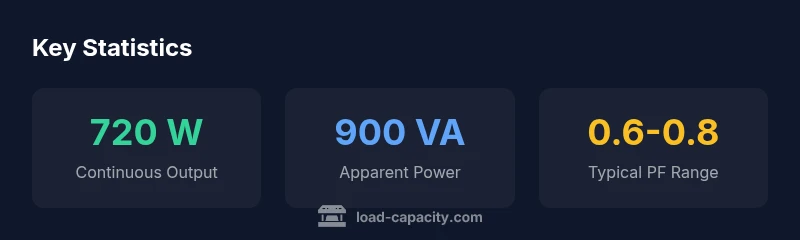
A 900 VA inverter typically delivers about 720 W of continuous output when operating at a power factor of 0.8. Real-world output can range from roughly 540 W to 720 W as PF varies between 0.6 and 0.8, with efficiency and temperature affecting usable capacity. Check the manufacturer’s PF rating to size loads correctly and anticipate startup surges within the inverter’s surge rating.
Understanding VA vs W and PF
Electrical specifications for power electronics use three key terms: VA (volt-amps), W (watts), and PF (power factor). The 900 VA rating describes apparent power, not real power. Real power (W) equals VA times PF. The PF depends on the load and inverter design, typically ranging from about 0.6 to 0.8 for consumer inverters. In engineering terms, this means a 900 VA inverter can produce roughly 540–720 W continuously, with the exact value set by the PF and efficiency. For engineers and technicians, this distinction matters when sizing loads to avoid overloading and to prevent excessive heat. According to Load Capacity, translating VA to watts using PF is essential for accurate sizing and safe operation.
Key takeaway: Always verify the PF rating from datasheets and use it to convert VA to usable watts before connecting devices.
Practical load capacity for a 900 VA inverter
In practice, the continuous wattage you can draw from a 900 VA inverter depends on PF and thermal derating. A PF of 0.8 yields about 720 W, while a PF of 0.6 reduces usable power to around 540 W. Temperature and aging can further derate capacity by a few percent. To stay within safe limits, design loads to operate at roughly 60–80% of the continuous rating under typical ambient conditions. This approach preserves functionality during small surges and reduces the risk of shutdown from overheating. Load Capacity’s guidance emphasizes considering both the ideal PF (theoretical capacity) and the real-world PF (actual performance).
- Start-up loads from motors or compressors may spike beyond continuous ratings; plan for a short-term surge within the inverter’s stated surge rating.
Efficiency, temperature, and aging effects on usable capacity
No inverter maintains peak efficiency at every load. Efficiency typically improves as load approaches a mid-range percentage of rated capacity, then falls at very low or very high loads. Temperature matters: high ambient temperatures reduce available current due to derating. Over time, components age and thermal margins shrink, effectively lowering usable capacity. For Load Capacity, monitoring thermals and performing periodic checks helps ensure sustained performance. When documenting life-cycle performance, include ambient temperature, load profile, and battery state. This makes comparisons between units meaningful and helps plan maintenance windows.
Practical tip: Use a thermal sensor or the inverter’s built-in monitor to detect overheating early and adjust loads or cooling.
How to size loads for real-world scenarios
A practical rule is to size loads at about 70–80% of the continuous rating to maintain reliability and allow for small surges. For a 900 VA inverter (540–720 W continuous), plan to run essential devices such as a laptop, router, lights, and a small fan without hitting the upper end of the range. Heavier or inductive appliances (air conditioners, space heaters, or large compressors) quickly push the system toward its limit and may cause shutdowns. When integrating multiple devices, sum their real power (W) requirements, then compare to the inverter’s continuous rating and PF.
- Use wattmeter readings to verify actual power draw instead of relying on nameplate values alone.
- Group loads by priority (critical, important, optional) to ensure critical devices stay powered during peak load periods.
Surges and battery considerations
Startup surges are common with many household devices (fridges, fans, compressors). A 900 VA inverter may tolerate a surge rating well above its continuous rating, but not all models share the same margin. Always check the surge rating in datasheets and ensure your battery bank can deliver the initial current without excessive voltage drop. Poor battery health or undersized cables can limit surge performance. Design overhead (extra batteries, thicker cables) helps ensure a smooth transition during startup events. Load Capacity recommends validating surge performance with a safe test under controlled conditions and documenting results for future sizing decisions.
Reading datasheets and verifying performance
Datasheets provide essential details: continuous power (W), apparent power (VA), PF, maximum surge, efficiency, and operating temperature range. When evaluating a 900 VA inverter, confirm the continuous wattage and the PF the device assumes for rating equivalence. If possible, perform a practical test at moderate load and monitor temperature rise and voltage stability. Compare results against the manufacturer’s stated specifications and your own safety margins. This disciplined approach reduces the risk of underestimating load requirements and improves system reliability.
Practical sizing checklist
- List all loads with their real power (W) and surge needs. 2) Sum the Watts and compare to 540–720 W depending on the PF. 3) Check the inverter’s surge capacity and battery capability. 4) Confirm ambient temperature and motor startup implications. 5) Add a 10–20% margin for aging and weather variations. 6) Document your sizing assumptions for maintenance and audits. 7) Reassess after any significant load change or environment shift.
Readouts for a 900 VA inverter
| Parameter | Value | Notes |
|---|---|---|
| Continuous output (W) | 540-720 | PF dependent |
| Rated apparent power (VA) | 900 VA | Nominal rating |
| Power factor assumption | 0.6–0.8 | Model-dependent |
| Typical efficiency | 85–90% | Depends on load and design |
Quick Answers
What does 900 VA mean in practical terms?
900 VA describes apparent power, not actual usable watts. Real watts depend on the load's power factor. For many inverters, a 900 VA rating corresponds to about 540–720 W of continuous output, depending on PF.
900 VA is the apparent power rating; real watts depend on the load's power factor. Typical continuous watts are around 540 to 720 for common PF values.
How do I calculate watts from 900 VA?
Multiply VA by the power factor: Watts = VA × PF. With PF around 0.6–0.8, a 900 VA inverter yields roughly 540–720 W.
Watts equal VA times the power factor. For a 900 VA inverter, expect about 540 to 720 watts at PF 0.6 to 0.8.
Can a 900 VA inverter handle fridge startup?
Fridge and compressor startups spike current. Some 900 VA inverters tolerate small surges, but you should verify the surge rating and ensure the battery can sustain the brief peak.
Startup surges are common with compressors; check the inverter's surge rating and battery capability.
What loads should I avoid on a 900 VA inverter?
Avoid large inductive or high-current devices like space heaters or large air conditioners. Aggregate loads should stay well below continuous rating to prevent overheating.
Avoid large inductive or high-current loads that push you near the continuous limit.
Is efficiency relevant to load capacity?
Yes. Efficiency losses reduce usable watts. Higher efficiency means more of the rated VA becomes usable watts, especially at mid-range loads.
Efficiency matters because losses reduce usable watts; better efficiency means closer to the rated watts.
How does battery capacity affect runtime at 900 VA?
Runtime depends on battery energy (Wh) and discharge rate. A larger battery bank extends runtime, but voltage sag during high draw can limit available power.
Battery size determines runtime; bigger batteries give longer operation, but beware voltage sag at high draws.
“VA rating is only meaningful when translated to real power with the PF. Engineers should verify PF and derating factors to avoid under- or over-sizing loads.”
Top Takeaways
- Convert VA to watts using the PF before sizing loads
- Aim for 60–80% of continuous rating to stay safe
- Check PF and surge ratings for startup loads
- Account for temperature and aging in capacity planning
- Verify datasheet values with practical measurements