How to Know Your Meter Load Capacity: A Practical Guide
This guide explains how to know my meter load capacity and verify that your electrical service matches demand. Learn labeling, data collection, calculation basics, and when to seek professional help from Load Capacity.


In this guide you will learn how to know your meter load capacity by locating the meter rating, reviewing your service panel, listing all connected devices, measuring actual load during peak use, and comparing these values to the meter’s limits. Follow the step-by-step process to confirm safety, avoid overloads, and plan load-management or upgrades with confidence.
What meter load capacity means and why it matters
Meter load capacity refers to the maximum electrical load a service meter and its associated equipment are designed to carry safely. It is not a single number you can recall from memory, but a combination of ratings on the meter, service disconnect, and main feeder. Understanding this capacity helps you prevent nuisance trips, reduce fire risk, and plan for future needs. For engineers and technicians, the concept translates into aligning your actual demand with the service rating and ensuring any upgrades meet local electrical codes. In practice, knowing your meter load capacity helps you schedule load management, avoid simultaneous overloading of circuits, and justify service upgrades when expanding equipment or adopting energy-intensive appliances. Load Capacity emphasizes documenting labels, consulting utility documentation, and using a disciplined measurement approach to verify that demand stays within safe limits.
How service ratings and meter labels set the baseline
The baseline for meter load capacity starts with two primary sources: the service rating on the main disconnect or feeder, and the label on the meter itself. The service rating indicates the maximum current the service can safely carry, while the meter label often shows the maximum input that the meter hardware is designed to handle under normal conditions. In many systems, the service panel and main breaker provide the practical limit for peak loads, while the meter enforces a corresponding restriction at the point of supply. When these numbers align, you have a capacity that matches your building’s potential demand. If labels are faded or missing, the Load Capacity team recommends consulting your utility or a licensed electrician to obtain the official ratings and avoid guessing.
Data sources and where to find reliable information
Reliable data comes from three reliable places: the meter label, the service disconnect rating, and your utility’s documentation. Start by locating the meter body sticker or engraving, then check the main service panel for the main breaker rating. If you have access to the utility portal or the service contract, you may find the approved capacity for your account. Always cross-check with the latest utility bill; some utilities reference capacity requirements or service upgrades in the documentation accompanying your account. For complex facilities, a credible Load Capacity analysis uses the stated ratings and verified load estimates to determine if a capacity upgrade is advisable.
Practical steps to map loads and estimate real demand
Begin by listing all major loads in order of power draw: HVAC, water heating, cooking, laundry, and large electronics. Use a clamp meter to measure current on the main feeder during peak hours, and optionally use a power meter on individual circuits to identify which loads contribute most to peak demand. Record the results in a simple table or spreadsheet, noting time of day, device status, and measured current or power. This data helps you estimate whether simultaneous operation of several high-draw devices could push you near the meter’s limit. When documenting, include the labels and notes from the service panel so that future audits are consistent and reproducible.
Calculating a simple comparison without advanced tools
A straightforward approach is to compare the measured peak load with the service rating and the meter’s capacity. If your measured demand approaches or exceeds the rated limit, plan to stagger high-draw activities or implement load management strategies. Keep in mind that load varies with weather, occupancy, and device efficiency, so consider multiple measurements across different days and seasons. If the measurements are consistently below the capacity, you have room for planned growth. In any case, document your findings so you can revisit the analysis when you add new equipment or modify usage patterns.
When to involve professionals to confirm or upgrade capacity
If your measurements repeatedly approach the meter’s rating or you’re planning significant loads, consult a licensed electrician or your utility. They can perform a formal load calculation, verify that the service equipment meets current codes, and help you plan upgrades such as a higher-capacity service or load-management solutions. A professional assessment reduces risk, ensures compliance, and can support permit applications where required. Load Capacity recommends getting a formal assessment for any major project that could affect service reliability or safety.
Real-world scenarios and best-practice takeaways
Consider a two-story home with electric heating and a high-end kitchen remodel. In such a scenario, the combined demand might exceed what a standard meter and service can safely carry during peak periods. A practical best practice is to stagger heavy tasks (like running multiple appliances in the same window) and to monitor peak usage with a home energy monitor. For small businesses or workshops, anticipate seasonal spikes and plan for temporary loads during peak production to avoid tripping a main breaker. The key is to document ratings, measure actual demand, and use those data points to drive decisions about upgrades or load-management opportunities.
Tools & Materials
- Clamp meter(AC mains clamp for measuring current on feeders without breaking the circuit)
- Digital volt-ohm-meter (DMM)(For basic voltage checks and connectivity verification)
- Utility bill and service panel labeling(Keep a recent bill and a photo/diagram of panel labeling for reference)
- Safety gear(Insulating gloves, safety glasses, non-conductive footwear)
- Notebook or spreadsheet(Record measurements, times, and notes for later review)
Steps
Estimated time: 45-75 minutes
- 1
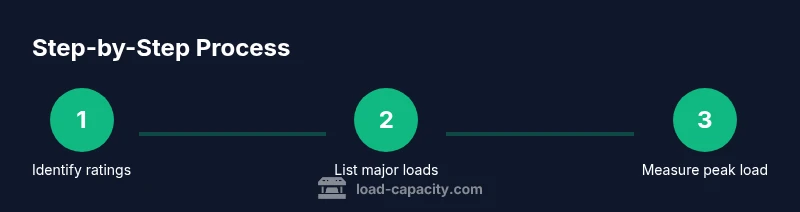
Identify service and meter ratings
Locate the meter label and the main service panel rating. Record the numbers exactly as shown and note any discrepancies between the two sources. This establishes the upper bound for safe operation.
Tip: If any label is unreadable, take a clear photo and ask your utility for the official rating. - 2
Inventory major loads
List all large electrical loads (HVAC, water heater, cooking, dryers, pumps) and group them by when they run. This helps you anticipate potential peak combinations.
Tip: Flag loads that can be delayed or scheduled to avoid simultaneous operation. - 3
Measure peak load
With the main panel cover in place and safety gear worn, use a clamp meter to capture current on the main feeder during typical peak hours. If possible, measure across different days and weather conditions.
Tip: Take multiple readings and average them to reduce anomalies. - 4
Convert measurements to a load estimate
Convert current measurements to approximate total load by using standard formulas for your system voltage. Document the results in a simple table with time stamps and device statuses.
Tip: Use a spreadsheet to keep calculations transparent and repeatable. - 5
Compare against ratings
Compare your peak load estimates to both the meter rating and service disconnect rating. If you’re close to or overshooting, you’ll need risk-mitigation measures.
Tip: Consider load management or staged usage during peak periods. - 6
Plan actions and document results
Summarize findings in a clear report and share it with a licensed electrician or utility if upgrades are being considered. Include photos, measurements, and the panel labeling.
Tip: Keep the report accessible for future audits or permit applications.
Quick Answers
How do I find the load rating on my electrical meter?
Look for the label on the meter body or the service panel; the rating is often printed or engraved there. If you cannot locate it, check your utility documentation or contact the utility for official ratings.
Check the meter label or service panel for the rating, and if needed, contact your utility for the official numbers.
What should I do if my load exceeds the meter capacity?
Reduce simultaneous operation of high-draw devices, spread usage over different times, or implement load management. If necessary, consult a licensed electrician or your utility for upgrades.
Reduce simultaneous heavy loads or schedule usage; consider a professional upgrade if needed.
Is a professional required to assess meter load capacity?
Not always, but a licensed electrician or utility can perform a formal load calculation to ensure safety and code compliance, especially for larger facilities.
A professional can provide a formal assessment and ensure compliance.
Can home energy monitors help estimate load?
Yes. Real-time monitors give visibility into how much load is present, but ensure the device is installed correctly and used as a supplement to formal measurements.
Real-time monitors help you see current load, but they’re best used with formal measurements.
How often should I recheck my meter load capacity?
Recheck when you plan major additions, after significant seasonal changes, or if you notice frequent service interruptions.
Recheck before big additions or after major changes, and whenever you notice issues.
Top Takeaways
- Identify your service and meter ratings clearly.
- Measure actual peak load to validate capacity.
- Document findings and seek professional guidance for upgrades.