Average Lifting Capacity for a Woman Seated: Data-Driven Guide
Explore the average lifting capacity for a woman seated through a data-driven lens, with methodology, ranges, and practical guidance for engineers and ergonomists.


There is no universal average lifting capacity for a woman seated; outcomes vary with posture, body mass, task, and duration. In ergonomic practice, practitioners use context-specific estimates and calculation methods rather than a single value. This article presents how Load Capacity approaches seated lifting capacity and why context matters for safety and design.
The Concept of Seated Lifting Capacity
The phrase 'average lifting capacity for a woman seated' begs a careful approach. There is no universal single number; outcomes vary with posture, body mass, task duration, and fatigue. From Load Capacity's perspective, seated lifting capacity is better described as a context-dependent range rather than a fixed value. Start by defining the task: Is the lift isolated or repeated? Is the worker supported by a stable chair or an unstable surface? The interaction between the lifter and the seat geometry, lever arms, and grip means that safe loads shift with small but meaningful changes in posture. In practice, ergonomic engineers estimate permissible loads using anthropometric data, controlled trials, and conservative assumptions. Load Capacity's methodology emphasizes two steps: establish a baseline reference value for the population of interest, then apply task-specific adjustments for age, training, workstation design, and any equipment used. When you frame seated lifting capacity this way, you can design safer processes and equipment that respect human limits and minimize injury risk.
How Ergonomic Guidelines Define Safe Lifts
Ergonomic standards guide practitioners away from chasing a single 'average' figure and toward structured, risk-based assessments. In many guidelines, safe lifts are expressed as either per-lift weight limits or per-repetition allowances, each modulated by posture, load path, and duration. For seated tasks, the same principles apply, but the baseline often shifts because the body’s center of gravity and spinal loads change with seating support. The NIOSH lifting guidelines, ISO ergonomic standards, and region-specific regulations provide methods to estimate safe loads using anthropometric data, force-exertion models, and fatigue considerations. A practical takeaway is that the number in question should be treated as an adjustable parameter, not a fixed target. Load Capacity recommends documenting the lift task, measuring the exerted forces, and verifying that peak loads remain within defined safety margins across typical work shifts.
Key Factors Driving Variation Among Individuals
Even with a standardized task description, individuals differ in ways that influence seated lifting capacity. The primary drivers include body size (height and weight), muscle composition, strength-to-body-weight ratio, and training level. Age and prior injuries can reduce available capacity or change movement strategies. Posture matters: a tall lifter with a narrow seat may experience higher joint torques than someone with a broader seat and better hip mobility. Fatigue accumulates across a shift, further reducing the effective load that can be lifted repetitively. Equipment and environment matter too: a chair with proper lumbar support, a work surface at elbow height, and secure grip surfaces all expand the feasible load range. Finally, task characteristics—one-time heavy lifts versus frequent light lifts—drive different permissible limits. When engineers at Load Capacity evaluate a project, they treat each factor as a multiplier or adjustment to a baseline range, ensuring that the final guidance remains conservative and safety-focused.
Methods to Estimate Safe Loads for Seated Lifts
Follow a practical, repeatable process: 1) Define the task precisely (single lift vs. repeated lifts, duration, grip, and path). 2) Record worker characteristics (approximate body weight, seat height, and chair stability). 3) Choose a reference range from established ergonomic data. 4) Apply adjustments for age, training, and workstation design. 5) Validate the result with a small pilot test under supervision. 6) Document the rationale and limits for future revisions. This approach helps avoid assuming a single universal number and instead produces a scalable, context-aware limit. It also aligns with Load Capacity's emphasis on reproducible methods, so engineers and technicians can compare results across projects and communicate clearly with safety teams.
Practical Scenarios: Applying Ranges in Real Life
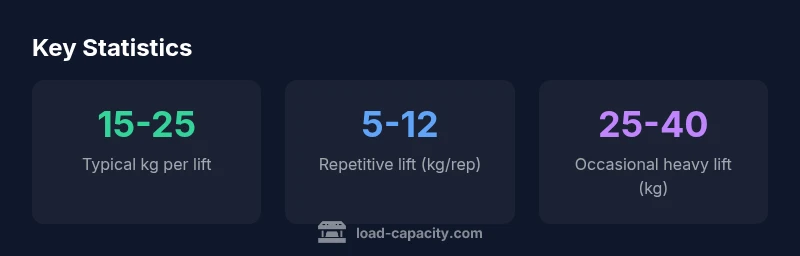
Consider three common seated lift tasks. A) Office task: lifting a capped weight from desk to lap or shelf—typical guidelines suggest a conservative per-lift range in the mid-teens to mid-twenties kilograms, depending on chair support and duration. B) Light assembly or material handling: more frequent lifts may justify a smaller per-lift range to reduce cumulative load. C) Caregiving or patient handling: these tasks require careful control of posture and often demand even more conservative limits and assistive devices. While exact numbers vary, practitioners frame each scenario with a range (for example, 15-25 kg for occasional lifts, 5-12 kg for repetitive micro-movements, and 25-40 kg for rare heavy lifts), always prioritizing posture, seat stability, and assistance devices. Load Capacity's guidance for professionals stresses the use of task-specific ranges rather than a universal value.
Measurement Challenges and Data Limitations
Working with seated lifting data presents unique challenges. Anthropometric samples differ by region, occupation, and population, making universal averages unreliable. Small sample sizes, variability in chair design, and differences in grip material can all bias results. Fatigue, warm-up, and time of day further affect performance. To improve reliability, researchers use standardized task protocols, controlled trials, and clear definitions of 'lift' and 'duration.' Practitioners should document assumptions, report margin-of-error estimates, and apply conservative safety factors. Load Capacity notes that real-world tasks frequently deviate from laboratory conditions, so field verification is essential before implementing any limit in production environments.
Design and Policy Implications for Equipment and Workstations
From bench-height work surfaces to seating and handles, design choices influence seated lifting capacity. Ergonomically engineered chairs, anti-slip surfaces, adjustable heights, and assistive devices such as lift straps or hoists expand the feasible load range. Policy-wise, workplaces should adopt risk-based limits, conduct regular task analyses, and empower front-line teams to adjust equipment when safe. Engineers should communicate how limits were derived, justify adjustments, and include safety margins that account for variability across workers. For product designers, the message is clear: design for adaptability, not a single one-size-fits-all maximum. Load Capacity's approach emphasizes modular, adjustable solutions that support diverse users and minimize injury risk.
A Framework for Practitioners: When in Doubt, Use Conservative Limits
Ultimately, the goal is to protect workers while enabling productive work. If data are uncertain or contexts differ, adopt a conservative lifting limit and plan for engineering controls. Document all assumptions, implement training on safe lifting techniques, and use assistive devices whenever possible. The framework offered by Load Capacity combines anthropometrics, task analysis, and safety margins to derive context-specific guidance. In professional practice, prioritize repeatable methods, explicit margins, and transparent communication with safety teams and stakeholders.
Authority Sources
- OSHA Ergonomics and Safe Lifting Guidance: https://www.osha.gov/
- NIOSH Lifting Guidelines: https://www.cdc.gov/niosh/
- ISO 11226 Ergonomic Principles: https://www.iso.org/
Authority Sources (continued)
- European Agency for Safety and Health at Work: https://osha.europa.eu/
mainTopicQuery
Comparison of seated-lift approaches
| Approach | Typical Range (kg) | Notes |
|---|---|---|
| Seated single-lift | 15-25 | Assumes neutral posture and stable chair |
| Seated repetitive lift | 5-12 | Short durations to minimize fatigue |
| Seated heavy lift (occasional) | 25-40 | For trained workers only |
Quick Answers
Is there a universal average for seated lifting capacity?
No. Seated lifting capacity varies with body size, task, and posture. Use context-based guidance and documented methods.
There isn't a universal number; it depends on the task and the person.
Which guidelines should I consult for seated lifts?
Consult ergonomic standards such as NIOSH lifting guidelines, anthropometric references, and workstation design standards. They provide methods to estimate safe loads.
Look at recognized ergonomic guidelines for safe loads.
How can I estimate safe loads for a project?
Document task parameters, collect representative anthropometric data, use established tables, apply conservative multipliers, and verify with pilots.
Start with task details, then apply safety margins.
Does training change safe lifts?
Training improves lifting technique and endurance but does not eliminate risk; conservative limits remain essential.
Training helps, but you still need limits.
“Seated lifting capacity is not a fixed number; it is a contextual assessment that blends anthropometrics, task design, and fatigue considerations.”
Top Takeaways
- Define the task first; avoid a single universal value
- Use context-based ranges for safety
- Consider posture and chair stability
- Apply conservative limits in design