Aluminum Sheet Load Capacity: A Practical Engineering Guide
A data-driven guide to aluminum sheet load capacity, exploring alloy/temper effects, testing standards, and design tips for engineers, technicians, and contractors working with aluminum sheet components.


According to Load Capacity, aluminum sheet load capacity hinges on alloy chemistry, temper, thickness, and support conditions. For engineers, this means selecting the right alloy/temper, validating through standards, and applying conservative load factors to ensure safety in real-world applications.
Aluminum Sheet Load Capacity: A Data-Driven Foundation
Load capacity is not a single property you look up in a table; it is the result of material science, geometry, and boundary conditions. For aluminum sheet components, the most influential factors are the alloy and temper, sheet thickness, and how the sheet is supported or constrained in the structure. The Load Capacity team emphasizes a disciplined approach: start with material data from the alloy and temper, adjust for thickness, and then apply appropriate safety and service factors based on loading scenarios. This approach helps engineers avoid underestimating stresses in panels, enclosures, or light-structure components and aligns with best practices across mechanical, aerospace, and civil disciplines.
Material Properties that Control Load Capacity
Aluminum sheets derive their load-carrying ability from the interplay of strength, stiffness, and toughness. Yield strength indicates when the material begins to plastically deform, while ultimate tensile strength shows overall resistance to fracture. Young's modulus governs stiffness and deflection under load. For design, you must consider how tempering changes these properties: heat-treated alloys (e.g., T6, T351) often offer higher yield strengths but can reduce ductility and weldability. Corrosion resistance, fatigue performance, and formation of alloys during fabrication also play roles. In practice, selecting an alloy with suitable workability and a temper that retains desired strength is the first critical step in ensuring that the sheet can safely carry the intended loads.
Alloy-T temper Relationships and Practical Implications
Different aluminum alloys provide different trade-offs between strength, formability, and corrosion resistance. For example, 6061-T6 offers good strength and machinability but may be less weldable than some non-heat-treated alloys. 5052-H32 is highly formable and has good corrosion resistance but lower yield strength. 2024-T351 delivers high strength but is more susceptible to corrosion and has different corrosion protection requirements. When planning a load-bearing sheet, engineers weigh these properties against the service environment (chemical exposure, temperature cycles, humidity) and construction details (stiffeners, fastening methods) to select a suitable combination that minimizes risk of yielding, buckling, or fatigue.
Geometry, Boundary Conditions, and Support Details
The sheet's geometry and how it is supported dramatically affect capacity. Span length, presence of stiffeners, edge conditions, and fastener patterns create varying bending moments and shear stresses. A plain, free-span panel will carry less load than a panel with continuous supports or a stiffened frame. Boundary conditions matter: clamped edges generally increase stiffness and reduce deflection, while simply supported edges allow more rotation and higher local stresses. For accurate predictions, engineers should model these effects, using hand calculations for simple cases or finite element analysis (FEA) for complex geometries. Always verify that deflections stay within serviceability limits to prevent functional issues like interference or fatigue.
Testing Standards and Design Values: Reading the Data
Design values for aluminum sheets come from material suppliers, the Aluminum Association, and standardized testing. Tensile tests (ASTM E8) and bend tests (ASTM E290) help determine yield strength, ultimate strength, and ductility for the specific temper. Fatigue and fracture data inform long-term performance under cyclic loads. When datasets are not readily available, engineers apply conservative design factors and use worst-case scenarios. It is essential to document the alloy, temper, thickness, and heat-treatment history used in calculations to enable traceability and ensure compliance with project specifications.
Calculation Approaches: From Hand Methods to FEA
For simple plate problems, hand methods based on classical plate theory can provide quick, conservative estimates of maximum allowable loads. For more complex geometries or where high accuracy is required, finite element analysis (FEA) offers a deeper understanding of stress distribution and deflection under real-world load paths. In both cases, start with the material properties corresponding to the selected alloy and temper, then apply appropriate boundary conditions and load cases. Validate results with physical testing when possible, and incorporate safety factors that reflect manufacturing tolerances, corrosion, wear, and potential impact loads.
Practical Design Guidelines and Safety Margins
Key practical recommendations include using thicker sheets in high-deflection regions, adding stiffeners where bending is anticipated, and choosing temper and alloy that balance strength with formability and corrosion resistance. Use conservative load factors in the early design stages and refine with test data. Document all assumptions and run sensitivity analyses to identify which parameters most influence capacity. Establish inspection plans to monitor any changes in thickness (due to wear or corrosion) and deflection, which can indicate reduced capacity over time.
Real-World Considerations: Case Scenarios and Trade-offs
In applications like equipment housings, transport panels, or light structural panels, aluminum sheet capacity must be evaluated against both immediate load cases (static weights, wind loads) and dynamic effects (shocks, vibrations). Trade-offs often arise between weight, cost, and safety margins. For example, increasing thickness raises capacity but adds weight and cost; using stiffeners improves stiffness without a large weight penalty. Always consider manufacturability: certain alloys weld less predictably or require post-weld heat treatment to restore properties. The goal is a robust, manufacturable design that meets safety requirements without overdesign.
Maintenance, Inspection, and Lifecycle Performance
Material properties can shift over time due to corrosion, wear, and fatigue. Regular inspection to detect thinning due to corrosion or pockets of stress concentration from damage is essential. Use protective coatings or inspections in aggressive environments. Track service history, including load magnitudes and frequency, to anticipate when refurbished components should be replaced rather than repaired. A proactive maintenance plan helps sustain the load-carrying capability of aluminum sheet components throughout the product lifecycle.
Representative alloys for aluminum sheet in load-bearing applications (values are ranges and depend on processing)
| Aluminum Sheet Grade | Temper | Approx Yield Strength (MPa) | Approx Tensile Strength (MPa) | Notes |
|---|---|---|---|---|
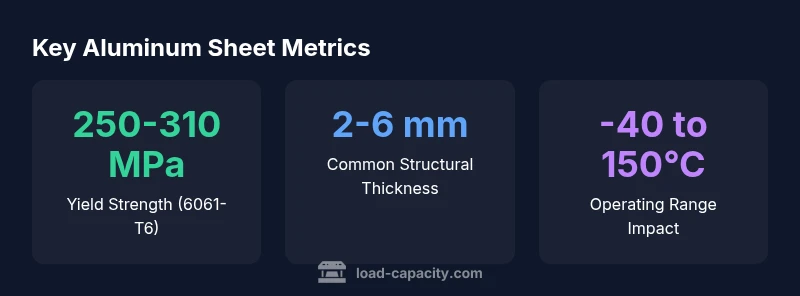
| 6061 | T6 | "250-310 MPa" | "290-350 MPa" | "Common structural alloy with good formability; weldable with post-weld heat treatment" |
| 5052 | H32 | "170-230 MPa" | "220-320 MPa" | "Excellent formability and corrosion resistance; lower yield strength" |
| 2024 | T351 | "420-470 MPa" | "470-520 MPa" | "High strength; less corrosion resistance; specialty use" |
Quick Answers
What factors influence aluminum sheet load capacity?
Load capacity is governed by alloy and temper, sheet thickness, boundary conditions, and operating environment. Temperature, corrosion resistance, and fatigue behavior also play a role. Understanding these factors helps engineers select suitable materials and design margins.
Key factors are alloy, temper, thickness, and how the sheet is supported. Temperature and corrosion also matter, especially in cyclic or harsh environments.
How do I estimate load capacity for a specific aluminum sheet?
Start with the alloy and temper data, choose the sheet thickness, and apply applicable load cases with safety factors. Use hand calculations for simple spans or FE analysis for complex geometries. Validate with testing where possible.
Use the material data, thickness, and boundary conditions, then apply conservative safety factors. For complex parts, run FE analysis and, if feasible, test a prototype.
What standards govern aluminum sheet load capacity?
Tensile tests typically follow ASTM E8/E8M. Fatigue and formability are covered by related standards; refer to the Aluminum Association guidelines for temper and alloy data. Always align with project-specific codes.
Tensile tests follow ASTM E8, and fatigue data comes from additional standards and manufacturer data. Check project codes for your exact part.
Can aluminum sheet load capacity be predicted without testing?
Predictions rely on material properties and geometry, but vary with processing history and environment. For critical parts, testing or full-scale validation is strongly recommended.
You can estimate it from material data, but for safety-critical parts, testing is recommended.
How does temperature affect aluminum sheet capacity?
Higher temperatures generally reduce yield strength and stiffness, increasing deflection risk. Low temperatures can improve some properties but may reduce ductility. Design must account for the operating range.
Temperature changes can change strength and stiffness; design for the expected range.
Why is temper important in load calculations?
Temper determines how heat treatment affects strength and ductility. It defines allowable forming, welding behavior, and long-term performance under load. Choose temper that matches the intended manufacturing and service conditions.
Temper changes strength and ductility, so pick it to suit how you will process and use the sheet.
“Aluminum sheet load capacity is highly dependent on alloy, temper, thickness, and support conditions. Design with conservative allowances and verify with material data and testing.”
Top Takeaways
- Choose alloy/temper first based on strength and formability
- Thickness and boundary conditions dominate bending capacity
- Consult standards and apply conservative safety factors
- Use simple calculations for initial sizing; verify with FEA or testing
- Plan for maintenance to preserve load capacity over time