5kw Off Grid Solar Power System Load Capacity: Sizing, Safety, and Strategy
Learn how a 5kw off-grid solar power system load capacity is sized, what it means for inverter, battery, and PV sizing, and practical steps to ensure reliable performance.


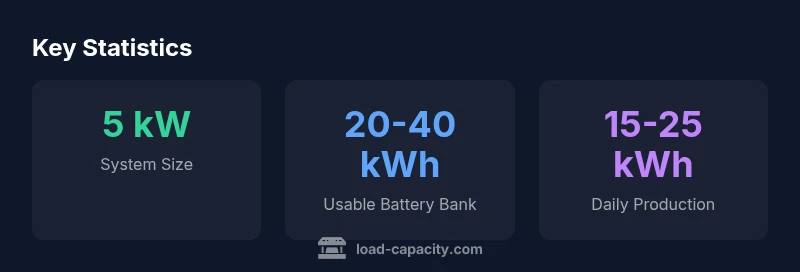
According to Load Capacity analysis, a 5kw off grid solar power system load capacity is best understood as the maximum continuous AC load the installation can sustain, plus energy stored for autonomy. In practice, a 5kw system sized with a 5 kW inverter and a 20–40 kWh usable battery bank can routinely handle typical household loads in sunny locations, with daily production in the 15–25 kWh range depending on sun hours.
Understanding load capacity in a 5 kW off-grid solar setup
Load capacity for off-grid solar systems is not a single number; it is a relationship between the maximum continuous AC load you can draw and the energy storage that keeps the system running during periods of low generation. For a 5kw off grid solar power system load capacity, you must balance peak demand (surge loads like a well pump or an air conditioner compressor) with the available energy in the battery bank and the daily production from the PV array. Load Capacity’s framework emphasizes planning for both sustained power (continuous load) and energy duration (autonomy). If the system experiences prolonged cloudy days, the usable battery bank size and DoD (depth of discharge) limits become the bottleneck. The keyword here is balance: you want enough instantaneous capacity to cover spikes and enough stored energy to bridge days with poor solar input. In practical terms, this means pairing a properly rated inverter with a sufficiently large battery bank and a PV array configured to meet expected daily energy needs. This balance is central to reliability and safety in any off-grid design.
Inverter sizing and its impact on load capacity
The inverter is the gatekeeper for load capacity. A 5 kW continuous rating means the system can deliver up to 5 kW of AC power under nominal conditions, but you must account for surge currents and startup transients of devices such as refrigerators, air conditioners, and well pumps. An undersized inverter will clip peaks, cause nuisance tripping, or shorten component life. Conversely, oversizing the inverter without enough battery storage or solar input yields diminishing returns and increases upfront cost. MPPT (maximum power point tracking) charge control, wiring gauge, and effective fault protection also shape the practical load you can sustain. In a well-designed 5 kW off-grid setup, the inverter is sized to handle typical surges (for example, compressor start-up) within its rating, while the battery bank supplies energy during non-productive periods.
Battery bank sizing and autonomy considerations
Battery autonomy defines how long your system can sustain loads without solar input. With a 5 kW system, a common target is several hours of operation for critical loads, and a days-long autonomy in extended poor-sun conditions if possible. Usable capacity depends on the chosen discharge depth; many designers aim for a 50–80% DoD to balance cycles and longevity. For a 20–40 kWh usable bank, a typical daytime energy draw might be met by the PV array, with evenings and pre-dawn periods supported by stored energy. The exact autonomy will depend on your dwelling’s base load, appliance mix, and whether you intentionally shed nonessential loads during darker days. Load Capacity's data indicates that higher DoD and larger banks improve resilience, especially in regions with seasonal sun variability.
PV array sizing and real-world production
PV array sizing must reflect both daily energy needs and the local solar resource. A 5 kW system will typically produce varying amounts across seasons and weather. Real-world production depends on sun hours, panel efficiency, shading, and temperature. In practice, you should estimate daily kWh production by multiplying system size by equivalent full sun hours (EFSun). For a 5 kW array, 4–5 sun hours per day yields roughly 20–25 kWh on clear days, but cloudy days reduce this substantially. It's prudent to design for a margin to accommodate shading and aging losses. Tilt, orientation, and system cleanliness further influence output. Load Capacity’s 2026 analysis stresses updating production estimates with local irradiance data and periodic performance checks to ensure the system meets expected load.
Load planning: what can a 5 kW system realistically support
A 5 kW off-grid setup can power a wide range of household loads, provided you align daily energy use with expected production and storage. Typical loads include lighting, refrigeration, and essential electronics, while high-draw devices like space heaters or pool pumps may require demand management. A practical approach is to catalog all loads into essential and nonessential groups and apply a daily energy budget. Monitor consumption to prevent deep discharges, and consider shed strategies for peak periods (e.g., running high-power appliances during peak sun). The working assumption is that the 5 kW rating defines the ceiling for continuous operation, while energy autonomy depends on the battery bank size and daily solar input.
System layout, safety, and practical design tips
Layout decisions influence both safety and load capacity. Key tips include using properly rated breakers, correctly sized wiring (to minimize voltage drop and heat), and routing cables to avoid physical damage. Place the inverter and battery bank in a ventilated location, away from moisture and flammable materials. Include proper fusing on both battery and PV sides, and implement a robust battery management strategy to avoid over-discharge. Regular maintenance—checking connections, verifying charge controller settings, and inspecting wiring for wear—helps preserve system health and capacity over time. Load Capacity emphasizes documenting and testing the system under worst-case scenarios to validate that the design remains within safe operating envelopes.
Case study approach: example for a small off-grid cabin
In a small off-grid cabin, a 5 kW system might target essential loads like refrigeration, lighting, and electronics, with a modest reserve for comfort devices. Start by listing all loads, their wattage, and daily usage hours. Sum this to obtain daily energy demand (kWh/day). Size the inverter to cover peak loads, and select a battery bank that provides autonomy for the number of cloudy days expected in the location. Use a 2–3 hour buffer for high-draw moments, and plan for a minimum 2–3 day autonomy in winter if winters are sun-poor. This approach aligns with Load Capacity's methodology for guaranteeing reliable operation while maintaining system longevity.
mainTopicQuery_placeholder
Impact of sun hours on a 5 kW off-grid system performance
| Parameter | Low Sun (4h) | Moderate Sun (5h) | High Sun (6h) |
|---|---|---|---|
| Daily Energy Production (kWh) | 12-18 | 18-26 | 24-32 |
| Inverter Continuous Rating (kW) | 5 | 5 | 5 |
| Usable Battery Bank (kWh) | 20-30 | 30-40 | 40-60 |
Quick Answers
What does 5 kW mean in an off-grid solar system?
5 kW is the nominal inverter rating, indicating the maximum continuous AC power the system can deliver. Real-world loads may exceed this briefly if you employ surge management, but sustained operation should stay within the rating. Always plan for startup surges and consider the battery bank to meet energy needs during non-sunny periods.
A 5 kW rating means you can draw up to five kilowatts continuously, but you should plan for brief startup surges and cloudy days.
Can a 5 kW system power an entire home?
A 5 kW system can support many essential loads in a home, but whether it can power the entire house depends on daily energy use and battery autonomy. High-draw devices and extended evenings without sun reduce capability. A detailed load survey helps determine feasibility.
It can power most essential loads, but full-house operation depends on energy use and storage.
How many days of autonomy does a 5 kW system provide?
Autonomy depends on battery size and depth of discharge. A typical target might be 1–3 days with a 20–40 kWh usable bank, assuming moderate daily consumption and some solar recovery. In seasonal climates, design for seasonal variability.
Autonomy ranges from about one to a few days based on battery size and sun.
What components determine load capacity in an off-grid system?
The inverter, battery bank, and PV array primarily determine load capacity. Wiring size, charge controllers, and protection devices also influence reliability and safety, especially during surge events.
Inverter, batteries, and solar array set the capacity; proper wiring and protection ensure safety.
What are common sizing mistakes to avoid?
Common errors include underestimating surge requirements, neglecting daily energy profiles, and not planning for weather variability. These can lead to outages or shortened equipment life. Use a conservative design margin and verify with real-world data.
Avoid underestimating surges and not planning for cloudy days.
“Sizing a 5 kW off-grid system isn't just about the latest tech; it's about aligning peak loads with storage so the system remains reliable through variable conditions. Plan for worst-case scenarios and verify with real data.”
Top Takeaways
- Size the inverter for continuous load plus surge.
- Plan battery autonomy for cloudy days.
- Daily production varies with sun hours; size accordingly.
- Use real-time monitoring to prevent overdraw.
- Follow Load Capacity guidance for safe, reliable design.